

Roman Kamushken
I shipped a product over a weekend. AI wrote most of the code, I wired up a landing page from a template I could rebrand in one AI prompt, and by Sunday night I had something real that people could sign up for. Then came the part nobody warns you about. I needed users, I had zero budget, and everyone said Reddit was where founders find their first hundred.
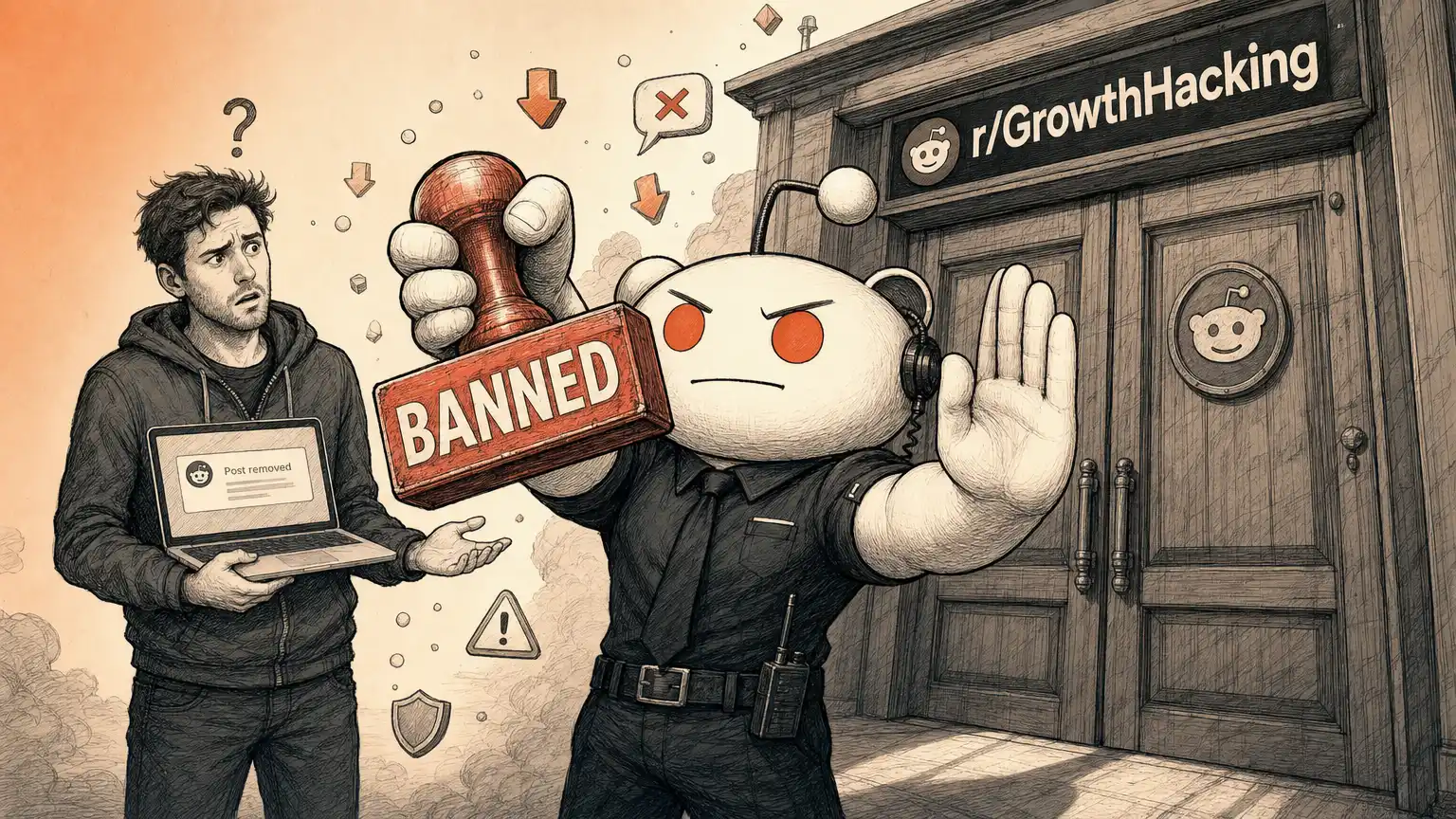
So I did the obvious thing. I found four subreddits full of my target audience, wrote what I thought were helpful posts, and dropped a link to what I built. By Monday morning, three were removed and one had a self-promotion warning attached to my username. I had not spammed anything. I genuinely thought I was helping.
If that story sounds familiar, you have probably read the exact thread I read next. Someone in r/GrowthHacking asking "how to use reddit for business?" after two months of the same treatment. The top reply said something that reframed the whole problem for me. This post is what I learned turning that reply into an actual routine.
Why Reddit buries you before a human even reads it
Here is the thing most founders get wrong. They think the challenge is learning how to post about their product without getting flagged. That framing is exactly why the removals keep coming.
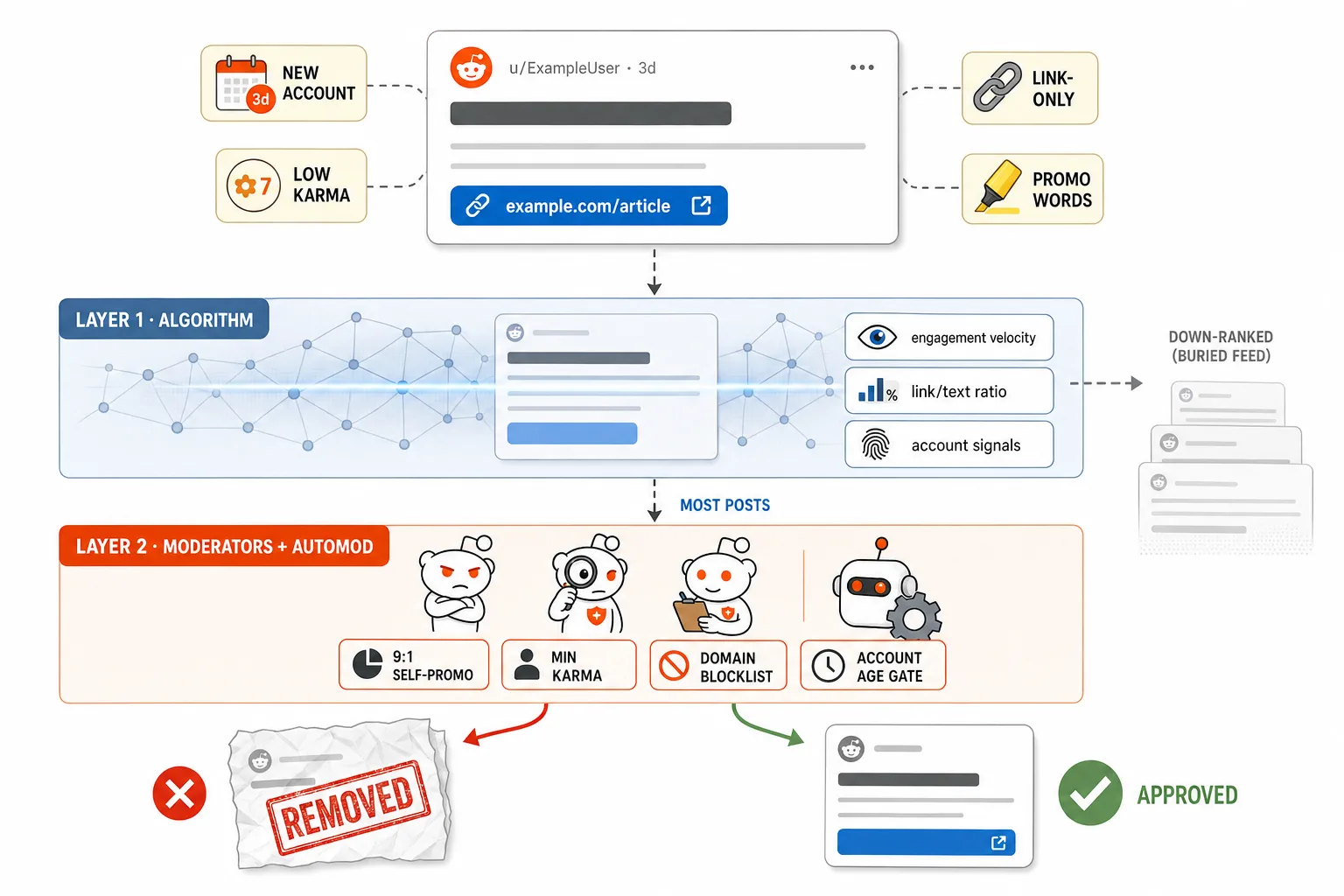
Reddit runs two layers of defense against promotion. The first is the ranking system, and it is quiet. It downranks anything that smells like an account whose entire purpose is steering conversation toward one product. You never see a warning from this layer. Your post just sits at the bottom with two upvotes and dies. No human moderator ever looked at it.
The second layer is the moderators. They are not hostile to companies. I want to be clear about that, because the wounded-founder posts always frame it as Reddit being anti-business. Mods are hostile to accounts whose comment history reads like a product brochure. Big difference.
When your account has fifteen comments and twelve of them mention your tool, both layers light up at once. The self-promotion guidelines that most subreddits inherit describe a rough ratio: for every post about your own thing, you should have around nine that are just you being a normal person. Most founders find this out after the ban, not before.
☞ The filters are tuned to catch a pattern, not a keyword. You cannot word your way around a pattern. You can only stop being the pattern.
What I tried that did not work
Before the routine that worked, I burned through every shortcut. Sharing these so you can skip them.
The "helpful" comment with a link at the end. I found threads where my product was relevant, wrote three useful paragraphs, then closed with "btw I built X that does this." Removed within the hour. The value was real, and it still read as bait because the link was the payload and everyone could smell it.
The fresh account. I made a new username specifically for promotion, thinking a clean slate would help. It did the opposite. New accounts with low karma get the harshest filtering. An account created last Tuesday that immediately starts talking about a SaaS tool is the single most obvious spam signal on the platform.
The direct landing page link. I dropped a raw link to my landing page in a comment. Reddit treats bare promotional URLs from low-karma accounts as close to radioactive. The comment was invisible to everyone but me within minutes.
And then there was the thing that taught me the most, which I did not even do myself. In that r/GrowthHacking thread, the original poster added an update thanking some agency called Visible Dolphin, saying they "handled the Reddit side" and it finally worked. Read enough of these and you learn to spot them. That update is almost certainly planted. It is the agency's own promotion wearing the costume of a grateful founder. The irony is thick. A thread complaining that Reddit punishes fake promotion, capped with a fake testimonial for a promotion service.
☛ If a Reddit success story ends with a conveniently named agency that "just handled it," treat it as an ad. The people who actually cracked Reddit describe something boring instead.
The unwritten rule nobody packages into a course
Here is the boring truth, and it is boring on purpose. The founders who figured Reddit out rarely explain it, because what they did does not sound like a growth hack.
They spent a couple of months being a normal participant in three or four subreddits. They answered questions that had nothing to do with what they sell. They built up comment karma and a username people started to recognize. And they named their product only when someone directly asked what they used.
That is the whole thing. The value has to be real and come first. The product has to feel like an afterthought, not the reason you showed up. Once you stop treating Reddit as a distribution channel and start treating it as a community you are actually part of, the removals dry up, because you stop tripping the exact pattern the filters are built to catch.
I resisted this for a week. As a vibe coder, my whole edge is speed. I built the product in two days, so spending a month commenting felt insane. Then I did the math differently. My paid acquisition budget was zero. A month of genuine participation costs me fifteen minutes a day and returns an account that can actually mention the product without dying. Compared to zero alternatives, that is a great deal.
My actual 30-day Reddit routine
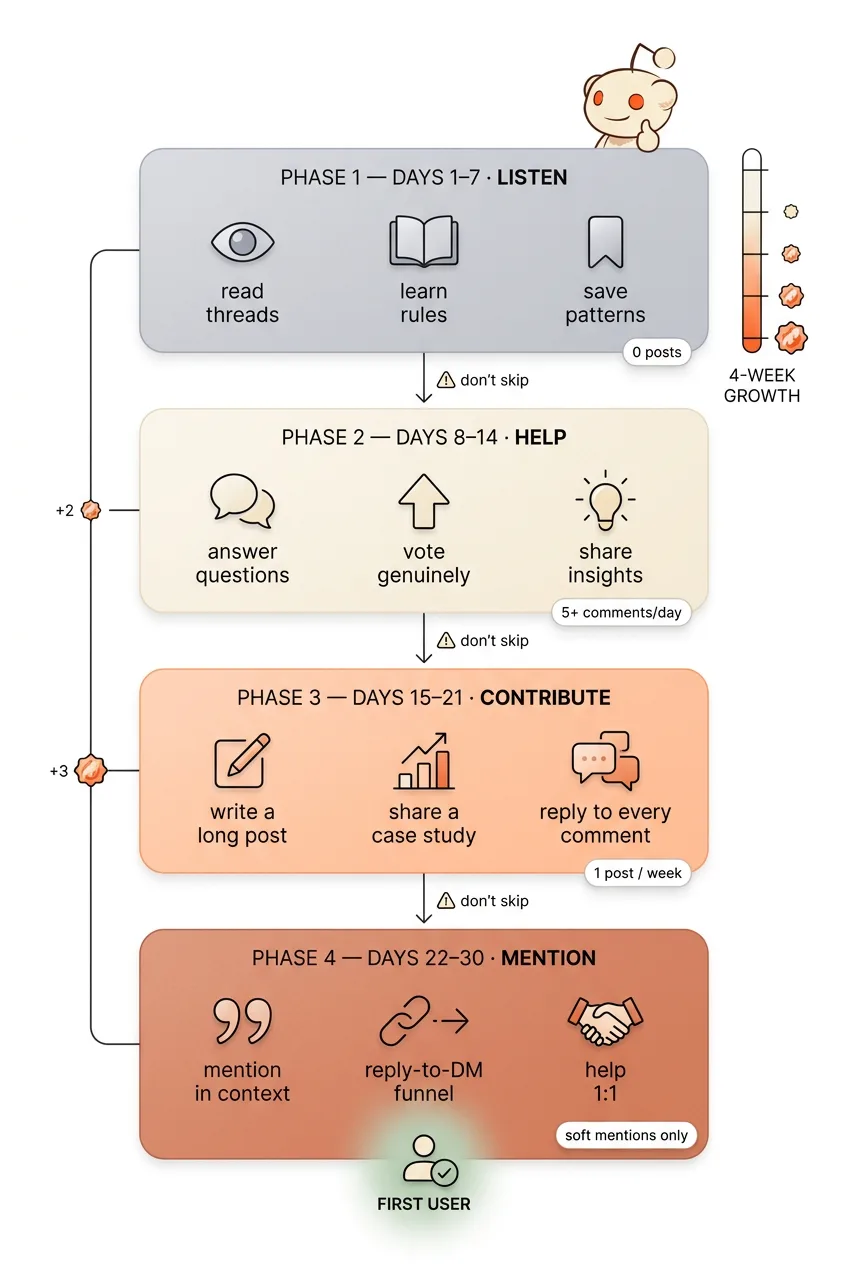
This is the routine I ran. It is unglamorous and it works. Fifteen to twenty minutes a day, no more.
❶ Pick three or four subreddits, not ten. You want places where your users already hang out and complain about the problem you solve. I picked two broad ones and two niche ones. Depth beats spread. A recognized name in four communities is worth more than an invisible one in twenty.
❷ Read the rules, actually read them. Every subreddit has a sidebar with rules and often a wiki about self-promotion. Some allow it on specific days. Some ban links entirely. Some have a megathread built for exactly what you want to do. Five minutes here saves you a ban later.
❸ Sort by new and answer questions for two weeks. No links. No product mentions. Just be useful. When someone asks how to do the thing you happen to know cold, write the best answer in the thread. This is where the karma and the recognizable username come from.
❹ Answer questions that have nothing to do with your product. This is the part people skip and it is the most important. If you only ever answer questions adjacent to your tool, the pattern is still there. Answer the off-topic stuff too. It makes you a person instead of a lead-gen bot.
❺ Track the recurring pain points. As you read, you will see the same frustrations posted over and over. Keep a note. This is free product research and free content research. I found six feature ideas and four blog topics this way, which is the same reason I check the AI inspiration gallery weekly for patterns I have not seen yet.
❻ After two weeks, share value without the link. Write a genuinely useful post. A teardown, a lesson, a mistake you made. No product. Let it earn upvotes on its own. Now the algorithm sees an account that contributes, and your next moves get more trust.
❼ Mention the product only when the context demands it. Someone asks "what did you use to build that?" or "does anything solve X?" Now you answer honestly, name your thing, and it lands as a recommendation instead of a pitch.
☞ The account is the asset, not any single post. You are spending 30 days building an account that has permission to speak.
How to talk about your product without tripping the filter
Eventually you get to mention what you built. The mechanics of that moment decide whether it converts or gets you removed.
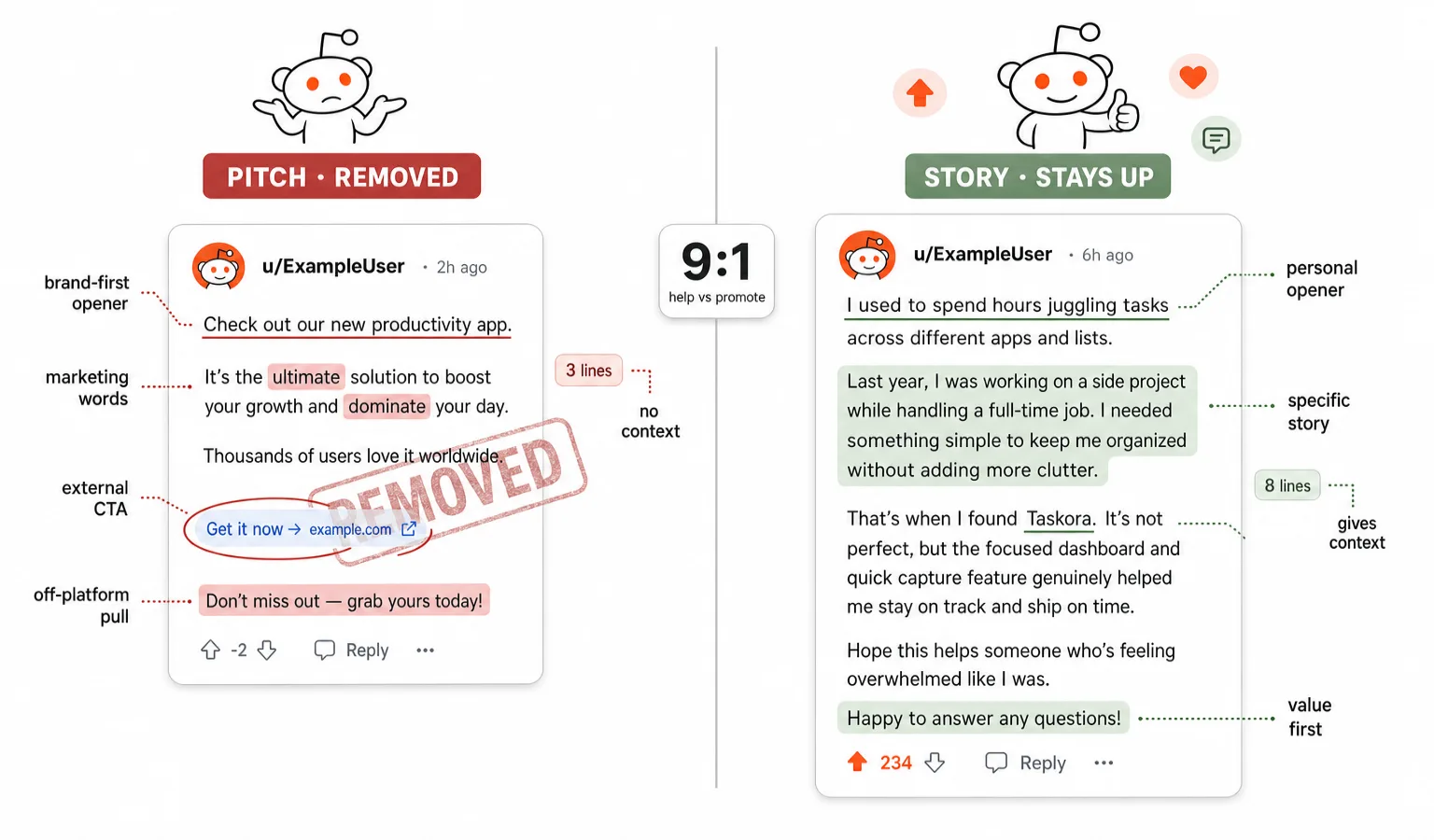
The rule I follow: the product reference has to survive deletion. If I removed the link, would the comment still be a good comment? If yes, post it. If the comment collapses into nothing without the link, the link was the point, and everyone including the filter knows it.
Phrasing matters more than you would think. "Check out my tool, it does X" is a pitch. "I hit this exact problem building my own thing, so I ended up making a small tool for it, happy to share if useful" is a person telling a story. Same link, completely different reception. The second one invites the reader to ask, which flips you from seller to helper.
Be honest with the math too. Founders oversell and Reddit users have a perfect nose for it. When I mention build time, I say the real number. Wiring a dashboard from scratch takes me around 14 hours. Starting from a prebuilt kit like Orion drops it to about four. That honest comparison earns more trust than any adjective. I learned the AI side of my workflow the same way, mentioning that I run it on Venice because the API is OpenAI-compatible and the chat stays uncensored when I iterate on rough ideas. Specific and true beats polished and vague, every time.
One more thing. Never drop three links in one comment. One reference, in context, tied to a direct question. That is the ceiling.
What to actually measure
Upvotes feel good and mostly lie. A comment can hit 40 upvotes and send zero people to your product. Here is what I track instead.
Profile clicks. Reddit shows you when people view your profile. A spike after a good comment means people are curious about who you are, which is the whole point of building the account. Your profile is where a soft, non-spammy line about what you are building lives.
Direct messages. The strongest signal by far. When someone DMs you asking about your product after a helpful comment, that is a warm lead who found you, not the other way around. My first ten users came through DMs, not link clicks.
Actual signups with a source tag. Put a UTM parameter on any link you do share so your analytics separate Reddit traffic. Vanity metrics blur the picture. A single signup that sticks around beats a hundred upvotes that bounce.
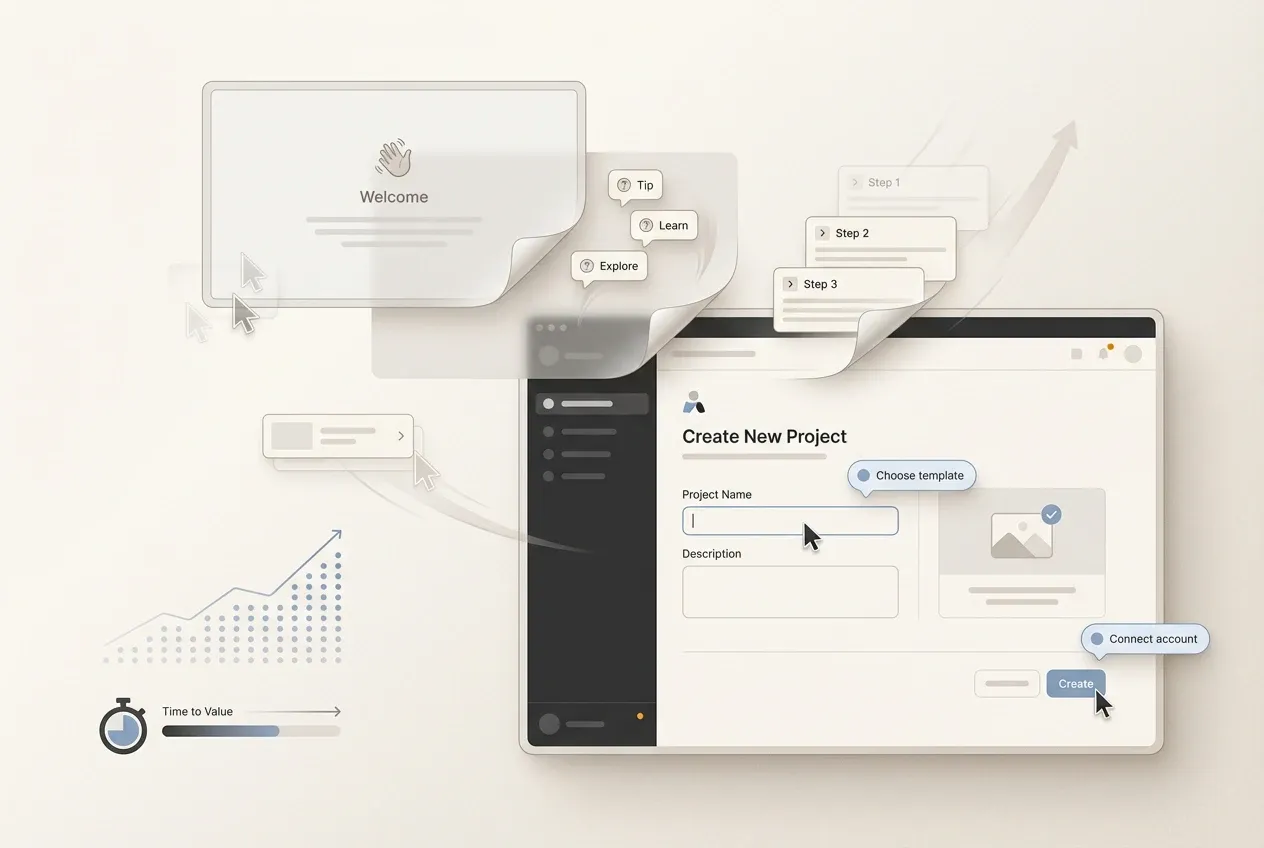
I would rather have one thread that sends four people who activate than a front-page post that sends four hundred who never come back. The same logic applies to your product itself. Getting them to the first real result fast is a whole discipline, which I wrote about in replacing onboarding with contextual help. Reddit gets them in the door. Your onboarding has to do the rest.
Reddit is slow, and that is the feature. The account you build over 30 days keeps working for months, unlike a paid post that stops the second you stop paying. If you want the compounding version of this idea applied to search instead of community, the same patience logic runs through link building for startups.
Frequently asked questions
Can I post a link to my landing page on Reddit at all?
Yes, but timing and account matter more than the link. A raw promotional link from a new, low-karma account gets filtered instantly. The same link from an account with two months of genuine comments, dropped in reply to a direct question, usually stays up and converts. Earn the account first, share the link second.
How much karma do I need before mentioning my product?
There is no magic number, and chasing a karma target misses the point. What the filters and mods actually read is your ratio and your history. An account with 200 karma that only ever talks about one tool looks worse than an account with 60 karma spread across genuine, varied conversations. Aim for a real history, not a score.
Will one self-promotion post get me banned?
Usually not on its own. A single removal with a warning is the system nudging you, not banning you. Bans come from a pattern of ignored warnings and an account whose whole history is promotion. Treat the first warning as free feedback, read the subreddit rules, and adjust before it escalates.
Should I just pay an agency to handle Reddit for me?
Be skeptical. Many Reddit success stories ending in a conveniently named agency are that agency's own planted promotion. An outside account cannot fake being part of your community, and the value you provide has to sound like you, because your users will meet you eventually. Spend the 30 days yourself. It doubles as free product research.