


Connor Patterson
Braze is a well-established customer engagement platform used by large consumer brands, but its enterprise positioning can also create friction. High contract costs, lengthy implementation, and continued dependence on engineering teams are among the reasons some companies begin looking for Braze alternatives.
The important thing is to understand what is actually driving the search.
Some teams want to reduce costs. Others want marketers to launch campaigns without waiting on developers. Others need capabilities such as loyalty programs, on-site personalization, or deeper CRM integration that Braze does not provide natively.
The right alternative depends on which of these problems matters most.
Why teams start looking beyond Braze
Braze is a capable platform, but it is designed for organizations with substantial budgets and technical resources. That makes it a strong fit for some companies and a difficult fit for others.
Several issues tend to come up repeatedly.
- Pricing can be difficult to predict. Braze does not publish straightforward pricing, and annual contracts can reach well into five or six figures depending on usage and requirements.
- Implementation can take time. Teams often need weeks or months to become comfortable with the platform, especially when setting up complex journeys and integrations.
- Some features require additional tools. Loyalty programs, on-site personalization, and certain CRM-related needs may require separate products.
- Reporting can feel limited. Some teams end up exporting data into external analytics platforms to get the level of reporting they need.
- Engineering support is often necessary. Custom integrations, advanced segmentation, and technical setup can place ongoing demands on developers.
None of these points make Braze a poor product. They simply mean that its ideal customer profile is narrower than the broader market of companies looking for customer engagement software.
The risks of switching platforms
Moving away from an enterprise marketing platform is not a decision to make casually.
A migration can involve customer records, historical engagement data, custom events, campaign logic, integrations, and reporting structures. If the transition is poorly managed, teams can lose important data or recreate workflows incorrectly.
There is also a risk in choosing a cheaper platform that solves one problem but creates several new ones.
A lower-cost product may not support the same channels, integrations, or segmentation requirements. A highly technical alternative may also create new bottlenecks if the marketing team does not have enough engineering support.
Timing matters as well.
Migrating during a major sales season or campaign period creates unnecessary operational risk. A quieter period gives teams more room to transfer data, test workflows, validate integrations, and fix problems before the new platform becomes business-critical.
The safest approach is to evaluate the migration process as carefully as the software itself.
Braze alternatives worth comparing
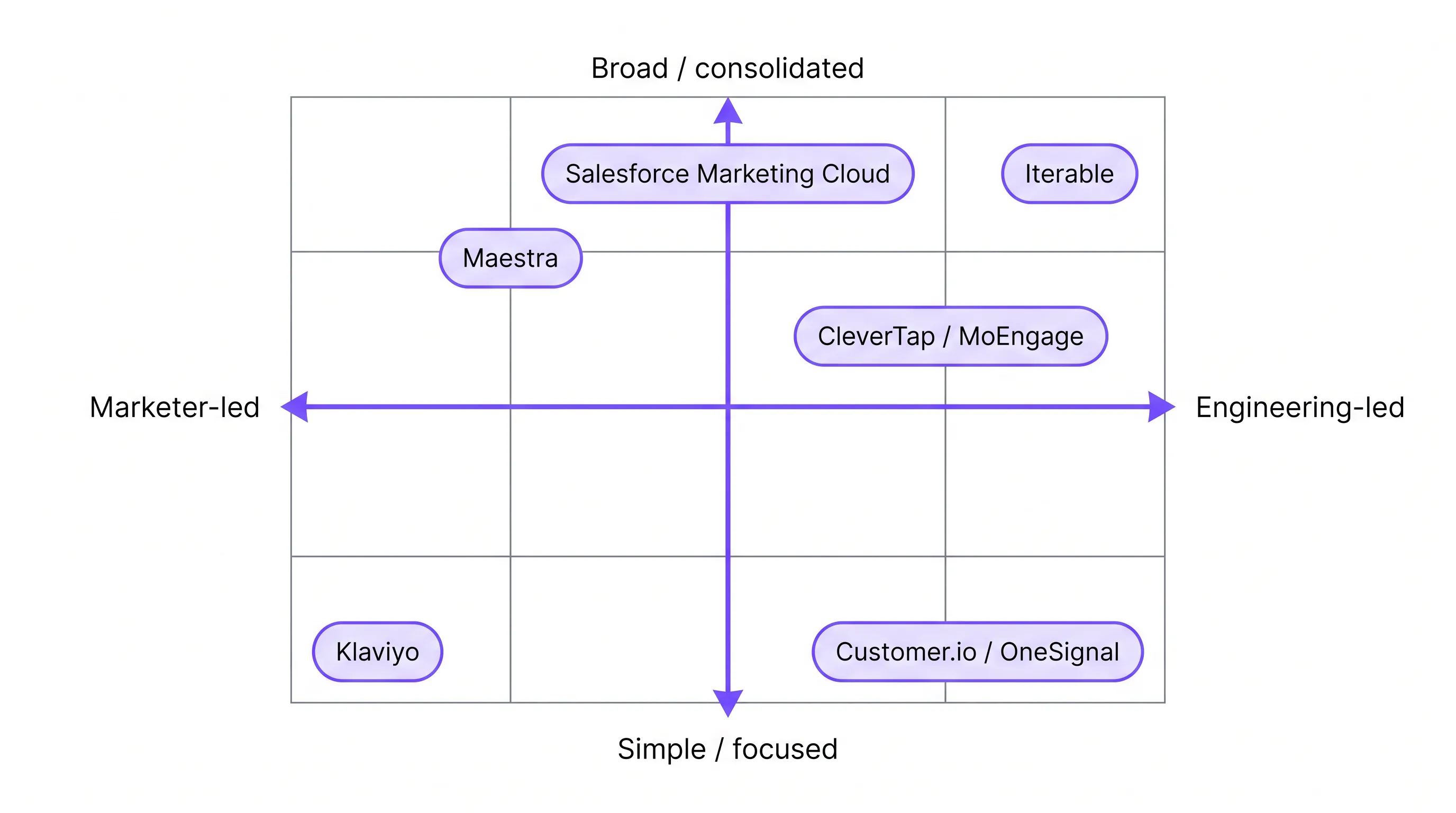
Different platforms solve different parts of the problem. The strongest option depends on your channels, team structure, technical resources, and budget.
Maestra, best for e-commerce stack consolidation
Maestra is designed for e-commerce brands that want to consolidate multiple tools into a broader customer engagement platform.
Instead of focusing only on messaging, it brings together capabilities such as marketing automation, loyalty, personalization, and other customer experience functions.
This can be useful for companies currently using Braze alongside several additional products to fill functional gaps.
For teams that want messaging, loyalty, on-site personalization, and more hands-on support in one environment, Maestra may offer a more complete alternative than replacing Braze with another messaging-only platform.
Iterable, best for engineering-led teams
Iterable is a strong choice for companies with capable in-house technical teams.
It offers flexible automation and supports complex customer journeys, making it attractive to businesses that still want a technically powerful platform but are considering alternatives to Braze.
For organizations with data and engineering resources available, Iterable can provide the flexibility needed to build sophisticated workflows without moving to a simpler marketing tool.
CleverTap and MoEngage, best for mobile-first businesses
CleverTap and MoEngage are especially relevant for businesses where mobile apps play a central role in the customer experience.
Both platforms place strong emphasis on push notifications, in-app messaging, behavioral engagement, and mobile analytics.
For companies that depend heavily on app activity rather than primarily email-driven marketing, these platforms may provide a more natural fit than Braze.
They can also be attractive when teams want strong mobile engagement functionality without taking on the same level of enterprise complexity.
Klaviyo, best for smaller e-commerce teams
Klaviyo is often a more straightforward choice for small and mid-sized e-commerce companies.
It is particularly strong in email and SMS and can be easier to manage for teams that do not need the broader enterprise architecture associated with Braze.
For a business focused mainly on lifecycle messaging and e-commerce automation, moving to a simpler platform can reduce both cost and operational overhead.
The trade-off is that Klaviyo may not offer the same breadth of functionality needed by larger or more complex organizations.
Customer.io and OneSignal, best for lean technical teams
Customer.io and OneSignal can be attractive options for smaller teams that still want behavioral messaging and technical flexibility.
They are generally more accessible than enterprise platforms and can work well when the main requirement is event-based communication across channels such as email, push, or in-app messaging.
These tools may be particularly suitable for product-led companies that want developers to retain control without committing to a large enterprise contract.
For lean teams, that balance between flexibility and cost can be more important than having the broadest possible feature set.
Salesforce Marketing Cloud, best for Salesforce-centric organizations
For companies already deeply invested in Salesforce, Salesforce Marketing Cloud may be a more logical alternative.
Its biggest advantage is integration with the wider Salesforce ecosystem.
That can justify the platform's complexity for organizations where CRM data, sales processes, and marketing operations are already closely connected.
For businesses that are not using Salesforce extensively, however, that same complexity may be harder to justify.
How to choose the right alternative
Before scheduling demos, define the problem you are actually trying to solve.
Start with a few practical questions:
- Is your biggest issue with Braze cost, complexity, or missing functionality?
- Does your marketing team need to work independently, or do you have engineering resources available?
- Which channels are essential for your customer engagement strategy?
- Do you need loyalty, on-site personalization, CRM integration, or primarily messaging automation?
- How complicated will migration be, and how much responsibility will the vendor take for it?
- Are you planning a complete platform replacement or a more limited rollout first?
These questions are more useful than comparing feature lists alone.
A platform with fewer features may actually be the better choice if it matches how your team works. Likewise, a more expensive system may still make sense if it replaces several separate products and reduces operational complexity.
Avoid comparing platforms only on price
Pricing matters, but it should not be the only factor.
A cheaper platform can become more expensive if it requires additional tools, more engineering support, or extensive custom work.
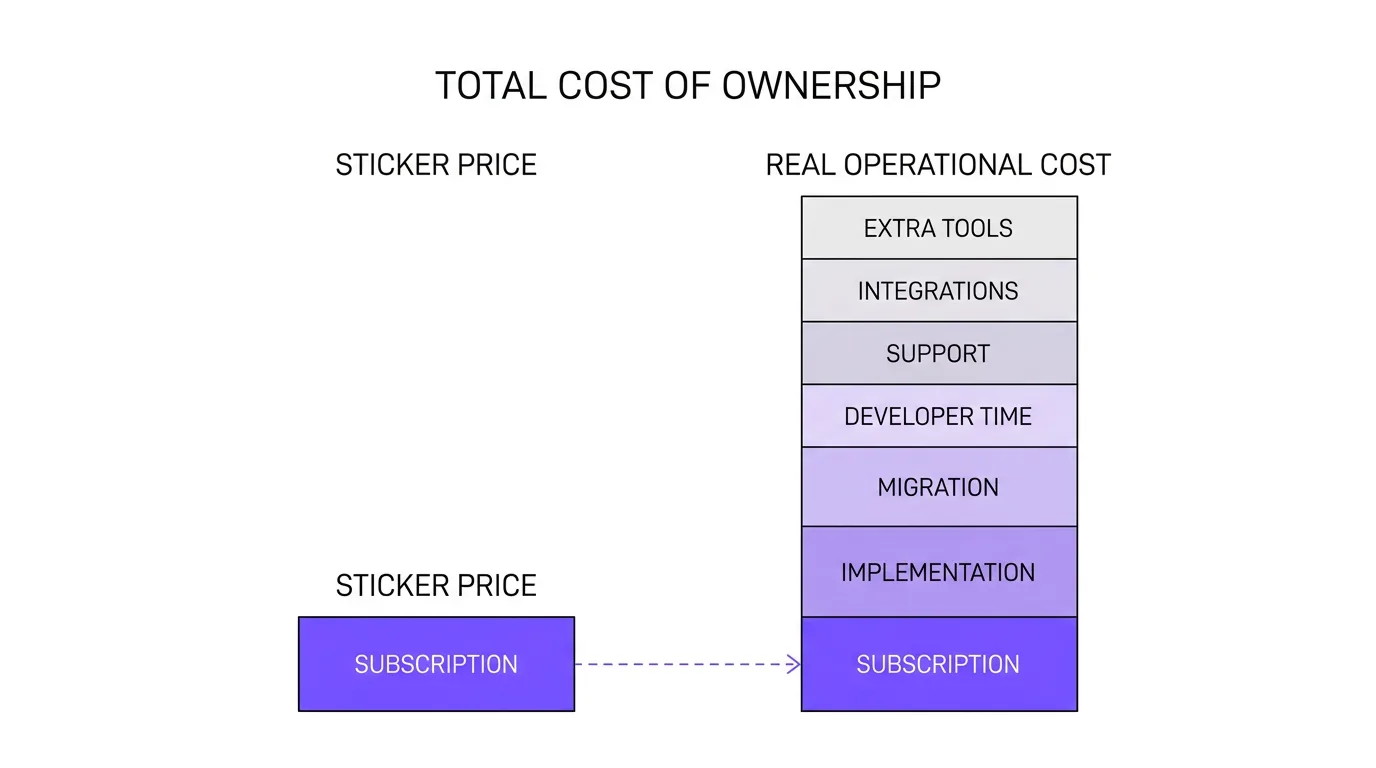
Similarly, an enterprise platform may justify a higher price if it consolidates several functions and reduces the number of vendors a team needs to manage.
The more useful comparison is total operational cost.
That includes software fees, implementation, migration, developer time, support requirements, additional integrations, and the cost of maintaining separate tools. Strong campaign reporting dashboards can also change the picture, since they reduce how often you export data into yet another tool.
Looking at the full stack often gives a very different answer than comparing subscription prices alone.
Conclusion
Braze remains a strong customer engagement platform, particularly for large organizations with the budget and technical resources to support it.
But it is no longer the only serious option.
Developer-led teams may prefer Customer.io, OneSignal, or Iterable. Mobile-first businesses may find CleverTap or MoEngage more suitable. Smaller e-commerce companies may benefit from the simplicity of Klaviyo, while organizations already built around Salesforce may prefer Salesforce Marketing Cloud.
For growing e-commerce brands that need messaging, loyalty, personalization, and broader customer engagement capabilities in one system, Maestra may offer a more consolidated alternative.
Changing platforms is ultimately an operational decision that goes well beyond a software purchase.
If your current marketing stack is making campaigns slower, more expensive, or harder to manage, evaluating alternatives makes sense. The goal is not to find the platform with the longest feature list. It is to choose the one that makes customer engagement easier for the team you actually have.