



Connor Patterson
Building a company valued at tens or hundreds of millions of dollars can make a founder look extremely wealthy. On paper, a large ownership stake may represent a substantial fortune. In practice, most of that value may still be locked inside the business.
This is where the difference between company valuation and personal financial security becomes important. Until shares are sold, transferred, or otherwise converted into accessible capital, founders may have very limited flexibility outside the company.
That is why more entrepreneurs are beginning to explore secondary alternatives for founders as part of broader financial planning. The goal is not necessarily to reduce commitment to the business, but to understand how much personal financial risk is tied to one private asset.
Paper wealth and accessible wealth are different
A common mistake is to calculate personal wealth directly from the latest company valuation.
Imagine a founder owns 20% of a business valued at $400 million. Mathematically, that stake is worth $80 million. But the founder cannot necessarily withdraw $80 million, invest it elsewhere, or use it to cover personal expenses.
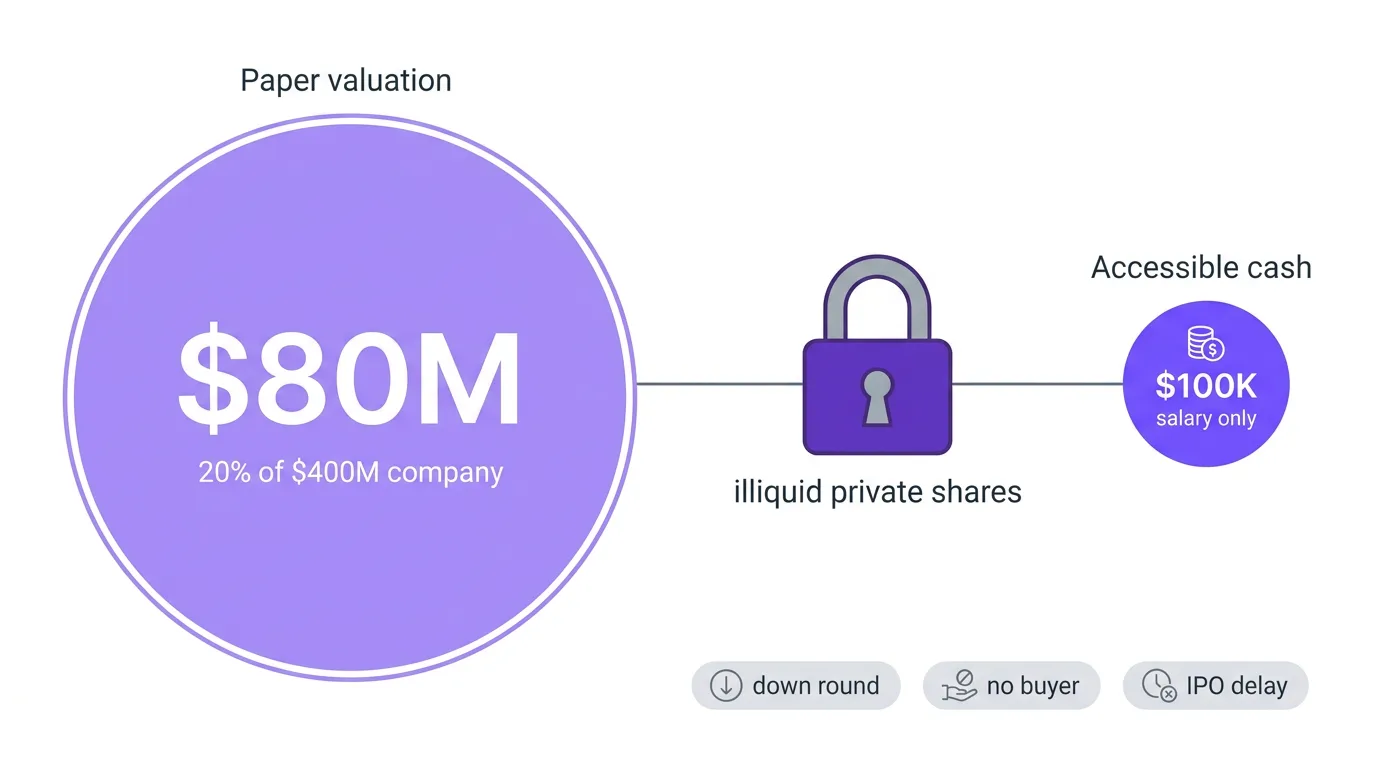
Private company shares are generally illiquid.
Unlike publicly traded stock, they cannot usually be sold whenever the owner chooses. A transaction may require company approval, an interested buyer, or a specific liquidity structure. The eventual value of the shares may also change significantly before they can be sold.
A down round, weaker fundraising environment, management conflict, or slowdown in the IPO market can all affect the value that ultimately reaches the founder.
For this reason, company valuation should not be treated as equivalent to cash or a diversified investment portfolio.
The founder salary and equity mismatch
Many founders occupy an unusual financial position.
They may hold equity theoretically worth millions of dollars while continuing to fund their personal lives primarily through salary.
That creates a considerable gap between visible wealth and usable income.
The business may be growing rapidly, investors may assign it a high valuation, and the founder may appear financially secure from the outside. Yet most of that wealth remains dependent on a future transaction.
This mismatch can become more significant as personal financial responsibilities increase.
Buying a home, supporting a family, building retirement savings, or simply creating an emergency fund may be difficult when most wealth exists in an asset that cannot easily be accessed. The same tension shows up early for anyone launching a SaaS with zero investments, where personal runway and company runway are the same thing.
Concentration risk is particularly high for founders
Diversification is one of the basic principles of personal wealth management. Founders often find themselves in almost the opposite position.
A very large proportion of their net worth may depend on one company.
That exposure is known as concentration risk.
Even when a founder strongly believes in the future of the business, the underlying financial risk remains. Company performance can be affected by market conditions, competition, financing availability, regulatory changes, leadership challenges, or broader economic events.
Founders frequently hold a far greater percentage of their wealth in one asset than would normally be considered diversified.
The issue becomes more important when that same company is also responsible for the founder's income.
One company can determine more than net worth
Founder risk is unusually interconnected.
The company may determine the value of the founder's equity, but it can also influence their salary, professional reputation, future career opportunities, and ability to raise capital for another venture.
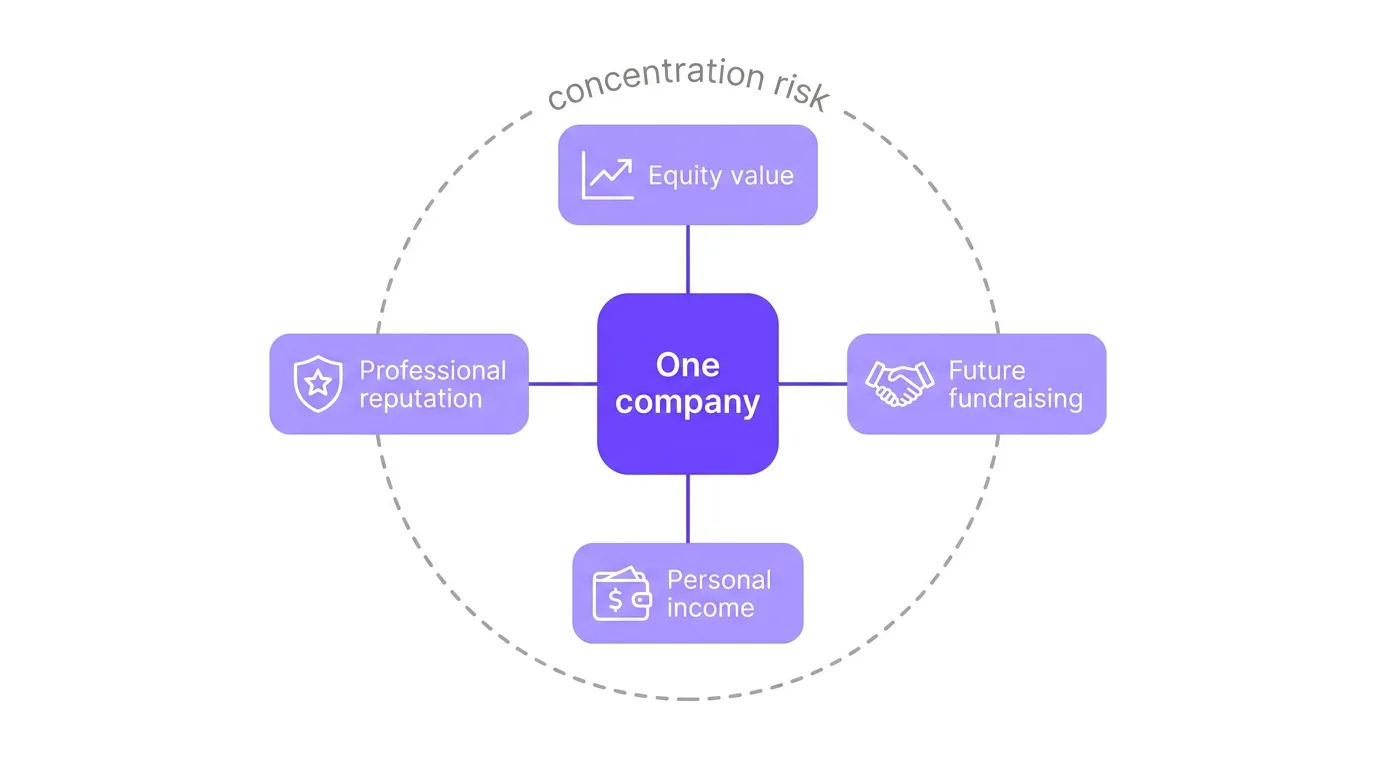
If the business encounters serious difficulties, several parts of the founder's financial life can be affected simultaneously.
A decline in company value may reduce the value of the equity. Financial pressure at the company may affect compensation. A difficult outcome may also influence how future investors or employers evaluate the founder.
This means that a founder is not simply holding a highly concentrated investment.
Their financial wealth, current income, and professional identity can all depend on the same business.
An exit can take much longer than planned
Founders often postpone personal financial decisions because they expect liquidity to arrive soon.
Perhaps the company appears to be approaching an acquisition. Maybe an IPO is discussed as a possibility within the next few years. A new funding round could also appear likely to create an opportunity for secondary liquidity.
But none of these events has a guaranteed timetable.
Market conditions change quickly. An acquisition can fall apart late in negotiations. An IPO window may close. A down round can change shareholder economics, while leadership disputes or fundraising difficulties can delay strategic plans.
A founder who expected liquidity in two years may still be waiting five years later.
Building a personal financial strategy entirely around the timing of an exit therefore introduces another layer of uncertainty.
Dave Waiser, the former CEO of Gett, has described how this can play out. When the company's IPO window closed, around $170 million of his paper wealth disappeared, although the business itself continued to perform well.
He later founded Accumulator, which allows founders at later-stage startups to exchange part of their holdings for a share of many other private businesses without selling. A founder can keep control of the company and its upside, while part of their wealth comes to depend on several exits rather than one.
Financial planning works better before liquidity
Personal financial planning is often treated as something founders should address after a successful exit.
In reality, some decisions need to be considered much earlier.
Tax planning is one example. Certain potential benefits depend on how shares were acquired, how long they have been held, and whether other eligibility requirements are satisfied.
Liquidity planning can also become easier when the company is performing strongly.
When valuations are healthy and investor demand is high, founders may have more options for exploring structured transactions or other ways of accessing part of their equity value.
Waiting until personal liquidity becomes urgent or the company encounters financial pressure can reduce those choices.
Pre-exit planning is therefore not simply preparation for managing money after an acquisition or IPO. It can help founders understand what options may exist while the company is still private.
Personal financial pressure can influence company strategy
Founders often try to separate personal considerations from business decisions, but financial stress can make that difficult.
Someone whose entire net worth is locked inside a private company may view an acquisition offer differently from someone who already has financial stability outside the business.
The same issue can influence fundraising decisions, the willingness to take risks, or the timing of a potential exit.
A founder under personal financial pressure may naturally place greater weight on short-term liquidity.
Creating some financial independence outside the company can help reduce that conflict.
It does not mean becoming less committed to the business. Greater personal stability can actually give founders more freedom to evaluate major strategic decisions based on the company's long-term interests instead of immediate personal needs.
Building security without abandoning the business
Financial security does not necessarily require a founder to sell the company or substantially reduce their ownership.
The more important objective is understanding how much personal wealth depends on a single future event.
Founders can begin by evaluating concentration risk, understanding the characteristics of their equity, considering potential pre-exit liquidity opportunities, and working with advisors familiar with private company ownership.
In some cases, accessing a relatively small portion of company value may be enough to create greater diversification and personal stability while leaving the founder heavily invested in future growth. Founders who started a SaaS business with no money tend to appreciate this balance early, because they already know how fragile a single income source can feel.
That can create a healthier balance between confidence in the business and responsible personal financial planning.
Final thoughts
Company valuation and founder financial security should not be treated as the same thing.
A founder can own equity worth millions on paper while having relatively little accessible capital outside the company. When personal wealth, salary, and professional prospects all depend on the same business, the resulting concentration risk can be significant.
The timing of an eventual exit adds even more uncertainty.
For that reason, personal financial planning should begin well before an IPO or acquisition becomes certain. Understanding liquidity options, considering diversification, and preparing for future financial decisions can give founders greater flexibility without reducing their commitment to building the company.
The equity a founder creates is real value. Financial security comes from understanding when and how that value can support life outside the business as well.