


Roman Kamushken
Six senior designers were asked, point blank, how they actually reached $300k and beyond in total compensation. I almost scrolled past. I have read a hundred "how I made it" posts and most are theater, the same recycled advice about passion and hustle dressed up in a new font. These were different. They were specific, a little unglamorous, and honest in the way people only get when nobody is selling anything. I read every word, and the pattern underneath them landed harder than I expected, because I had spent thirteen years proving the same things from the opposite side of the fence.
Here is the short version. They came from different companies, different decades, different routes in. Some were principals, one a VP, one sat at $700k total comp inside a Fortune 500. And not one of them led with visual craft. The portfolio, the Figma fluency, the pixel polish, none of it came first. What they credited was closer to behavior than to anything you'd list as a hard skill.
I sat with that for a while, because I went the other way.
I never climbed to VP. I became a maker instead. UI kits, a template store, a business I built and very nearly destroyed. Different game, different scoreboard. So when I read six people describing the ladder I stepped off, I expected to feel like an outsider. I didn't. I recognized every single thing they named. The same five behaviors that move a designer toward $300k inside a company are the ones that decided whether my own bets paid off.
That is what this post is about. The five, what they actually mean, and why you can start practicing all of them this week without handing in your notice.
What six senior designers actually said
The answers came from a real mix of people, which is why the overlap is worth noticing.
One was a principal at a big tech company past the $300k mark, the person everyone went to when they needed to know what was going on across the org. Another, clearly senior, put relationships at the very top and barely mentioned tools. A veteran told everyone to stop staying in their lane and stop waiting for permission. Someone with a non-traditional path, a $12-an-hour internship to IDEO to big tech leadership, argued the windy road was the advantage. A VP walked through seventeen years from junior to the executive room in clean stages. And a principal at a Fortune 500, sitting at $700k, dropped a tight ranked list.
That last list is the one that stuck with me. Eight items. Learn to present. Learn the politics. Build alliances. Drive the work. Say no. The eighth and final item was "be good at what you do 😉", winking emoji included.
Read that ordering again. The person earning $700k put craft last, half as a joke. The pattern was repeated, in different words, by a VP who had spent seventeen years working their way to the executive room — and we will come back to exactly what that VP said in Skill 4. Six independent answers, and the same handful of patterns kept surfacing. I pulled out five.
Skill 1: Operating without a job description
The most common thread had nothing to do with talent. It was about scope, and refusing to be boxed by it.
Your job description is a floor. It is the minimum you were hired to deliver. The designers who broke through treated it as exactly that, a starting line rather than a fence. One principal described becoming the person the whole org came to when they needed to understand what was actually happening. That role was never in a job posting. He built it by handling things end to end until people stopped checking his work and started assuming it was done well.
Here is the reframe that matters. This is not about doing more tasks. It is about owning outcomes that technically belong to someone else, and doing it as a teammate rather than a turf-grabber. You step into the messy gap nobody owns, you make the result good, and you make zero noise about whose box it came from.
I learned this the hard way, from the maker side. When I started shipping UI kits and templates, my "role" dissolved overnight. There was no one to tell me my lane. I was the designer, the support rep, the person writing release notes, the one answering refund emails at midnight. The formal title stopped meaning anything. What counted was whether the outcome landed for the person who paid me.
You do not need to quit to practice this. The move is available inside your current role this quarter.
→ Take ownership of one outcome that sits just outside your official scope
→ Ship one public artifact about work you already did, a write-up, a teardown, a small case study
→ Volunteer for the ambiguous project no one wants to own yet
☞ The fastest way to outgrow a title is to quietly do the job one level up before anyone gives you permission.
The people who reach $300k are rarely the ones who did their job perfectly. They are the ones who became impossible to fit back into the box they started in.

Skill 2: Relationships as multipliers, not networking
Ask people how they got promoted and "networking" is the word that makes everyone wince. It sounds like collecting business cards at a conference you didn't want to attend. That is not what the senior designers meant.
More than one of them put relationships at the very top of the list, above craft, above process, above everything. And the version they described was almost the opposite of transactional. It was about being the kind of person other people quietly root for when you are not in the room. You earn that by helping others succeed, especially your manager and their peers, without keeping a ledger.
The distinction is simple. Networking asks what this person can do for you. An alliance asks what you can take off this person's plate. The first feels like sales. The second feels like friendship, and it compounds for years because people remember who made their hard week easier.
For mid-level designers this works on two fronts. Inside the company, set up time with people more senior than you across functions, share work earlier than feels comfortable, and make your teammates look good in front of their bosses. Outside the company, the same instinct scales further than you think. A thoughtful reply, a generous teardown, a useful thread, and slowly people in your field know your name before they ever meet you.
I am not a natural extrovert. I never worked a room in my life. What I did instead was write, in public, consistently, for people I would never meet. An audience built that way is just a relationship at scale, and it does not require you to be loud. It requires you to be useful on repeat.
The designers who plateau often have the strongest portfolios in the room. The ones who climb have the strongest reputations in rooms they are not even standing in.

Skill 3: Storytelling as career infrastructure
Most designers think of presenting as a thing that happens in a meeting. You build the deck, you walk the room through it, the meeting ends, the deck dies in a folder. That framing is why so much good work goes unrewarded.
The senior designers treated communication completely differently. Presentation skill showed up again and again, and the people who valued it most were not talking about charisma. They meant clarity, and they meant durability. A clear story about your work keeps paying out long after you stop telling it.
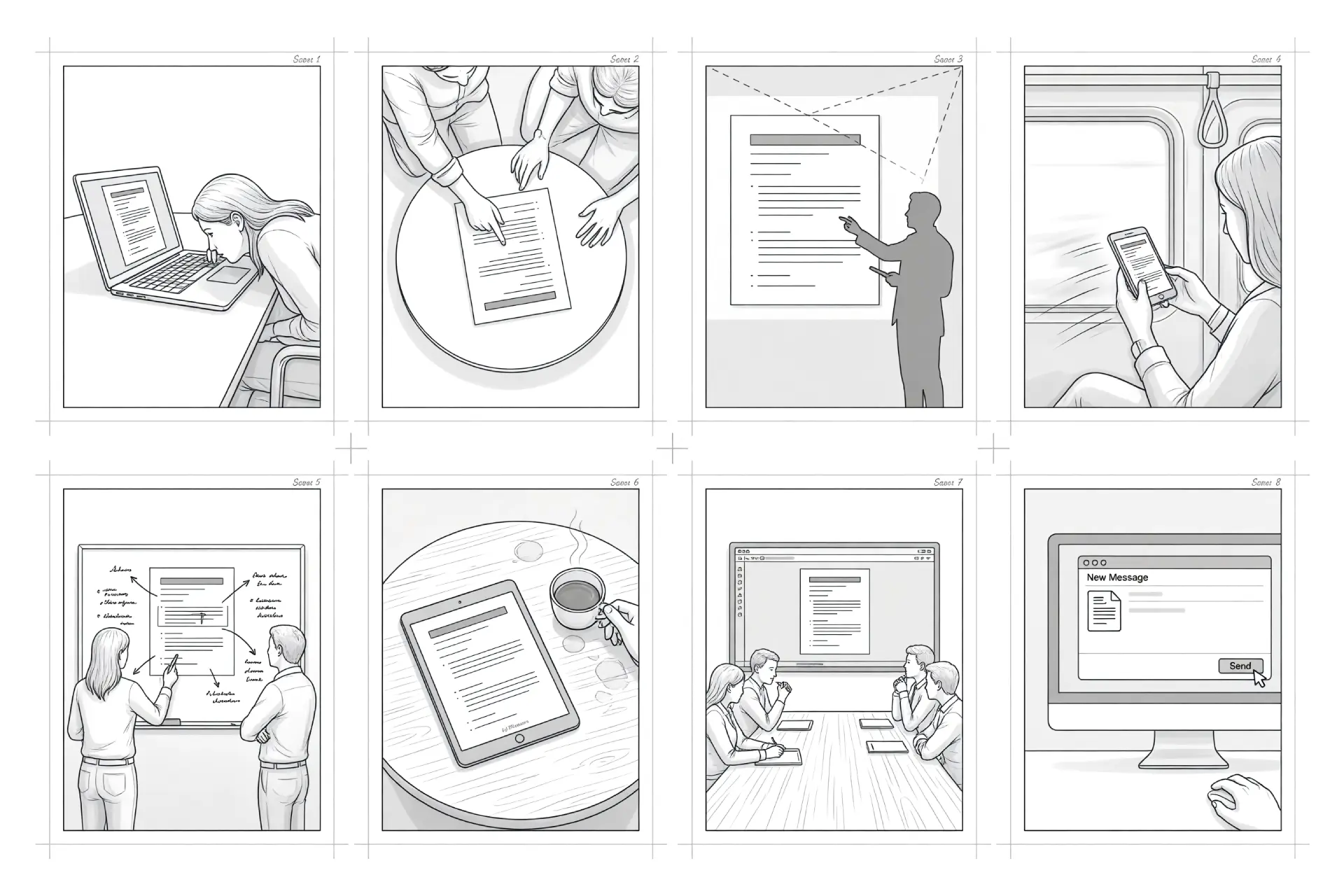
Think about where your reputation actually lives. It lives in the artifacts that travel without you in the room. The doc someone forwards to their VP. The slide a PM screenshots into a planning thread. The framing that gets repeated in a meeting you were never invited to. Each of those is storytelling that outlived its moment, and that is the whole point.
This is the difference between a presentation and infrastructure. A presentation is consumed once. Infrastructure keeps working while you sleep. A well-written project recap, a teardown of a pattern you nailed, a short internal post explaining why you chose this structure over that one, these compound. People reuse them, cite them, and slowly start attributing the thinking to you.
I have leaned on this harder than almost anything else I do. When I wrote a detailed guide on how to design a UI kit foundation, it was not a marketing exercise. It was me turning private craft into a public, reusable story. That single piece has introduced me to more designers than any conference ever did, and it keeps doing it years later without another minute of my time.
You can start at the smallest scale. Write up the last project you shipped, one page, plain language, focused on the decision and the outcome rather than the screens.
→ Document one finished project as a short internal or public write-up this month
→ Lead with the problem and the result, keep the craft details in the middle
→ Make it skimmable so a busy executive gets the point in thirty seconds
☛ What most designers miss: the work does not speak for itself. The story you attach to it does, and unlike the work, the story can be in ten rooms at once.
Skill 4: Translating craft into business
This is the one that separates senior designers from the ones who stay mid-level with a great portfolio.
The clearest statement of it came from a VP who had spent seventeen years getting to the executive room. As one VP of design put it, "Your role as a designer is to build business value just as much as PM's role is to build business value." Read that slowly. He is not saying design serves the business. He is saying design builds the business, on equal footing with product management, and that the designers who internalize this stop waiting to be invited to the strategy table.
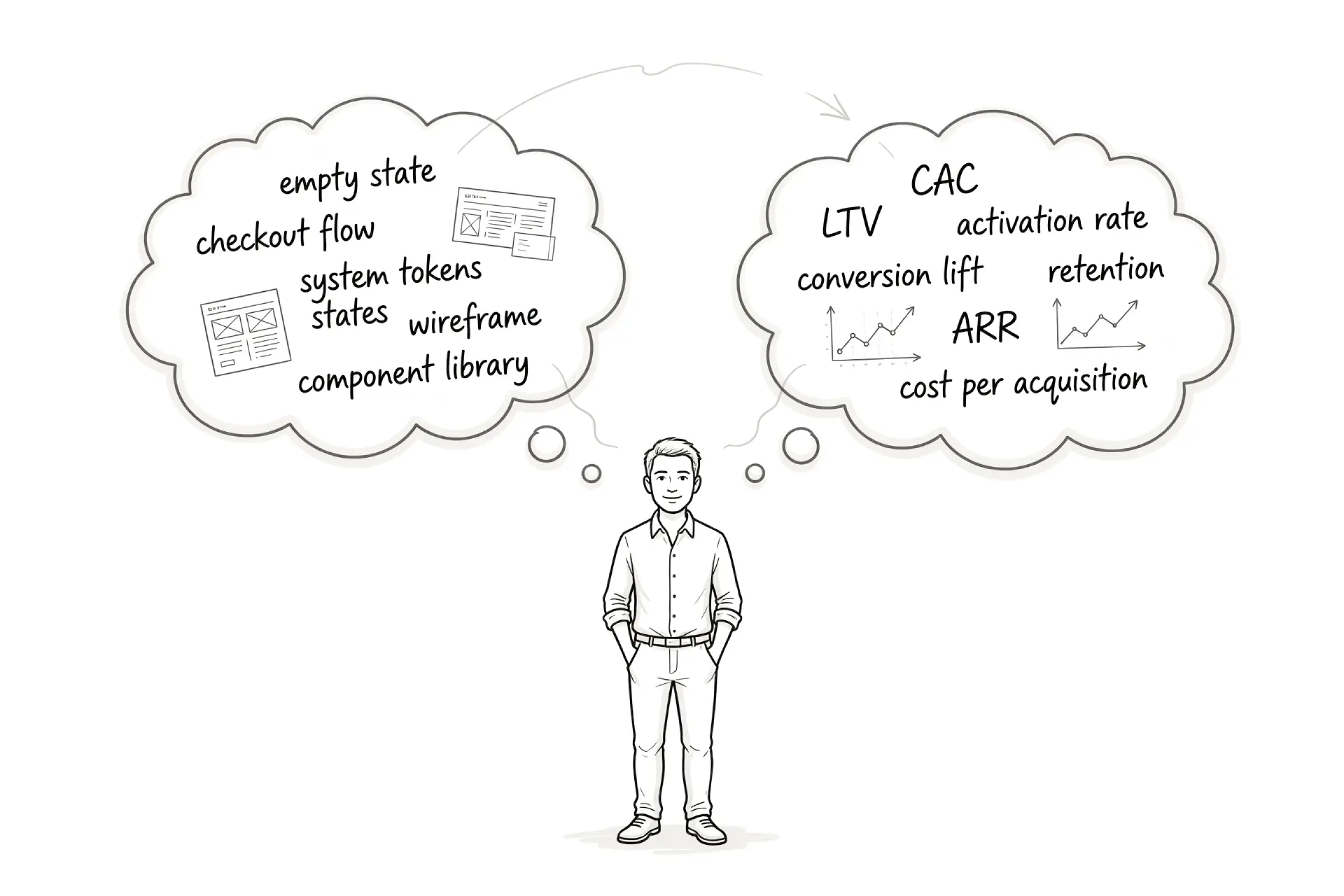
Most designers can describe what they made. Fewer can describe what it earned, saved, or unlocked. That gap is the whole game. When you can connect a flow you redesigned to a retention number, a support-cost reduction, or a conversion lift, you start speaking the language that executives actually budget around. You become legible to the people who decide compensation.
You do not need an MBA for this. You need to learn the handful of numbers your business runs on and tie your work to them on purpose.
Building Setproduct forced this on me with no mercy. I had to learn unit economics from scratch. What does a single UI kit actually cost to produce in hours and energy. What does it cost to acquire one customer. How does the lifetime value math work when someone buys one kit versus a full bundle. None of that is visual craft, and all of it decided whether the craft survived. The same shape of thinking applies whether you are pricing a template or justifying a design hire.
→ Learn the three to five core metrics your product is measured on
→ For your next project, write one sentence connecting the design to one of those metrics
→ Use that sentence in your next review, out loud, before anyone asks
☞ Craft translated into money does not cheapen the craft. It is what gets the craft funded for another year.
The designers earning the most were rarely the best illustrators in the building. They were the ones who could stand in a room full of PMs and finance people and make design sound like an investment instead of a cost.
Skill 5: Selective ambition as a filter
The last pattern is the one that feels wrong to ambitious people, which is exactly why it works.
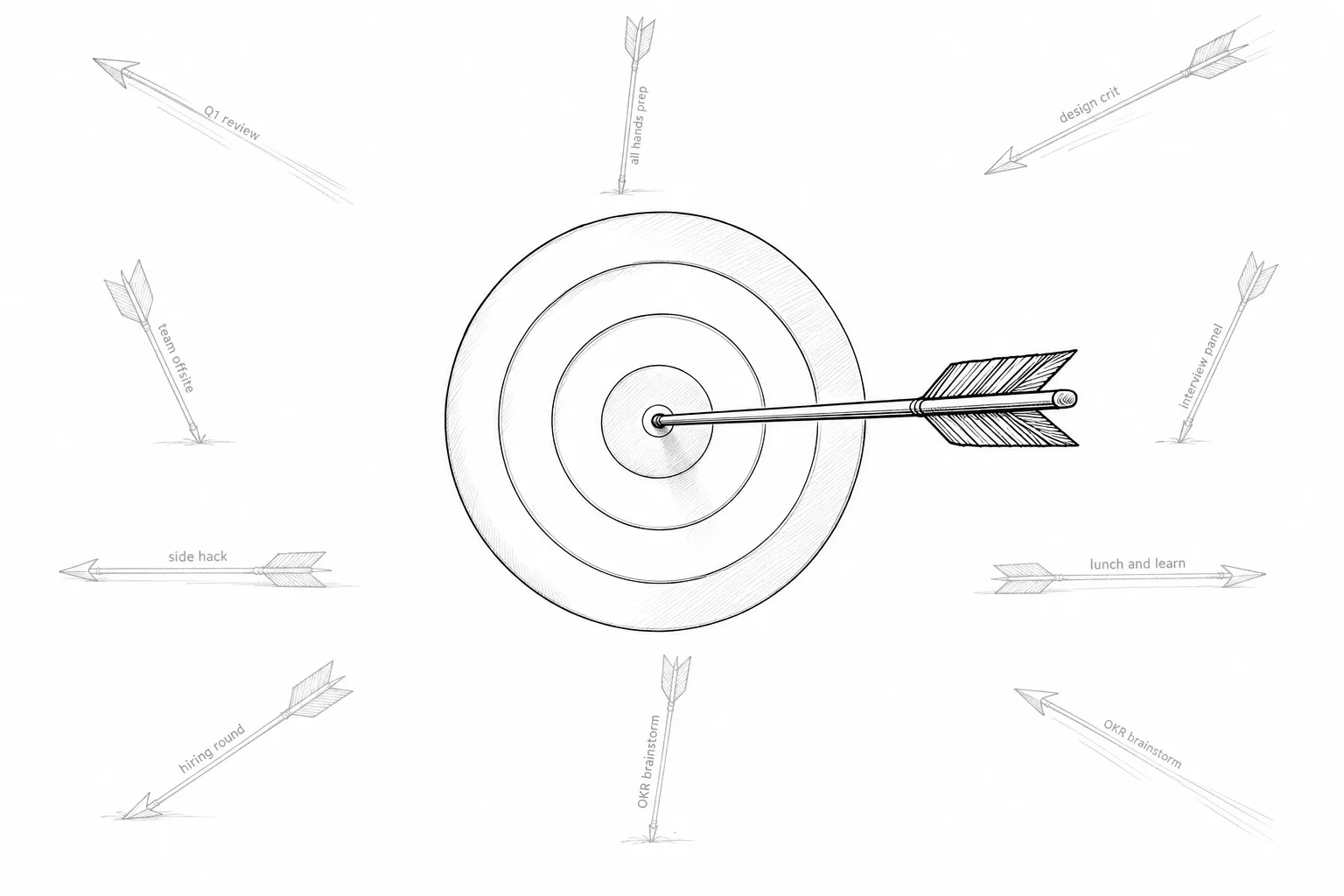
Two of the senior designers said some version of the same thing. Volunteer fast for the few opportunities that matter, then say no to almost everything else. One framed it as turning down roughly ninety percent of what comes your way. That number sounds reckless until you have watched a talented designer spread across nine projects and become forgettable on all of them.
Ambition is usually treated as appetite. Take more, cover more, raise your hand for everything. The designers who actually reached the top used ambition as a filter instead. They protected a small number of bets and went absurdly deep on them. Depth came from subtraction, from the courage to let good opportunities pass so the great ones got everything.
For a mid-level designer inside a company, this is more available than it looks. You probably cannot control your whole workload. You can choose where your discretionary energy goes. Pick one initiative this half and go deeper on it than anyone expects, instead of being adequately present on five. The person who owns one thing completely is remembered. The person spread thin is a resource, not a name.
I learned this discipline by getting it wrong first. My instinct as a maker was always to widen, to serve every designer alive, because a bigger audience felt like a bigger bet. It was the same instinct that makes a designer say yes to all five projects. When I built Nocra, I forced myself the other way. I pointed it at one narrow audience, teams building AI products, and shaped every component, every template, every default for them and no one else. The product got sharper the moment I stopped trying to serve everyone. A career works on the identical math. The designer known for going deep on one domain is worth more than the one who is vaguely useful across six. Focus is what makes a product memorable, and it is the exact same thing that makes a person memorable. Narrow on purpose, and you become the obvious choice instead of an option.
→ Choose one initiative this half to go unusually deep on
→ Decline or delegate something good to protect it, on purpose
→ Judge the quarter by depth on the few, not coverage of the many
☞ Saying no is not a lack of ambition. It is ambition aimed through a narrower hole, which is the only way it ever hits anything.
The scoreboard question
So here is the part nobody likes to say plainly.
The corporate path is real and it pays. Five behaviors, applied for a decade, can carry a designer to $300k and well past it. That is not a consolation prize. It is a genuinely good life. Stability, real scale, problems that are worth solving. I am not here to talk anyone out of it.
The maker path I took leads somewhere different. It is not about climbing higher or being purer about it. The cash flow has a different shape, and so do the risks. The income is lumpier. The equity is in my own work instead of a company's stock. The wins are mine and so are the failures, all of them, including the business I watched implode in real time.
Here is what took me years to see. The five behaviors do not care which scoreboard you are playing on. Operating beyond your scope, building real alliances, telling durable stories, translating craft into money, aiming ambition through a narrow filter. These move you forward whether the prize is a VP title or a product people pay for. They are the engine. The scoreboard is just where you decide to point it.
And that is the quiet thing worth sitting with. You do not have to leave your job to start playing a different game. You can practice every one of these from inside your current role, this week, with nothing at stake yet.
So pick one. Take the smallest version of the skill that scares you least. Write up one project so the story travels without you. Tie one design decision to one business number out loud in your next review. Go deep on one thing and decline something good to protect it. The behavior is portable. Start it where you already stand, and decide later which board you want to win on.
If you want a low-stakes place to practice the maker muscle without quitting anything, study how other people build. I keep a running AI inspiration gallery for exactly that, a way to look at hundreds of real interface decisions and sharpen your own judgment on someone else's dime.
Frequently asked questions
❶ Does this mean visual craft does not matter?
No. Craft is the price of entry, and weak craft will cap you fast. The point is narrower. Past a certain level, craft stops being the thing that differentiates you, because everyone in the room already has it. The five behaviors are what decide who moves up from a crowd of skilled designers.
❷ Can I apply these skills while staying at my current job?
Yes, and that is the whole argument. Every behavior here, expanded ownership, alliance-building, public writing, business literacy, selective focus, can be practiced inside your existing role with zero risk. You do not need a title change or a resignation letter. You need one project and a decision to start.
❸ How long does it take to build these skills?
Years, honestly, and that is good news. These compound. A single write-up or one well-aimed business argument feels small in week one. Repeated across a few years, they build a reputation that walks into rooms ahead of you. The designers at $300k did not sprint there. They stacked small reps.
❹ Is there a path that combines corporate and independent?
Absolutely, and it is the most common one I see now. You keep the stable job, practice these behaviors there, and build a small public body of work on the side. Writing, a tiny product, a niche audience. The corporate role funds the experiment while the maker muscle grows. No dramatic exit required.