

Connor Patterson
A B2B SaaS website has to do more than look polished. It has to explain a product quickly, build trust with multiple stakeholders, support long buying cycles, and give internal teams a site they can actually update as messaging, features, and campaigns evolve. That is why choosing among SaaS web design agencies is usually less about visual taste alone and more about finding a partner that can combine structure, positioning, UX, development, and ongoing maintainability.
The agencies below are not interchangeable. Some are strongest at subscription-based website and design support, some specialize in Webflow or composable CMS builds, and some are better suited to brand-led enterprise redesigns for complex B2B software companies. This ranking focuses on verified B2B tech relevance, website capabilities, platform fit, and service transparency rather than generic creative claims.
What makes SaaS web design different for B2B tech brands
Designing a B2B SaaS website is fundamentally different from designing a simple brochure site or a consumer landing page. A software company often needs to explain a complex product, show how it fits into an existing stack, address several buyer personas, support both self-education and sales-led conversion, and maintain credibility with technical and commercial audiences at the same time.
That creates five recurring website challenges. First, the product and its value need to become clear quickly, even when the offering is abstract or highly technical. Second, the site needs to establish trust through structure, messaging, product detail, and proof points rather than just visual polish. Third, the journey has to support multiple stages, from early research to high-intent demo requests. Fourth, the site often needs space for integrations, use cases, industries, pricing logic, and solution pages. Fifth, marketing teams need templates and CMS flexibility so the website can grow with the company instead of turning into a bottleneck after launch.
What services should a SaaS web design agency offer
The best SaaS web design agencies usually combine strategic thinking with practical implementation. Even if an agency does not handle every surrounding discipline, it should be clear about where strategy ends, where design begins, whether development is included, and how the finished site will be managed after launch.
Website strategy and information architecture
A strong agency should be able to research audiences, structure the sitemap, define navigation, and organize product information so each buyer type can find the right material without friction. For B2B tech brands, that often means mapping content by role, industry, company size, or use case rather than relying on a generic services menu. Good information architecture makes the site easier to understand and easier to scale as the product grows.
UX/UI design and conversion-focused pages
Visual quality matters, yet B2B SaaS UX comes down to clarity and momentum. An agency should understand page hierarchy, CTAs, demo-request flows, product storytelling, and how to reduce friction on high-intent pages like pricing, integrations, solutions, and forms. At the same time, it should not assume that a prettier interface automatically improves conversion without validating user needs and business context.
That second point is where most redesign budgets go wrong. A new visual layer without a design system behind it just resets the same problems two years later, and a landing page that only looks new rarely moves the numbers behind it.
Website development and CMS implementation
For SaaS companies, launch is not the finish line. The site needs responsive development, performance, accessibility, scalable templates, and a CMS that the internal team can actually use. Depending on the agency, that may mean Webflow, WordPress, a headless CMS environment, or custom development, but the important point is whether the chosen setup fits the company's publishing workflow and future growth.
SEO foundations and ongoing website optimization
A redesigned site should not sacrifice crawlability, internal linking, metadata structure, or content scalability. Some agencies offer technical SEO, migration support, content architecture, and ongoing site optimization, while others focus mostly on design and build. Buyers should verify whether SEO foundations are truly included or whether they need a separate partner for that work.
How we ranked the best SaaS web design agencies
This list was built using the same criteria across all seven providers, with official websites, service pages, published case studies, and portfolio evidence used as the primary sources. The aim was to find the firms most relevant to B2B technology companies that need websites capable of clarifying products, supporting demand generation, and evolving with the business, rather than to crown the most visually impressive agency in the abstract.
The ranking emphasized six factors:
→ B2B SaaS and technology experience
→ Portfolio and design quality
→ UX and conversion strategy
→ Development and CMS capabilities
→ SEO and scalability support where offered
→ Transparency around scope, pricing, and client evidence
Published testimonials and case studies were treated as agency- or client-published evidence rather than independent audits, and no unsupported numerical scoring was added.
Buyers who already have a rough agency shortlist usually get more from the tips for landing pages built by startups than from another list of logos.
7 best SaaS web design agencies for B2B tech brands
These seven agencies serve different needs. Some are better for recurring design support, some for Webflow-led B2B builds, some for composable or enterprise website systems, and some for high-end brand-led redesigns with strong product storytelling.
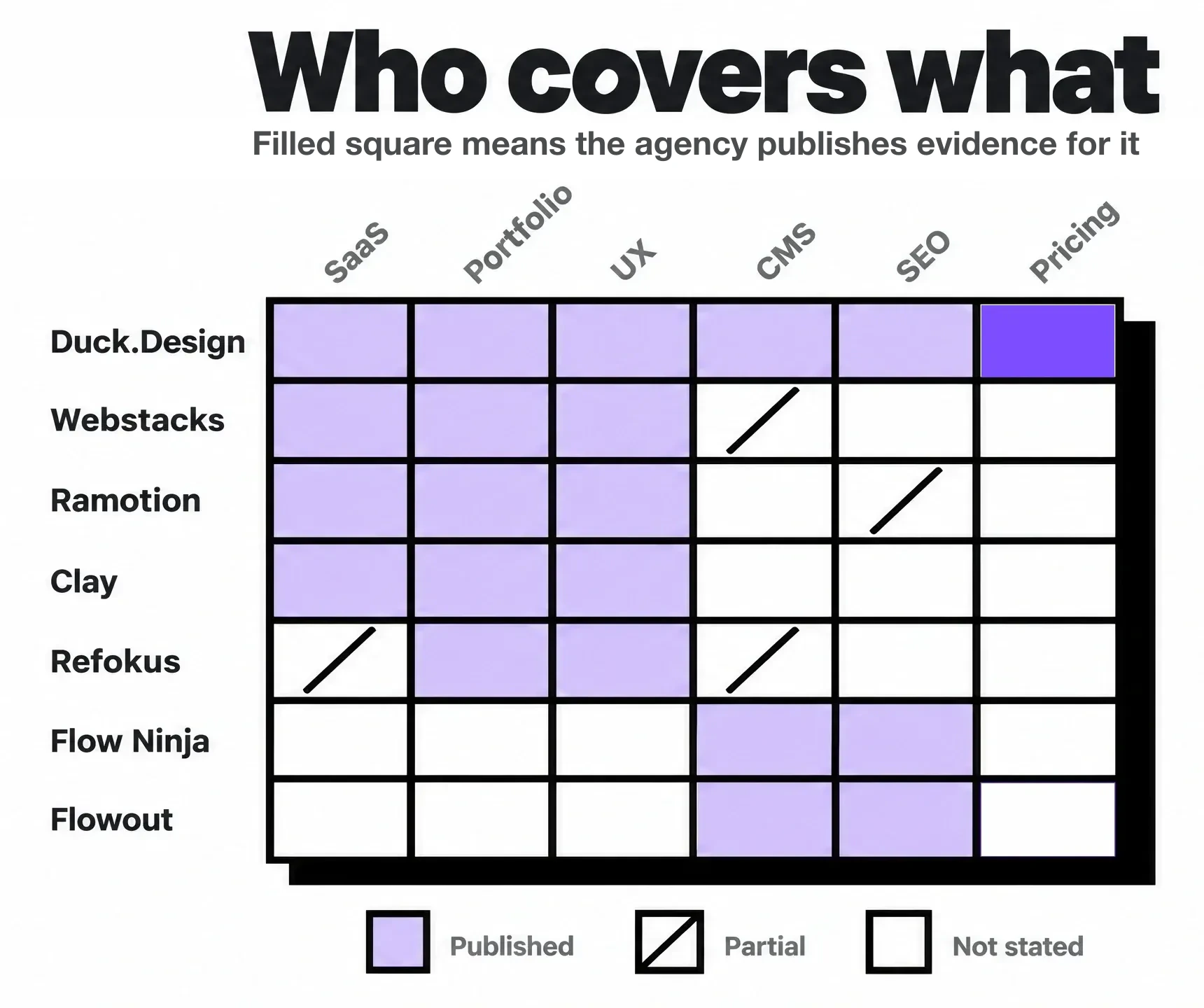
The matrix on the right shows how each of them lines up against the six criteria we ranked on. A filled square means the agency publishes evidence for that criterion on its own site. A hatched square means the claim is partial. An empty square means nothing is published.
Read the top rows as strategy-led project agencies: strong on SaaS positioning, portfolio, and UX, quiet on pricing. Read the bottom rows as Webflow partners built for ongoing operations: weaker on brand positioning, much stronger on CMS work and post-launch support. Almost the entire pricing column is empty, which is the honest state of this market.
| Agency | Best for | Core capabilities | Development and platform | Pricing |
|---|---|---|---|---|
| Duck.Design | B2B tech teams needing ongoing website and creative design support | Landing pages, website design, UI/UX, branding, motion, no-code build support | Webflow, WordPress, Wix, Framer, Shopify under the Build plan | From $1,199/month |
| Webstacks | Scaling B2B SaaS brands needing strategic website systems | Website strategy, design systems, redesigns, content architecture, ongoing site evolution | Composable and headless CMS environments, custom B2B website builds | Not publicly listed |
| Ramotion | SaaS and enterprise brands needing brand, web, and product clarity together | Website audits, IA, copy support, design systems, web design, development, CRO | Custom development plus CMS and integrations | Not publicly listed |
| Clay | Enterprise or growth-stage tech brands prioritizing premium design and digital experience | Branding, web design, development, UX/UI, content production | Custom development and web builds, platform specifics not publicly standardized | Not publicly listed |
| Refokus | B2B tech startups wanting strong brand expression and Webflow execution | Brand positioning, visual identity, web design, Webflow development, motion, 3D | Webflow and creative development | Not publicly listed |
| Flow Ninja | Marketing teams that want a Webflow build plus ongoing WebOps support | Strategy, design, copy, Webflow development, CMS training, SEO/AEO, WebOps | Webflow specialization | Not publicly listed |
| Flowout | High-growth SaaS teams wanting a subscription-style Webflow partner | Migration, custom website build, ongoing growth support, CRO, SEO support | Webflow Enterprise, migration from WordPress and HubSpot | Not publicly listed |
1. Duck.Design
Description: Duck.Design is a SaaS web design agency that helps B2B technology companies build and improve their websites through subscription-based design services and no-code website development. It offers website and landing-page design, UI/UX, branding, motion, and broader marketing creative through tiered monthly subscriptions. Its public Build plan also lists no-code development across Webflow, WordPress, Wix, Framer, and Shopify, which makes it more flexible than design-only subscriptions for teams that need implementation support. It is most relevant for startups and SaaS marketing teams that want ongoing website and creative work without hiring a full internal design department.
Key services:
→ Landing page and website design
→ UI/UX and mobile app design
→ Product interface design
→ Dashboards and onboarding flows
→ Design systems
→ Presentation and pitch deck design
→ Logo and brand guide work
→ Motion design and explainer assets
→ No-code website development on the Build plan
Engagement model: Duck.Design publicly lists three plans. Graphic Design at $1,199/month, Creative Suite at $1,899/month, and Build at $1,999/month. The service includes unlimited requests, unlimited revisions, Trello-based project management, source files, and cancel-anytime terms, with most first updates delivered within 24 hours and more complex requests potentially taking up to 48 hours. The Build plan is the critical difference for website buyers because it adds no-code implementation support instead of stopping at visual design.
B2B tech relevance: Duck.Design publicly positions SaaS UI/UX work around product interfaces, dashboards, onboarding, and design systems, and it also lists case categories such as B2B mobility platforms and AI platforms. That makes it relevant for software companies that need recurring website pages, product visuals, landing pages, and interface-related marketing design without necessarily hiring a traditional project-based web agency.
Best for: SaaS startups and lean marketing teams that want ongoing website and creative design support, especially when speed and subscription flexibility matter more than a one-time custom redesign process.
Why we chose it:
→ Public pricing is clearer than most competitors
→ Verified website, UI/UX, and no-code build scope
→ Flexible subscription model for ongoing website work
→ Strong fit for recurring B2B tech design needs rather than one-off production only
2. Webstacks
Description: Webstacks is one of the most B2B SaaS-specific agencies in this ranking. Its positioning is built around modern B2B website systems that can scale with product complexity, evolving demand-generation needs, and ongoing content operations rather than functioning as static marketing sites. That makes it especially relevant for software companies moving upmarket or trying to align the website more tightly with business strategy.
Core services:
→ Website strategy and structure
→ Design systems and reusable page components
→ Marketing website redesign
→ CMS and composable website implementation
→ Content architecture
→ Ongoing website evolution
Notable work: Webstacks' public case study for Calendly explains how it helped redesign the site to support a shift from a PLG-focused motion to a stronger enterprise sales motion. The project included reworked solutions pages, pricing architecture, resource-center organization, integrations content, and a Contentful-based composable setup designed for faster iteration and more scalable marketing operations.
Best for: Scaling B2B SaaS companies that need a strategic website rethink, especially when site structure, CMS flexibility, and long-term marketing operations matter as much as visual redesign.
Why we chose it:
→ Very strong B2B SaaS positioning
→ Clear evidence of strategy-led website work
→ Strong relevance for CMS scalability and content operations
→ Better fit for complex SaaS marketing websites than for simple brochure projects
3. Ramotion
Description: Ramotion combines branding, website strategy, web design, development, and optimization in a way that is highly relevant to B2B software companies. It publicly positions itself for B2B, SaaS, fintech, cybersecurity, startups, and enterprise clients rather than for generic small-business websites. Its website offering is broad enough to cover both strategic structure and technical implementation, which gives it more depth than a pure design studio.
Core services:
→ Website audit
→ Information architecture and copy support
→ Website concept development
→ Full website creation
→ Web design systems
→ CRO support
→ CMS implementation
→ Third-party integrations
→ Ongoing maintenance
Notable work: Ramotion's public site lists technology and SaaS clients such as Stripe, Mozilla, Adobe, Crunchbase, Redis, Okta, Clearbit, Xero, Descript, Salesforce, and Citrix. Even without publishing standardized pricing, that client mix makes it one of the more clearly tech-oriented agencies in this ranking.
Best for: B2B SaaS and enterprise brands that want brand clarity, conversion-minded website design, and technical delivery from one partner.
Why we chose it:
→ Strong B2B and SaaS positioning
→ Broad capability range from strategy through maintenance
→ Publicly visible technology client relevance
→ Better-rounded offering than agencies focused only on Webflow execution
4. Clay
Description: Clay is a premium digital design agency with deep roots in UX and a strong reputation in technology, SaaS, fintech, and enterprise web experiences. Its public portfolio emphasizes high-end web design, branding, development, and digital product thinking rather than low-cost or template-based site production. For B2B tech brands, the appeal lies in brand system thinking combined with sophisticated digital execution.
Core services:
→ Branding and identity
→ Web design
→ Development
→ UX/UI design
→ Content production
→ Motion and visual assets
→ Product and enterprise design support
Notable work: Clay's web portfolio includes projects for Tipalti, Cornerstone, Phenom, Stripe, Slack, Marqeta, and Q2, alongside other technology and fintech brands. That mix suggests a strong fit for enterprise-grade or growth-stage software companies that need product communication and website polish at a very high level.
Best for: Growth-stage and enterprise tech brands that want a premium agency for brand-led website work, especially when design craft is part of the positioning strategy.
Why we chose it:
→ Exceptionally strong tech and SaaS portfolio
→ Clear overlap between brand, web, and product expertise
→ Strong fit for enterprise and sophisticated B2B brands
→ Less ideal for budget-sensitive teams because pricing is custom and likely premium
5. Refokus
Description: Refokus is a branding and website agency that focuses heavily on ambitious technology startups, especially in AI, climate tech, infrastructure, and other emerging categories. Its work leans toward distinctive storytelling, strong visual identity, motion, and Webflow execution rather than conservative corporate web design. That makes it particularly useful for B2B startups that need a website to sharpen positioning and make a complex product feel easier to understand.
Core services:
→ Brand positioning
→ Visual identity
→ Brand design
→ Web design
→ Webflow development
→ Creative development
→ Motion
→ 3D animation
→ Strategy
Notable work: Refokus publicly showcases startup and tech projects involving companies such as Meridian, Botify, Brighwave, Summon, Cula, Heimdall Power, and Space Capital. Its work page also includes client quotes that specifically reference visual identity, website redesign, Webflow execution, and fast delivery for technology startups.
Best for: B2B tech startups that need a stronger story, sharper visual identity, and a website built to feel modern and differentiated.
Why we chose it:
→ Very clear specialization in ambitious tech startups
→ Strong brand-plus-website positioning
→ Verified Webflow and creative development focus
→ Best fit for companies that want a memorable presentation alongside functional page templates
6. Flow Ninja
Description: Flow Ninja is a Webflow-focused agency that frames its offer as an embedded web team for modern marketing organizations. Its positioning is especially strong for SaaS and scaleup teams that want one partner to handle strategy, design, Webflow development, CMS enablement, and ongoing site operations instead of stopping at launch. That operational angle makes it more relevant to growth teams than to brands seeking a purely creative redesign.
Core services:
→ Brand and website strategy
→ UI design and art direction
→ Copywriting
→ Custom animations
→ Webflow development
→ Replatforming to Webflow
→ CMS setup and education
→ Ongoing WebOps
→ Technical SEO monitoring
→ Quarterly CRO audits
→ SEO and AEO support
Notable work: Flow Ninja publicly lists clients such as Upwork, Trustly, Judi Health, Uberall, 21.co, Invoca, Andela, and CrossRiver. It also emphasizes ongoing WebOps and enterprise-grade Webflow replatforming rather than only launch-phase work, which is useful for SaaS companies that expect the website to keep changing after redesign.
Best for: B2B marketing teams that want a Webflow-native partner for build plus ongoing operations, especially when internal teams want CMS independence without taking on all technical work themselves.
Why we chose it:
→ Strong Webflow specialization
→ Ongoing WebOps model is a real differentiator
→ SEO/AEO and CRO support extend value beyond launch
→ Best fit for teams that treat the website as an operating system, not a one-time project
7. Flowout
Description: Flowout is a Webflow Enterprise Partner positioned for high-growth SaaS companies and startups that want an ongoing website partner with predictable subscription-style support. It combines build, migration, optimization, and ongoing growth services rather than focusing only on upfront redesign work. That makes it a useful alternative for teams that prefer recurring support over a traditional fixed-scope web project.
Core services:
→ Custom website design and development
→ Migration from WordPress or HubSpot to Webflow
→ Ongoing page and content updates
→ Resource centers and interactive tools
→ SEO support
→ CRO and A/B testing support
→ Complex integrations
→ Enterprise Webflow support
Notable work: Flowout's official site highlights work with Jasper, Sendlane, Riverside.fm, ActiveCampaign, Accelo, Clipboard Health, and other SaaS-oriented brands. The agency also positions itself around Webflow migrations and ongoing support, which is especially relevant for fast-moving SaaS marketing teams that want to publish and iterate quickly after launch.
Best for: SaaS teams that already know they want Webflow and would rather work with a recurring external partner than staff all website work internally.
Why we chose it:
→ Strong SaaS and Webflow positioning
→ Ongoing support model fits growth-stage companies well
→ Migration and optimization services go beyond visual design
→ Lower on the list only because pricing is not public and its platform focus is narrower than some broader agencies
How to choose the right SaaS web design agency
Define the main problem with your current website
A website problem is not always a design problem. Some companies need a visual refresh, while others actually have a messaging problem, a navigation problem, a CMS problem, weak trust signals, or a site structure that no longer matches the business. The clearer the problem definition, the easier it becomes to shortlist the right type of agency.
Match the agency to your business stage
Early-stage SaaS startups often need a brand and story they can grow into. Scaling B2B companies may need a stronger CMS architecture, more solution pages, stronger conversion paths, and more coordination across product lines. Enterprise software brands may need governance, migration planning, and more complex internal workflows. That is why an agency that is ideal for a startup launch may not be the best fit for a mature multi-product company.
Evaluate the process behind the portfolio
Strong portfolios can hide weak process. Ask how the agency handles discovery, stakeholder interviews, sitemap planning, messaging dependencies, design reviews, development, QA, launch support, and post-launch iteration. A beautiful homepage mockup is not enough evidence that the team can manage a complex B2B website program.
Confirm SEO, CMS, and ownership requirements
A redesign should not leave marketing teams trapped in a hard-to-edit system. Confirm who will control the CMS, what happens to redirects and metadata, whether analytics and SEO foundations are included, whether source files or code are handed over, and how future page creation will work after launch.
Validate results and agree on success metrics
SaaS website success can mean different things. More qualified demo requests, stronger trial signups, better sales enablement, cleaner self-education journeys, or simply the ability to ship new content faster. The important thing is to agree on what matters before the work begins and avoid vague promises that design alone guarantees growth.
Common mistakes when hiring a SaaS web design agency
The most common mistake is choosing based on visual style alone. A polished portfolio does not prove the agency can clarify a complex product, support multiple buyer personas, or build a website your team can maintain.
Another mistake is overvaluing motion and visual effects while underweighting structure, content clarity, and usability. This happens often in B2B SaaS, where impressive presentation can hide weak product explanation.
Companies also get into trouble when they assume web design automatically includes development, SEO, copywriting, analytics, and CRO. Proposal scopes vary a lot, and comparing them as if they include the same work leads to bad decisions. The same sizing logic applies when you are choosing a design team for a product rather than for a website.
Finally, many teams forget to clarify ownership and post-launch operations. If the CMS is difficult to use, if source files are not clearly handed over, or if ongoing support assumptions are vague, the redesign can create a new bottleneck instead of solving the old one.
Questions to ask before hiring a SaaS web design agency
Ask these questions during discovery calls and proposal reviews:
→ What comparable B2B SaaS or technology companies has the agency worked with?
→ How does it learn the product, buyer personas, and market context?
→ Who owns strategy, design, development, and content responsibilities?
→ Which CMS and development platforms does it actually support well?
→ Are SEO foundations, redirects, and analytics implementation included?
→ How are feedback cycles, revisions, and scope changes managed?
→ Who owns final designs, source files, code, and published content?
→ What launch support and post-launch maintenance are available?
→ How will project success be measured?
→ Which costs are included in the proposal, and which are additional?
The point of these questions is not to collect rehearsed answers. It is to see whether the agency can describe a clear process, a realistic scope, and a working model that fits your team.
Frequently asked questions
What does a SaaS web design agency do?
It designs and, in many cases, develops marketing websites for software companies. That usually includes site structure, page design, UX/UI, product storytelling, CMS setup, and sometimes SEO foundations, migration support, or ongoing optimization.
How much does a B2B SaaS website redesign cost?
Costs vary based on scope, complexity, messaging needs, development work, CMS choices, and whether the engagement is project-based or subscription-based. Most agencies in this ranking use custom quotes, while Duck.Design is the clearest public example of subscription pricing.
How long does it take to design a SaaS website?
There is no universal timeline because timelines depend on page count, stakeholder alignment, content readiness, development complexity, and migration requirements. A landing-page program or iterative subscription model will move differently from a full enterprise redesign.
What should a B2B SaaS website include?
At minimum, it should include clear product messaging, use-case or solution pathways, trust signals, relevant product detail, and conversion paths such as demo or trial actions. The exact structure depends on the company's business model, motion, and buyer personas.
Should a SaaS company choose Webflow or WordPress?
That depends on internal workflows, technical resources, integration needs, content volume, and who will manage the site after launch. Webflow is often attractive for fast-moving marketing teams, while WordPress or headless setups may fit companies with broader publishing or engineering requirements.
Does a SaaS web design agency also handle SEO?
Sometimes, but not always. Some agencies on this list clearly mention technical SEO, content structure, or ongoing optimization, while others focus more on design and development, so the exact scope should be confirmed before signing.
How can a company measure the success of a website redesign?
The best measures depend on the business, but common ones include qualified demo requests, trial signups, user engagement on key pages, publishing speed, and clearer sales journeys. Measurement only works well if you define a baseline and set up proper tracking.
Can a design subscription handle an entire SaaS website redesign?
Sometimes, but only if the provider's scope, capacity, and implementation model match the project. A design subscription is often a strong fit for landing pages, iterative updates, and recurring website work, but a full strategic redesign may still require deeper discovery, architecture, and development support.