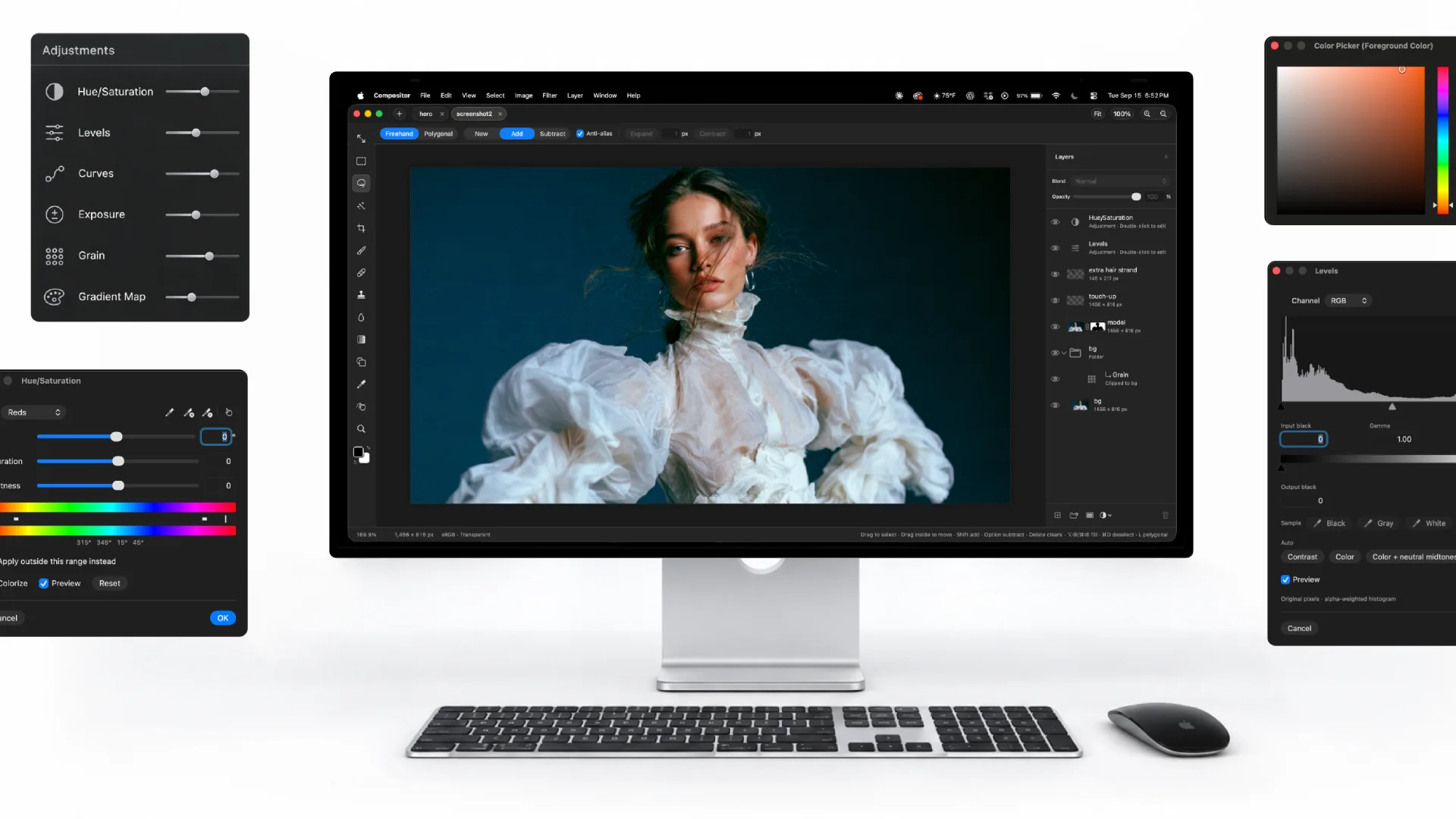

Photoshop costs more than a side project deserves, and GIMP never quite feels like home once your hands learned Photoshop first. Robbie Tilton built Compositor to close that gap for himself, then opened the source. It is a full image editor for macOS, built around the compositing and retouching work a designer actually does, and the license costs nothing.
What Compositor actually does
Compositor is a native macOS app, not a web wrapper and not an Electron shell. It needs macOS 26 or later on an Apple silicon Mac, and it ships as a signed, notarized build that updates itself. Inside is the editor you would expect from a Photoshop replacement: layers and folders, masks, adjustment layers, layer effects, a full selection toolset, retouching brushes, a Camera Raw panel, and a filter stack.
The README is blunt about why it exists. The author used Photoshop for compositing and post-processing, wanted to keep that workflow, and did not want to keep paying for it. Compositor answers that specific complaint. Keep the muscle memory, drop the subscription, and let anyone who wants more open the Xcode project and change it.
Why the Photoshop habit is hard to break
Free editors rarely fail on features. They fail on feel. The blend mode list sits in a different order, the shortcuts live somewhere else, and every small difference pulls you out of flow. That friction is why so many designers keep the paid app and complain about it instead of switching.
Compositor leans into the habit instead of fighting it. Blend modes follow Photoshop’s order, so a folder’s opacity dims everything inside it the way you remember. Keyboard shortcuts match Photoshop across the board, and the Keyboard Shortcuts panel in the Edit menu remaps any of them. Even the small things carry over. You can drag a number’s label to scrub its value, exactly as in Photoshop.
☞ The switch is cheap because the interface follows the conventions your hands already know.
Photoshop files and shortcuts still work
Compositor opens Photoshop PSD and PSB files at 8-bit RGB. Layers and folders stay editable, along with masks and blend modes. Fill shapes hold up too, along with simple horizontal text. Other vectors and vertical text come in as pixels. The app shows a conversion report before anything applies, so you see what will flatten before you commit to it.
CMYK is not supported, which rules Compositor out for print production. For screen work and image composites, the import path covers the files you get handed.
A project format AI agents can write
This is the part that matters most to anyone building with AI right now. A Compositor project, a .comp, is not a binary blob. It is a folder with a manifest.json and an images directory of PNG layer files plus optional mask PNGs. Anything that can write a file can build or edit that project, with no plugin layer standing between the agent and your layers.
Point an agent at the open project and it writes layers while you watch. Compositor reloads the canvas as the files change, usually within half a second. What comes back is a set of ordinary layers you can blend and mask, then paint on, not a frozen render. The README names Claude Code and Codex as the tools to try first, which tells you who it was built for.
That design turns an image editor into a target for an AI workflow. You generate a moody scene, a product composite, or a batch of variations without opening a dialog, then finish the details by hand. The interface that surrounds those images is its own job, and these AI agent UI design patterns cover that side.
What ships in the box
The feature list is long, so here is the short version:
- ❶ Layers and folders with the full set of Photoshop blend modes, masks included on both
- ❷ Adjustment layers for curves and levels, along with exposure and color balance, all editable at any time
- ❸ GPU-rendered layer effects for strokes and drop shadows, color overlays and glows, all editable later
- ❹ Non-destructive transform for moving, scaling, rotating or flipping a layer, with snapping to edges and centers
- ❺ Selections from marquee, lasso, a Magic Wand that samples color, and an Object tool that traces what you click
- ❻ Select Subject, plus Content-Aware Fill that can extend an image past its own edges
- ❼ Retouching brushes (Brush, Spot Healing, Clone Stamp) and shape tools (Gradient, Rectangle, Ellipse, Type), with text that stays editable
- ❽ A Camera Raw panel and a filter stack with live previews limited to the current selection
- ❾ Multiple projects in tabs, Search Commands on ⌘F, and a fullscreen mode that leaves the canvas alone on black
Import covers raster formats (JPEG, PNG, HEIC, TIFF, WebP), vector input (SVG), camera RAW and Photoshop files. Export gives you PNG or JPEG, or a one-page PDF at print size. Install takes one Homebrew command, and updates arrive on their own.
Limits to weigh before you install
Compositor is one person’s project, and the constraints are worth knowing before you move a real workflow onto it. It runs only on macOS 26 and newer, on Apple silicon. Intel Macs and Windows are out, and there is no CMYK path for print.
The app is English only, and the author is not accepting translation pull requests right now. He explains why in the README. One person maintaining it, every new string needing translation forever, and languages he cannot review. It is an honest answer, and it also tells you the scale of the project.
Photoshop and GIMP still have deeper ecosystems. Plugins and brushes, along with tutorials for those apps, run into the millions. Compositor gives you the core editor and the source code, and it expects you to bring your own learning curve.
Frequently asked questions
Is Compositor really free?
Yes. It is MIT licensed, so you can read and fork it, then ship it in personal and commercial work without paying a license fee. The source lives on GitHub, and the author takes new features as pull requests rather than as a subscription.
Can I open Photoshop files in it?
Yes, for 8-bit RGB documents. Layers and folders stay editable. So do masks and blend modes, along with fill shapes and simple horizontal text. Vertical text and complex vectors rasterize on import, and CMYK files do not open. A report shows the conversion before it applies.
Does it run on Intel Macs or Windows?
No on both. Compositor targets macOS 26 and later on Apple silicon. That limit buys a native build with direct access to the GPU for layer effects and live previews. If you are on Intel or Windows, this one is not for you yet.
What is a comp file?
A .comp is a project folder, not a single file. It holds a manifest.json describing the document and its layers, and an images folder with one PNG per layer plus optional mask PNGs. Open one in Compositor and the canvas updates live as those files change, which is what makes the format work for scripts and AI agents.
Why it belongs on your Mac
You want a compositing tool that respects your budget and your habits. Compositor gives you Photoshop-shaped layers and effects, plus the masks and the shortcuts, for free, in a native macOS build that keeps working while it saves. If the monthly bill on creative software has been on your mind, this is the same instinct behind dropping paid design tools.
The agent-readable project format is the piece that makes it more than a cheaper clone. It turns the editor into something an AI workflow can drive directly, which is rare in a category that still treats project files as black boxes. Grab the build from GitHub, point an agent at a .comp, and watch the layers arrive. When you want the interface around those images to match, our free Figma resources and design and code kits are built for the same fast, solo workflow.









.webp)