



Roman Kamushken
SEO Twitter declares guest blogging dead about every six months. Meanwhile, one guest post we published in Q1 2025 still pulls 121 organic clicks per month and shows up inside Google's AI Overview for the query "guest posting opportunities."
That gap between the discourse and the dashboard is why this article exists.
What follows is nine benefits, each attached to a number we tracked ourselves or a mechanism you can verify in your own Search Console. No recycled 2018 talking points about building relationships with influencers.
The audience here is specific: founders, SaaS marketers, and SEO managers deciding whether $200 to $2,000 per placement is money well spent. By the end you will know which benefits are real in 2026, which three situations burn budget, and how to vet a site before your card gets charged.
1. Compounding organic traffic that outlives paid ads
A guest post is an asset. A PPC campaign is a rental.
Our own guest posting opportunities post is the cleanest example we have. It brings 121 organic clicks and 19,180 impressions per month, and both numbers are still climbing 18 months after publish date.
Nothing was spent on that page after the day it went live. No retargeting, no bid adjustments, no creative refresh.
Compare that against Google Ads. The traffic curve on a paid campaign is a step function: you fund it, clicks appear, you stop funding it, clicks vanish inside 24 hours. There is no residual.
The flywheel works like this. The post ranks, ranking earns natural links from people citing it, those links push the ranking higher, and the higher ranking earns more citations. Every month the asset is worth slightly more than the month before.
☞ The correct way to price a guest post is not cost-per-link. It is cost divided by 24 months of projected traffic.
2. Referral traffic from readers who trust the host site
Rankings are the slow benefit. Referral clicks start on day one.
We send 383 referral sessions per month to the sites linked from setproduct.com. Those visitors did not search for the brand and did not see an ad. They were reading an article, hit a link that answered their next question, and clicked.
Context does the qualifying work. Someone reading about design system tokens who clicks through to a Figma plugin has already self-selected twice: once by choosing the topic, once by choosing the link.
That is why context-matched referral converts 5 to 10 times better than cold display traffic in our own funnel. The reader arrives mid-problem instead of mid-scroll.
Cold traffic needs convincing that a problem exists. Referral traffic from a trusted host arrives already convinced.
3. Google AI Overview citations, the new featured snippet
This is the benefit that did not exist when most guest posting advice was written.
Google's AI Overviews pull source citations from a small set of pages it considers reliable on a given query. setproduct.com currently holds 29 tracked AI Overview appearances. Every one of those is a slot where a brand mentioned in the article gets surfaced above the classic blue links.
Three things make a page AIO-eligible in our testing.
❶ Question-shaped H2s. Google matches the user's phrasing against your headings before it reads the body.
❷ Direct-answer paragraphs of 40 to 60 words placed immediately under those headings. Longer and the model paraphrases badly. Shorter and it skips you.
❸ Article schema with a named author and a publish date. Google documents its expectations for AI features in Search, and structured markup is the part you control fully.
Publishing on a domain that already earns AIO citations shortcuts the hardest part. The trust signal is borrowed, and your paragraph rides along inside it.
4. LLM training data and citations inside ChatGPT or Perplexity
GA4 now shows an AI Assistant traffic channel. That line was zero two years ago and is not zero anymore.
Language models build their sense of "which tools matter in this category" from the same corpus of trusted publications that Google indexes. Being named in an article on a domain those crawlers already respect puts your product into the recommendation set.
Ask Perplexity for the best Figma dashboard kits and it will name five products. Those five were not chosen by an algorithm reading your homepage. They were chosen by the weight of third-party articles mentioning them.
This is the least measurable benefit on the list and the one growing fastest. Treat it as a positioning play with a 12-month horizon, not as a channel you report on this quarter.
5. Faster time-to-live-link than manual outreach
Every link acquisition tactic has a hidden cost, and it is usually calendar time.
Broken-link building requires finding dead pages, building a replacement asset, and convincing a webmaster who owes you nothing. Realistic timeline: six to ten weeks per link, with a success rate under 10%.
HARO and its successors depend on a journalist choosing your quote. You can send 40 pitches and land two. Ahrefs has documented how thin the response rates get across link building tactics at scale.
Niche edits are faster but you inherit someone else's page, its age, and its existing link neighborhood. We broke that comparison down in guest posts vs niche edits.
A guest post has one negotiation, one editorial pass, and a publish date you can put in a spreadsheet. Two to four weeks, and you wrote every word.
6. Topical authority through associated context
Google evaluates the site around your link, not only the page holding it.
A link from a domain with 200 published articles about product design carries a signal that a link from a general lifestyle blog with one random tech post cannot replicate. The first says "this is what we cover." The second says "this was an outlier."
Think of it as neighborhood value. Your link inherits the semantic context of everything published nearby.
This has a practical consequence for site selection. A DR 60 general-interest site is frequently worth less to a SaaS brand than a DR 40 site that has covered nothing but SaaS for four years.
Relevance beats raw authority scores more often than most agency pitch decks admit.
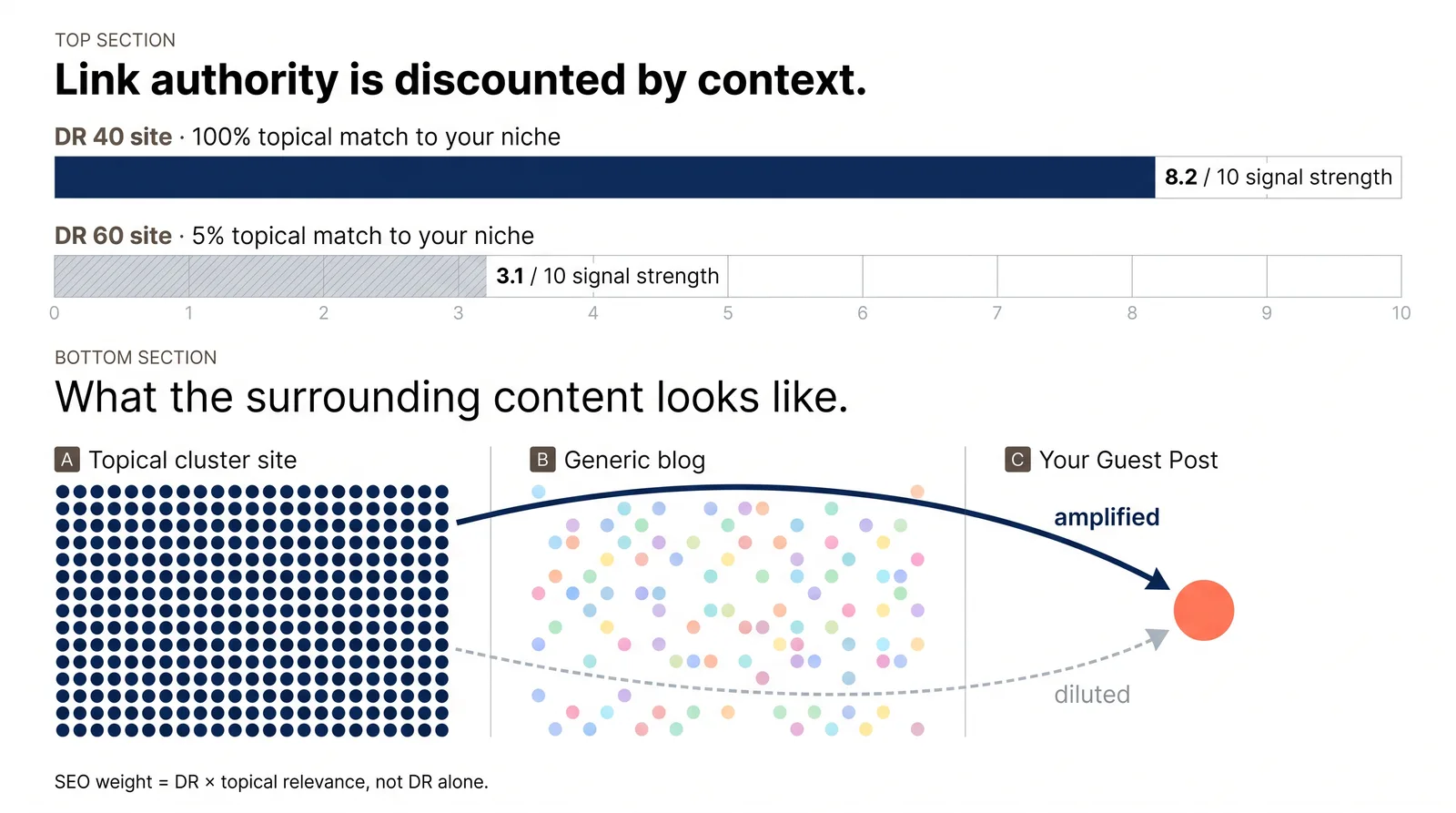
Read the bottom half of that chart carefully. A guest post surrounded by a dense topical cluster gets amplified. The same post dropped into a generic blog covering everything from crypto to gardening gets diluted before it reaches your domain.
7. Anchor text control that other tactics do not give you
You write the sentence, so you choose the anchor.
That matters more after the March 2026 spam updates tightened the penalty for unnatural anchor patterns. Google's link spam policies are explicit that links intended to manipulate rankings violate the guidelines, and exact-match anchors at volume are the loudest possible signal.
The safe pattern we use: roughly 70% branded or naked-URL anchors, 20% partial-match phrases, 10% exact-match commercial terms.
Over-optimization looks like five placements in one quarter all pointing at the same page with the same three-word commercial phrase. That pattern is trivially detectable and gets discounted.
☛ Editorial sites that let you dictate the exact anchor on every link are usually the sites with no editorial standards at all. A good editor pushing back on your anchor is a quality signal, not an obstacle.
8. Warm introduction to the host audience
Premium placements bundle distribution that has nothing to do with links.
A newsletter mention puts your name in front of subscribers who opted in and open the email. A social share from the host account borrows an audience that was built over years.
We call this borrowed distribution. The link is the durable part, and the launch-week spike is the part that makes the invoice feel worth it immediately.
Ask before you pay. Many sites include newsletter and social promotion in their higher tier and never mention it on the pricing page.
9. E-E-A-T signals for YMYL-adjacent verticals
Fintech, health-tech, and legal-adjacent SaaS live under harsher scrutiny than a design blog.
For those categories, a byline on a third-party site does something a company blog cannot. It separates the claim from the seller. An author page listing your name, credentials, and published work builds a verifiable trail that Google's quality raters are instructed to look for.
Two details make the difference. Insist that your byline links to a real author page rather than a generic "Staff" account. Ask whether that author page carries Person schema.
We built author pages into the setproduct.com blog for exactly this reason. A byline that resolves to nothing is a wasted placement.
When guest blogging does not work
Three situations where the money is gone before the invoice clears.
Sites with fake traffic. Bot-inflated analytics are cheap to buy and easy to spot if you know what to look for. Sessions with 100% bounce, zero scroll depth, and a traffic geography that does not match the language of the site.
PBN networks in disguise. A cluster of sites with the same theme, the same publishing cadence, and the same registrar, all linking to each other. Google has been deprecating these networks in bulk since 2023, and a link from a deindexed domain is worth exactly zero.
Sites that publish everyone. If there is no editorial gate, your article sits next to casino spam and offshore pharmacy content. The neighborhood argument from benefit six cuts both ways.
The test is simple. Ask what percentage of submissions they reject. A site that cannot answer has no answer.
How to evaluate a guest post site before paying
Seven checks, in the order we would run them.
❶ Real Google Analytics screenshot, not just an Ahrefs number. Ahrefs undercounts actual sessions by 3 to 4 times on most sites because it only models keywords it tracks. Ask for the GA4 acquisition report.
❷ Referring domains above 500. Below that threshold the site has not earned enough trust for its outbound links to carry weight.
❸ Google News inclusion. Check news.google.com/publications for the publisher. News inclusion means a human at Google approved the site.
❹ AI Overview appearances. Ahrefs and SE Ranking both track this now. Zero appearances on a site with real traffic suggests structural or trust problems.
❺ Domain age above three years. Domains registered last year with DR 50 bought that DR. The math does not work otherwise.
❻ Editorial rejection rate above 30%. Ask directly. The answer tells you whether you are buying placement or buying a listing.
❼ Public prohibited-topics list. Sites that publish their restrictions have thought about their neighborhood. Sites that accept anything have not.
Run these seven before the first payment, not after the third disappointing placement. We applied the same criteria when building our own guest article program for web development topics.
Google published its own guidance on what makes content perform in AI experiences on Search. Read it before you finalize a target list, because the criteria there overlap almost exactly with the seven above.
Frequently asked questions
Does guest blogging still work in 2026?
Yes, with a narrower definition of "works." Mass placements on low-quality sites stopped working around 2022. Editorial placements on topically relevant domains with real audiences still drive rankings, referral traffic, and AI Overview citations. Our own tracked posts confirm this 18 months after publication.
How much does a quality guest post cost?
Expect $200 to $2,000 per placement in 2026. Below $200 you are almost certainly buying a link farm listing. Above $2,000 you are paying for a brand name rather than measurable SEO value. Most sites worth using price between $280 and $900.
Do-follow or no-follow, which should you insist on?
Insist on do-follow for paid placements. A no-follow link still passes referral traffic and brand mentions, but it will not move rankings in any measurable way. If a site only offers no-follow, price the placement as advertising rather than as SEO.
How many guest posts should a startup publish per month?
Two to four for most early-stage companies. That pace builds a natural-looking link velocity without triggering pattern detection. Publishing 20 in one month and zero for the next five is the profile that gets discounted. Consistency beats volume every time.
Can guest posts hurt your SEO?
Yes, in three ways. Links from deindexed or PBN domains carry no value and signal bad judgment. Exact-match anchors repeated across placements look manipulative. Publishing on sites with no editorial standards associates your brand with whatever else they publish.
The compounding case, restated
Guest posting is not a link tactic anymore. It is a distribution asset that pays organic clicks, referral sessions, AI Overview slots, and LLM recommendations from a single publication event.
The post we cited at the top cost one afternoon of writing. It has returned 18 months of climbing traffic and continues to grow.
Everything depends on site selection. Run the seven checks, keep the anchor profile boring, and treat each placement as a 24-month asset rather than a monthly line item.
Setproduct passes its own checklist: DR 42, 11,000+ monthly readers, indexed in Google News, cited in 29 AI Overviews. Accelerate costs $288 with one do-follow link and a 3-day turnaround, Maximize costs $348 with two do-follow links and homepage placement. See our guest post plans before committing budget.