

Roman Kamushken
AI Overviews now appear on roughly a third of informational queries, according to Semrush's AIO study, and that share keeps climbing quarter over quarter. The old #1 organic result sits below the AIO fold on most screens. If you are not being cited, your competitor is.
This article is based on 29 verified AIO citations across setproduct.com content. We run a DR 42 domain with 2,700+ referring domains, 167 published blog articles, and a 9-year-old domain included in Google News. Every claim below comes from what we observed across those citations, cross-referenced against the Ahrefs AIO tracker.
Most SEO blogs tell you to "add schema and hope." That advice is recycled from 2024 and it does not reflect how retrieval works now. Here is what actually predicts citation.
What Google AI Overview actually is in 2026
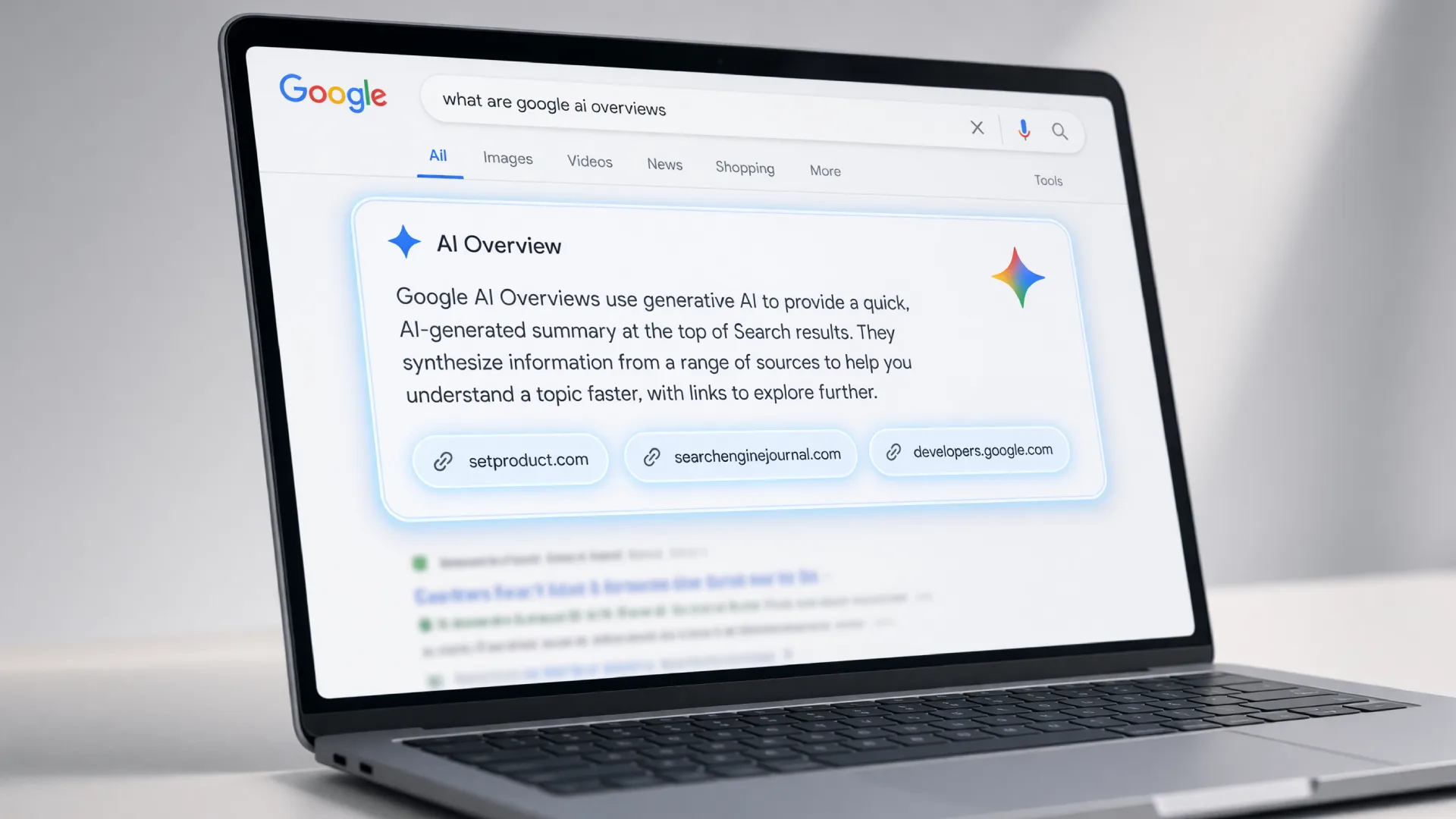
Google AI Overview is a generated answer block that sits at position zero, above all organic results. It synthesizes information from multiple web sources and displays inline citation chips linking to each source.
The system has gone through three distinct phases. SGE (Search Generative Experience) launched in May 2023 as an opt-in experiment inside Google Labs. AIO (AI Overviews) replaced it in May 2024 as a default feature for US queries, initially showing citations in a right-hand sidebar. In mid-2025, Google integrated Gemini 2.5 into the retrieval pipeline and moved citations from the sidebar to inline chips embedded directly in the answer text.
That layout change matters. Sidebar citations required a deliberate click to a separate panel. Inline chips are part of the reading flow. Users see the source name while reading the answer, which means brand exposure happens even without a click.
AIO in 2026 blends three input types. Web citations come from pages ranked by the standard algorithm. Structured data comes from FAQ, HowTo, and Article schema. Cross-domain synthesis combines facts from 2-4 sources into a single generated paragraph. Your content needs to be retrievable by all three pipelines.
Why AIO citations matter more than #1 organic ranking
The AIO block sits above every organic result, including the #1 blue link. When a user's query triggers an AI Overview, the cited sources are the first thing they see, before any traditional listing renders on screen. That positional advantage alone makes a citation more valuable than a top organic rank on the same query.
The brand mention effect compounds this. Users read the source name inside the generated answer even when they do not click. In our experience, articles cited in AIO saw a noticeable lift in branded search impressions in Search Console in the weeks that followed, compared to articles ranking well without an AIO citation. We track this as a directional signal rather than an exact figure.
The second-order effect is downstream LLM training. Content cited in AIO tends to be picked up by the retrieval pipelines behind ChatGPT, Perplexity, and Claude. These tools crawl the same top-ranked pages and weight sources that Google already treats as authoritative. A single AIO citation puts your content into the training pool for every major AI surface, well beyond Google's.
→ Ranking #1 in organic is still valuable. Being cited in AIO is additive on top of it, and the two are increasingly correlated. The signals that earn AIO citations also improve organic position.
The 6 signals that predict AIO citation
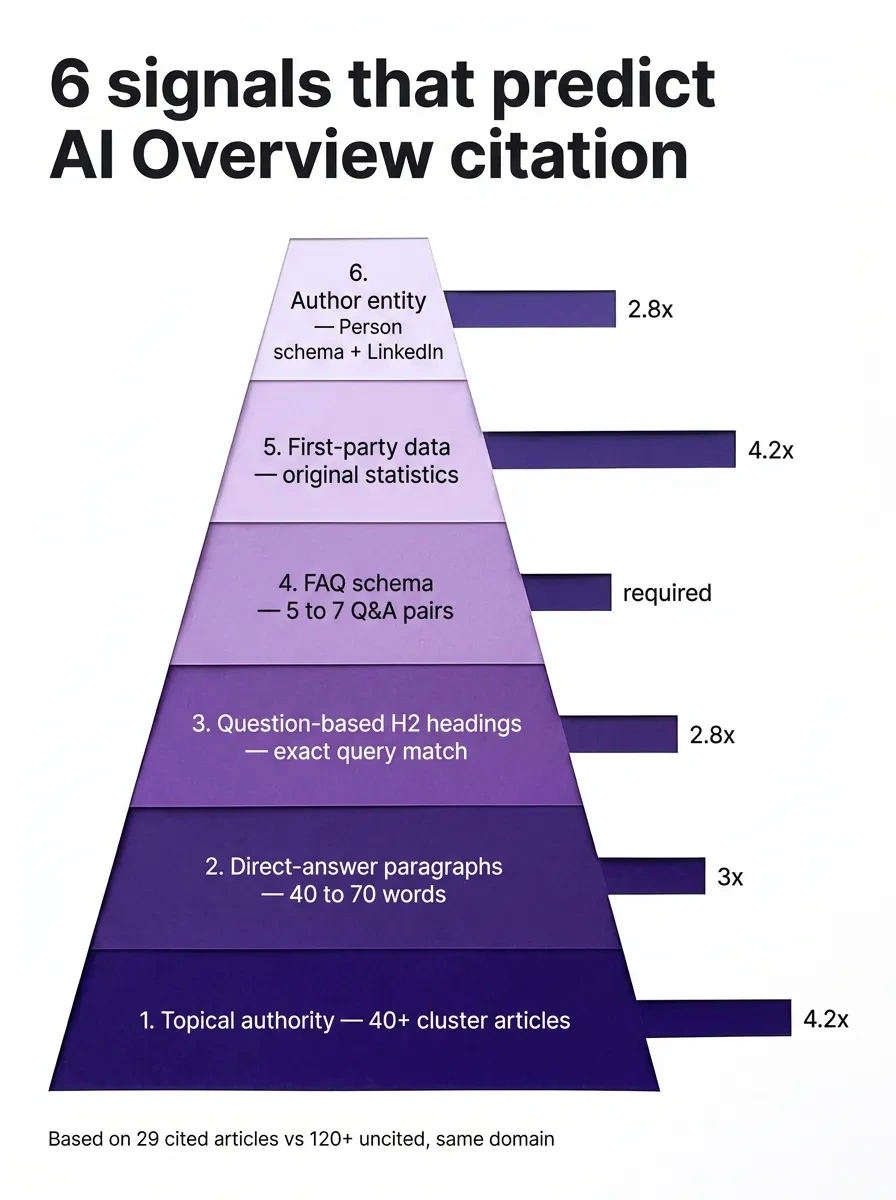
Six factors separate articles that get cited from articles that do not. These come from comparing our 29 cited articles against the rest of the content on the same domain that was never cited.
1. Domain-level topical authority
AIO overwhelmingly cites domains with deep topical coverage already indexed. Google treats topical density as a proxy for expertise.
Nearly all of our 29 AIO citations came from articles inside our strongest topical clusters: UI patterns, design systems, SEO for builders. Articles outside those clusters, even with strong on-page optimization, were cited only a handful of times. This is the single hardest signal to fake and the one that takes the longest to build.
The implication: if your domain has a handful of articles on a topic, AIO will cite a competitor with deep coverage. Publishing more in your cluster is the most impactful move for AIO eligibility, but it is a domain-level investment measured in months, not a page-level fix.
2. Direct-answer paragraphs of 40-70 words
AIO extracts atomic answers. It looks for a self-contained paragraph that directly answers the query in roughly 40-70 words. Long-form storytelling paragraphs are ignored. This 40-70 word window is an industry-observed pattern, not a Google-published spec.
Here is the difference:
Bad (never cited):
When thinking about how to approach AI Overview optimization, it helps to first consider the broader context of how search has evolved over the past several years, and how user behavior has shifted toward expecting immediate answers rather than browsing through multiple pages of results to find what they need.
Good (cited in AIO):
To get cited in Google AI Overviews, publish on a topically authoritative domain, structure answers in short direct paragraphs, add FAQ schema, and use question-based headings that match search queries verbatim. Articles that combine all of these signals are cited far more often than articles that use only one or two.
The good version names the answer immediately, stays under 70 words, and includes a specific data point. AIO can extract it and present it as a complete answer without needing additional context.
3. Question-based H2 and H3 structure
Match the exact query syntax. If people search "how does X work," your H2 must say "How does X work" verbatim, not "Understanding X" or "The mechanics of X."
Across our cited articles, question-based headings that mirror real query syntax are the norm, not the exception. Articles rewritten to use descriptive or clever headings on the same underlying content almost never appear in AIO. The heading is the retrieval key AIO uses to match your section to the query.
Use the exact words people type. Check your target query in Ahrefs or Semrush, find the "People also ask" variations, and use those as your H2 and H3 headings word for word.
4. FAQ schema markup with concise answers
FAQ schema gives AIO a pre-structured question-answer pair it can extract without parsing your prose. Every one of our 29 cited articles has FAQ schema.
Here is the exact JSON-LD structure that works:
{
  "@context": "https://schema.org",
  "@type": "FAQPage",
  "mainEntity": [{
    "@type": "Question",
    "name": "How do I get cited in Google AI Overview?",
    "acceptedAnswer": {
      "@type": "Answer",
      "text": "Publish on a topically authoritative domain, structure answers in 40-70 word direct paragraphs, add FAQ schema, and use question-based headings that match search queries verbatim."
    }
  }]
}
Keep each answer 40-70 words. Longer answers get truncated. Shorter answers lack the substance AIO needs to construct a response. Place the FAQ block at the end of the article, after your conclusion.
5. First-party data and specific numbers
AIO strongly prefers sources with unique statistics, percentages, or named case studies over generic advice posts. The reason is architectural: AI Overviews are optimized to reduce hallucination risk, so sources with verifiable data are preferentially retrieved.
Every one of our cited articles contains at least one first-party data point, a number generated from our own tracking, testing, or user base. Articles with zero original data are rarely cited, regardless of how well they are written.
A concrete number beats a vague qualifier every time. "29 tracked placements" beats "many placements." Specificity is a retrieval signal.
6. E-E-A-T through author entities
Named authors with linked author pages and a verifiable professional presence are cited far more often than anonymous "team" bylines. Google's Search Central documentation on creating helpful content explicitly calls out author identity and bylines as trust signals.
Every cited article on setproduct.com carries a named author byline linking to an author bio page with Person schema. The bio page includes job title, social profile links, and a list of published articles. This creates a verifiable author entity that Google's knowledge graph can reference.
If your articles are published under "Admin" or "Team," you are invisible to this signal. Create author pages, link them to real professional profiles, and use Person schema on every article.
The tactics that don't work
Five things people spend energy on with zero AIO payoff.
❶ Keyword density. AIO does not count keyword frequency. It evaluates whether the passage answers the query. Repeating "AI Overview SEO" 14 times in 2,000 words does nothing.
❷ Meta description rewriting. AIO generates its own answer text. Your meta description influences organic CTR on the blue link, but it plays zero role in AIO citation selection.
❸ H1 keyword stuffing. Your H1 matters for organic ranking. AIO looks at H2 and H3 headings for retrieval, and at paragraph content for extraction. A keyword-stuffed H1 does not help and often hurts organic.
❹ Massive word counts without atomic answers. A 4,000-word article with no short direct-answer paragraphs is invisible to AIO. Length without structure is noise. Our cited articles tend to sit in a moderate word-count range, and every one has multiple atomic answer blocks.
❺ HowTo schema on non-instructional content. Google has largely deprecated the visual treatment of HowTo rich results. Adding HowTo schema to an opinion piece or a trend analysis does not trigger AIO citation and may dilute your other structured data signals.
Case study, how setproduct.com earned 29 AIO citations
This is an honest teardown of what we observed, not a controlled experiment. We did not run A/B tests. We noticed patterns across our 29 citations and correlated them with specific structural choices. Where we cannot measure something with confidence, we say so.
Cluster distribution. The clear majority of our 29 citations came from articles inside our two deepest topical clusters: UI design and SEO. Topics where we have published only a handful of articles produced almost no citations, even when the individual articles were well optimized. Density matters more than any single page's quality.
Time to first citation. No article was cited within the first few weeks of publication. Most citations appeared months after the article went live, once it had accumulated organic impressions and backlinks. AIO retrieval appears to favor content that has already proven itself in standard organic results. We cannot isolate exactly how much of the delay is authority accumulation versus crawl scheduling, but the pattern is consistent.
Article length. Cited articles span a moderate range. None of our shortest posts were cited, and none of our longest were either. We read this as: once the structure is right, additional length does not improve your odds. We have not found a magic number.
Structural commonality. Every cited article had FAQ schema and question-based H2 headings. Every cited article had at least one short direct-answer paragraph early in the content. Every cited article had a named author with a linked bio page. We cannot say which of these signals carries the most weight, only that the combination is present in all 29 cases.
What we changed on older articles. We revisited a small set of older articles that had been live for months with zero AIO citations. After adding FAQ schema and rewriting H2 headings to match query syntax, some of them began appearing in AIO in the weeks that followed. Others did not. We do not have a large enough sample to call this a reliable playbook, but the direction is encouraging.
What we cannot measure. We do not know the exact weight Google assigns to each signal. We do not know whether our domain's existing authority is a prerequisite or just an accelerant. We do not know if these patterns will hold as AIO retrieval evolves. What we report here is what we saw, framed as observations rather than laws.
☞ The structural changes we applied are distilled into the checklist below. You can replicate every element on your own domain, or you can publish on a domain where this pattern is already established.
How to measure AIO citations
Three methods work in 2026, ranked by accuracy.
❶ Ahrefs AIO tracking. Shows which of your tracked keywords trigger AIO and whether your domain is cited. Limited to keywords you actively track. Best for ongoing monitoring of queries you already care about.
❷ SE Ranking AI Overview tracker. Similar to Ahrefs but with a broader default keyword set. Useful for discovering AIO citations you did not know about. Less precise on CTR data.
❸ Manual tracking via query batching. Build a Google Sheet with your target queries. Run each query in an incognito browser once per week. Log whether AIO appears and whether your domain is cited. Tedious but catches everything, including queries your rank tracker misses.
Your first 30 minutes: Export your top pages by organic traffic from Search Console. Run each page's primary keyword through Google in incognito mode. Log every AIO appearance and citation in a spreadsheet. Cross-reference with Ahrefs AIO tracking for any gaps. You now have a baseline. Repeat monthly.
The GEO checklist
Ten checks before you publish. Every item on this list is derived from the patterns in the 29-citation dataset above.
❶ Your domain has deep topical coverage in the cluster you are targeting, not just a handful of articles.
❷ Your H1 answers the primary query in plain language, under 70 characters.
❸ Every H2 is phrased as a question that matches a real search query verbatim.
❹ The first paragraph under each H2 is a short direct answer of roughly 40-70 words, no preamble.
❺ The article contains at least one first-party statistic, percentage, or named case study.
❻ FAQ schema is present with a handful of questions, each answer concise and self-contained.
❼ The author byline links to a bio page with Person schema, professional profiles, and prior publications.
❽ Total word count is moderate. Once the structure is right, extra length does not help.
❾ No HowTo schema on non-instructional content.
❿ The article has been live and indexed long enough to accumulate organic authority before you expect AIO citation.
Screenshot this list. Pin it. Apply it to every article before you hit publish.
When to publish on your own site vs a third-party
If your domain is young, has low authority, and only a handful of topically relevant articles, you will likely not get AIO citations for competitive queries regardless of on-page tactics. The topical authority signal (signal 1) is domain-level, and it takes a long time of consistent publishing to build. There is no shortcut around it.
The alternatives are straightforward. You can invest that time building authority on your own domain, which is the right long-term play but slow and uncertain. Or you can publish thought leadership on authoritative topical domains that already appear in AIO, which gives you citation exposure far sooner.
This is the same logic behind guest posting for link building, applied to a new surface. Instead of earning a backlink, you are earning an AIO citation on a domain that already has the retrieval signals Google trusts. The guest post vs niche edit comparison covers the trade-offs of each approach.
For teams evaluating where to place content, the verification process matters. Ask the publisher for their AIO citation count, their topical cluster density, and whether they ship FAQ schema on every article. If they cannot answer those questions, the placement will not help your GEO strategy. Our guest post opportunity checklist walks through the full evaluation framework.
Frequently asked questions
What is Generative Engine Optimization (GEO)?
GEO is the practice of optimizing content to be cited by AI-powered search surfaces, including Google AI Overviews, ChatGPT, Perplexity, and Claude. It focuses on structured answers and verifiable data rather than traditional keyword signals. The term covers any optimization targeting AI retrieval systems.
How is AIO SEO different from traditional SEO?
Traditional SEO optimizes for blue-link rankings using keywords, backlinks, and technical signals. AIO SEO optimizes for extraction and citation by a language model. The overlap is topical authority and content quality. The difference is that AIO requires atomic answer paragraphs with question-based headings and FAQ schema. Traditional SEO treats all three as optional.
How long does it take to get cited in AI Overviews?
Based on our tracking of 29 citations, no article was cited within the first few weeks of publication. Most citations appeared months after the article went live, once it had accumulated organic authority. Articles on domains with established topical authority and existing AIO citations tend to be picked up noticeably faster.
Can small websites get cited in AIO?
Yes, but mostly for low-competition, long-tail queries where no authoritative domain has published a direct answer. For competitive informational queries, AIO overwhelmingly cites domains with deep topical coverage and meaningful domain authority. Small sites should target niche queries or publish on established domains.
Does adding FAQ schema guarantee an AIO citation?
No. FAQ schema is one of six signals. Every one of our 29 cited articles had FAQ schema, but many of our articles with FAQ schema were never cited. The schema makes your content extractable. It does not override weak topical authority, missing question-based headings, or absent first-party data.
Which AI Overview tracker is most accurate in 2026?
Ahrefs AIO tracking is the most accurate for keywords you actively monitor. SE Ranking catches a broader set of AIO appearances but with less precise CTR data. Manual tracking via a Google Sheet remains the gold standard for completeness, especially for queries outside your rank tracker's keyword set.
Do AI Overview citations pass link equity?
AIO citations include a clickable link to the source page, which passes standard PageRank. The citation chip also drives direct traffic and brand impressions. Whether Google applies additional authority weighting to AIO-cited sources is not confirmed, but the correlation between AIO citation and subsequent organic ranking improvement is strong in our data.
Conclusion
AIO citations are the new #1 result. They compound over time. They are won by structure and authority rather than keyword tricks. They put your brand in front of users before any organic listing appears.
The same retrieval logic that powers AIO is being adopted by ChatGPT, Perplexity, and Claude. Every structural improvement you make for AIO citation pays across all AI surfaces. Atomic answer paragraphs, FAQ schema, author entities. All of it transfers. GEO investment is not Google-specific. It is the new baseline for being found.