



Roman Kamushken
A white label SEO reseller program lets your agency sell SEO under its own brand while a vendor handles delivery. You set the price and keep the client relationship. You also keep the gap between what you charge and what you pay. It pays off when you can sell faster than you can hire, and it hurts when you cannot control the work.
TL;DR
→ You sell and the vendor delivers, while your brand sits on everything the client sees.
→ Markup is where the business lives. Typical agency markup on white label SEO runs around 2.5x to 3x the vendor cost.
→ Outsource the repeating production. Keep strategy and pricing in house, and own the client relationship.
→ Vet a program on white-label depth and support speed, then check who owns the accounts and the data.
How a white label SEO reseller program works
Three parties sit in the model. The client buys SEO from you and never sees the vendor's name. Your agency owns the contract and the relationship. The vendor supplies the audits and the content, and sometimes the whole campaign, depending on what you buy.
The split matters more than the tooling. You control strategy and pricing, and you own communication. The vendor controls execution. When that line blurs, clients start to wonder who is really doing the work, and margin leaks out of the account.
Most programs sell in one of two shapes. A managed retainer covers a monthly bundle of work, usually a report plus some on-page fixes and links. A per-task model bills each job alone, so you buy links by the placement or content by the article. Managed retainers are simpler to resell. Per-task models give you finer control over cost when you already deliver part of the work.
If you have not chosen a supplier yet, our white label SEO platforms comparison walks through six options and the trade-off between a full platform and a lighter reseller program.
The margin math
Your margin is what the client pays minus what the vendor charges, minus the hours you spend on the account. The first two numbers are easy to see. The third is where agencies quietly lose money, because account management is real work that few people bill for.
Typical agency markup on white label SEO runs around 2.5x to 3x the vendor cost. Local retainers sit at the low end, and link building sits at the top, because the client is buying judgement as much as output.
| Service level | Vendor cost (typical) | What you charge (typical) | Markup |
|---|---|---|---|
| Local SEO retainer | $400 to $800 per month | $1,000 to $2,000 per month | 2.5x |
| On-page and content | $750 to $1,500 per month | $2,000 to $4,000 per month | 2.7x |
| Link building | $1,000 to $2,000 per placement | $3,000 to $6,000 per placement | 3x |
| Full-service retainer | $1,500 to $3,000 per month | $4,000 to $9,000 per month | 2.7x to 3x |
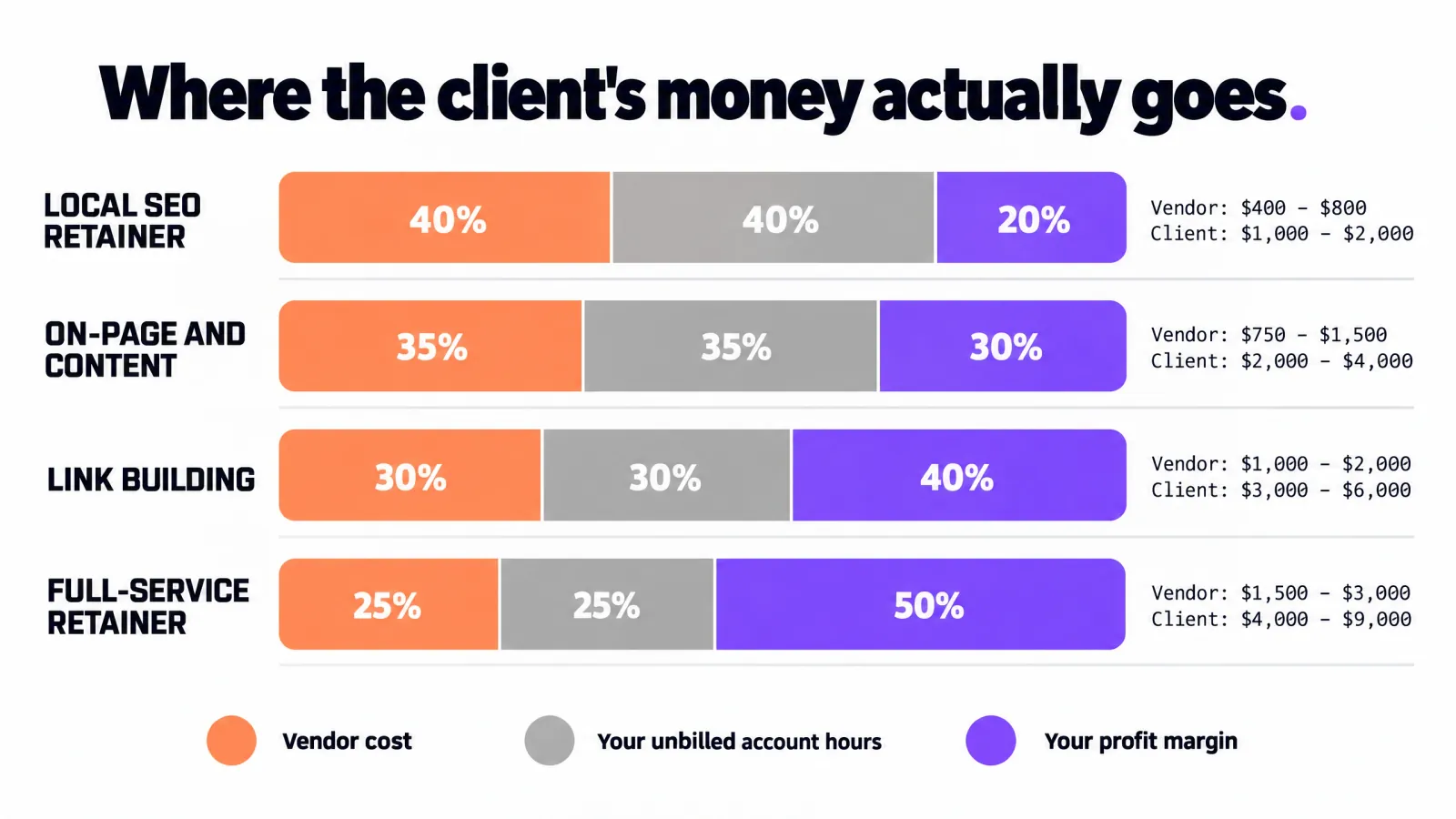
Treat these as working ranges and adjust them for your market. Real pricing moves with the niche and the competition for the client's keywords. It also moves with how much of the work you keep in house.
Compare that against hiring. A reseller book of ten clients costs a typical $4,000 to $12,000 per month across vendors, depending on the service mix. Local retainers sit at the low end, and full-service retainers push toward the top. One in-house specialist covers 3 to 5 accounts, so ten accounts need 2 or 3 hires, which runs a typical $8,000 to $21,000 per month once you add salary and taxes to the tool costs. At the low and mid mix the reseller route costs less, and it carries no payroll at any tier. Hiring wins when you want deep control over a few large accounts.
☛ Two costs kill margin faster than anything else. One is scope creep, where a client asks for one more page or one more campaign and nobody reprices. The other is churn, because onboarding a new client costs the same whether the last one stayed for three months or three years.
What to outsource and what to keep in house
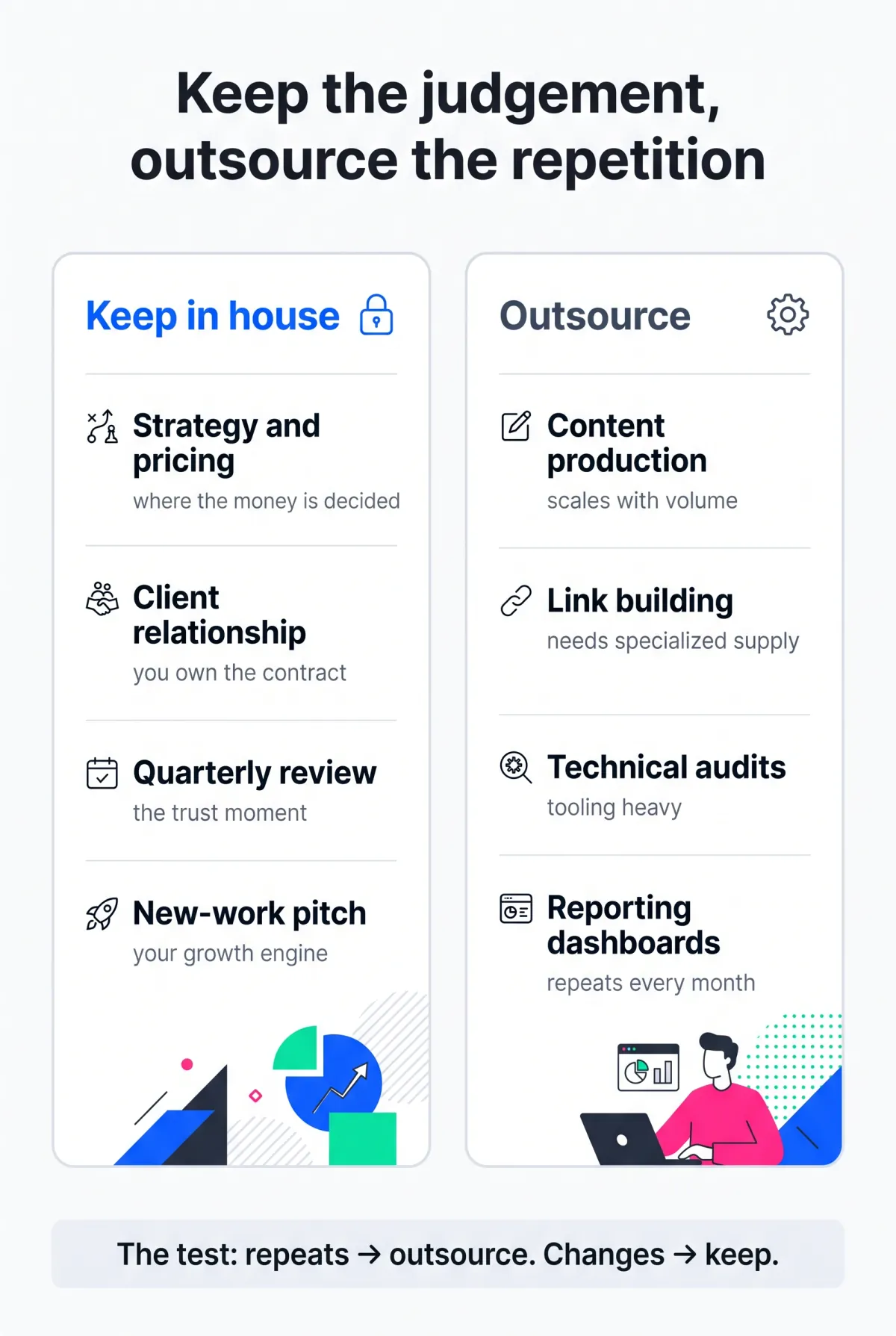
Outsource the work that scales with volume and needs specialized tools. Content production and link building fit, and so do technical audits. Rank tracking and reporting dashboards scale the same way, and a good vendor pays for itself on the first client. For the link layer, some agencies resell a supply like Setproduct's guest posting service and keep the placements branded to themselves. Our guide to guest posts vs niche edits covers what each link type costs and where the risk sits.
Keep these in house instead:
→ Strategy and pricing.
→ Account management and the client relationship.
→ The quarterly review and the pitch for new work.
A useful test sits behind that list. If a task repeats the same way for every client, outsource it. If it changes with the client's goals, keep it. That line keeps your delivery honest and your margins predictable.
If the tool layer is the part you want to rebrand, our guide to white label SEO tools covers what to resell and what to build in house.
How to vet a reseller program
Seven questions separate a program you can resell for years from one that embarrasses you in month two.
- White-label depth. Does the vendor disappear, or does its name still appear in emails or on the dashboard?
- Branded reporting. Can clients receive reports with your logo and colours on your own domain?
- Support and response time. Ask for the actual SLA. A program that answers in two days will leave you answering angry clients.
- Delivery speed. How fast does work go live, and what happens when a deadline slips?
- NDA and non-solicitation. Will the vendor stay away from your clients and keep your list private?
- Entry threshold. Is there a minimum spend or a setup fee, and does it fit a small book of clients?
- Account ownership. Who owns the analytics and the backlink data if you leave? And who owns the content? Get this in writing.
☞ If a vendor dodges question seven, treat it as a no. Data you cannot export is not yours to keep.
Risks
Four risks are worth naming before you sign anything.
Loss of control. The vendor sets the pace on delivery. When a client grows impatient, the pressure lands on you.
Cannibalization. Some vendors also sell direct. If their marketing targets your city or your niche, you are paying to build a competitor.
Vendor dependence. Once your reporting and links route through one partner, and the content sits in their system, switching costs weeks of lost work and a shaky month for the client.
Margin compression. Vendors raise prices. Clients resist raises. If you are not watching both, the gap between them closes and the account stops being worth it.
Quality belongs on that list too. Search engines judge the client's site on the links and content you ship, so weak supply is a risk your agency owns. Google's starter guide is a plain reminder of what actually earns rankings.
None of this means avoid the model. It means vet the exit before you need it.
Frequently asked questions
What is a white label SEO reseller program?
It is an arrangement where a vendor delivers SEO work while your agency sells it under its own brand. Your clients deal with you and pay your invoices. You keep the difference between your price and the vendor's cost. The vendor stays invisible unless you choose to name it.
How much can an agency mark up white label SEO?
Typical markup runs about 2.5x to 3x the vendor cost. Local retainers sit near 2.5x, and link building reaches 3x, because it carries more judgement. Your real margin is lower once you subtract the hours you spend managing the account.
What is the difference between a reseller program and a platform?
A platform usually bundles tools and delivery in one system, with reporting on top, so it covers more of the stack. A reseller program tends to focus on rebranding and reselling, sometimes with lighter tooling behind it. Platforms cost more and hide less work. Reseller programs suit agencies that already deliver part of the job.
Where can I find a good SEO reseller program?
Start with vendors that publish their pricing and show a branded report demo before a sales call. Ask for two current agency references and a sample client report. If a vendor will not show you the white-label output up front, keep looking. Our white label SEO platforms comparison lists six options with their trade-offs.
Can a small agency resell SEO without hiring?
Yes, and small agencies are the model's main audience. You sell SEO from day one and let the vendor deliver, then bring functions in house as revenue grows. Start with one provider and one service. Add a second only once you know which part you want to own yourself.
Resell SEO without carrying the payroll
White label SEO lets a small agency sell like a larger one without building the team first. The model works when you keep strategy and the client relationship, and hand off the production that repeats. Pick a vendor on white-label depth and exit terms, price with a real markup in mind, and watch the hours nobody bills.
If link building is the part you plan to resell first, Setproduct's guest posting service is built for agencies that need placements under their own brand. Publish with Setproduct to see how it works, and our guide to guest posting opportunities covers where to buy placements and what they cost.