

Stephen Green
The way designers find and use creative assets has changed dramatically over the past two decades.
When VectorStock launched in 2007, digital design was dominated by desktop applications, traditional keyword searches and downloadable stock graphics. Designers typically searched external marketplaces, downloaded artwork and manually imported files into their projects.
Today, artificial intelligence, natural-language search and cloud-based design platforms are transforming those workflows.
For VectorStock, a New Zealand-based company that has spent nearly 20 years building one of the world's largest dedicated vector graphics marketplaces, these changes represent an opportunity to rethink how stock content is discovered and used.
Its recent introduction of AI-powered semantic search and a dedicated Figma plugin illustrates how an established creative marketplace is adapting to a new generation of design tools.
Building a specialist vector marketplace
Founded in Auckland, New Zealand, in 2007, VectorStock Media Limited launched VectorStock.com with a clear focus: building a marketplace dedicated entirely to vector graphics.
Unlike general stock platforms offering photography, video and audio, VectorStock concentrated on scalable digital artwork.
Vector graphics are particularly valuable in professional design because they can be resized without losing quality, making them suitable for branding, illustration, user interfaces, packaging, websites and merchandise.
Over nearly two decades, VectorStock expanded its collection through a global community of independent contributors.
By 2026, the marketplace had grown to more than 51 million vector graphics from over 55,000 contributors, spanning icons, illustrations, backgrounds, patterns, templates and commercial artwork.
But the growth of digital content introduces a fundamental challenge: how do users find exactly what they need among millions of possibilities?
For much of the stock media industry's history, the answer was keywords. That approach is now evolving.
From keyword search to AI-powered discovery
Traditional stock marketplaces depend heavily on metadata. An illustration might be tagged with words such as "business", "technology", "abstract" or "background", allowing search engines to match those terms with a user's query.
While effective for straightforward searches, keyword-based discovery struggles with more descriptive creative ideas.
A designer looking for "a playful hand-drawn illustration for a sustainable children's clothing brand" may struggle to find suitable artwork when those exact words don't appear in the image's metadata.
The problem is that designers think in visual concepts, while traditional search engines often operate through individual keywords.
In 2026, VectorStock introduced a new AI-powered semantic search system designed to address this limitation.
Instead of relying exclusively on traditional keyword matching, semantic search uses machine-learning technology to interpret the meaning behind descriptive queries and connect them with relevant visual content.
Designers can now search using natural phrases such as:
- "Vintage-style hand-drawn Christmas decorations"
- "Minimalist botanical illustrations for sustainable packaging"
- "Modern 3D UI landing page website concept"
- "Cute hand-drawn birthday icons"
- "Nature-inspired web page design templates"
The objective is simple: move from matching keywords to understanding creative intent.
This reflects a broader transformation in search technology, where AI increasingly connects natural language with visual information.
For a marketplace with more than 50 million graphics, making existing content easier to discover may be just as important as continuing to expand its collection.
Why better discovery matters more than library size
For years, stock graphics platforms competed partly on the size of their collections.
Larger libraries meant more choice, more styles and a greater likelihood of finding suitable artwork.
But as collections grow, navigating them becomes increasingly difficult.
A library containing millions of graphics is only valuable if users can efficiently find the right ones.
This challenge has become even more significant with the emergence of generative AI, which has accelerated the production of digital imagery.
The creative industry is no longer facing a shortage of visual content. Instead, it increasingly faces the challenge of organising, evaluating and discovering an enormous supply of artwork.
VectorStock's investment in semantic search reflects this shift.
Rather than focusing exclusively on adding more designs, the company is developing technology to help users navigate its existing collection more intelligently.
It represents a change in the role of a stock graphics marketplace: from being primarily a repository of downloadable artwork to becoming an AI-assisted visual discovery platform.
Bringing a 19-year-old graphics library into Figma
Search technology is only one part of VectorStock's evolution.
Another major change in creative software is the growing demand for integrated workflows.
Modern designers increasingly expect external resources to be available inside the applications they already use.
Figma has become an important platform for UI/UX design, product development, prototyping and collaboration. Its plugin ecosystem allows designers to access specialised tools and resources without leaving their working environment.
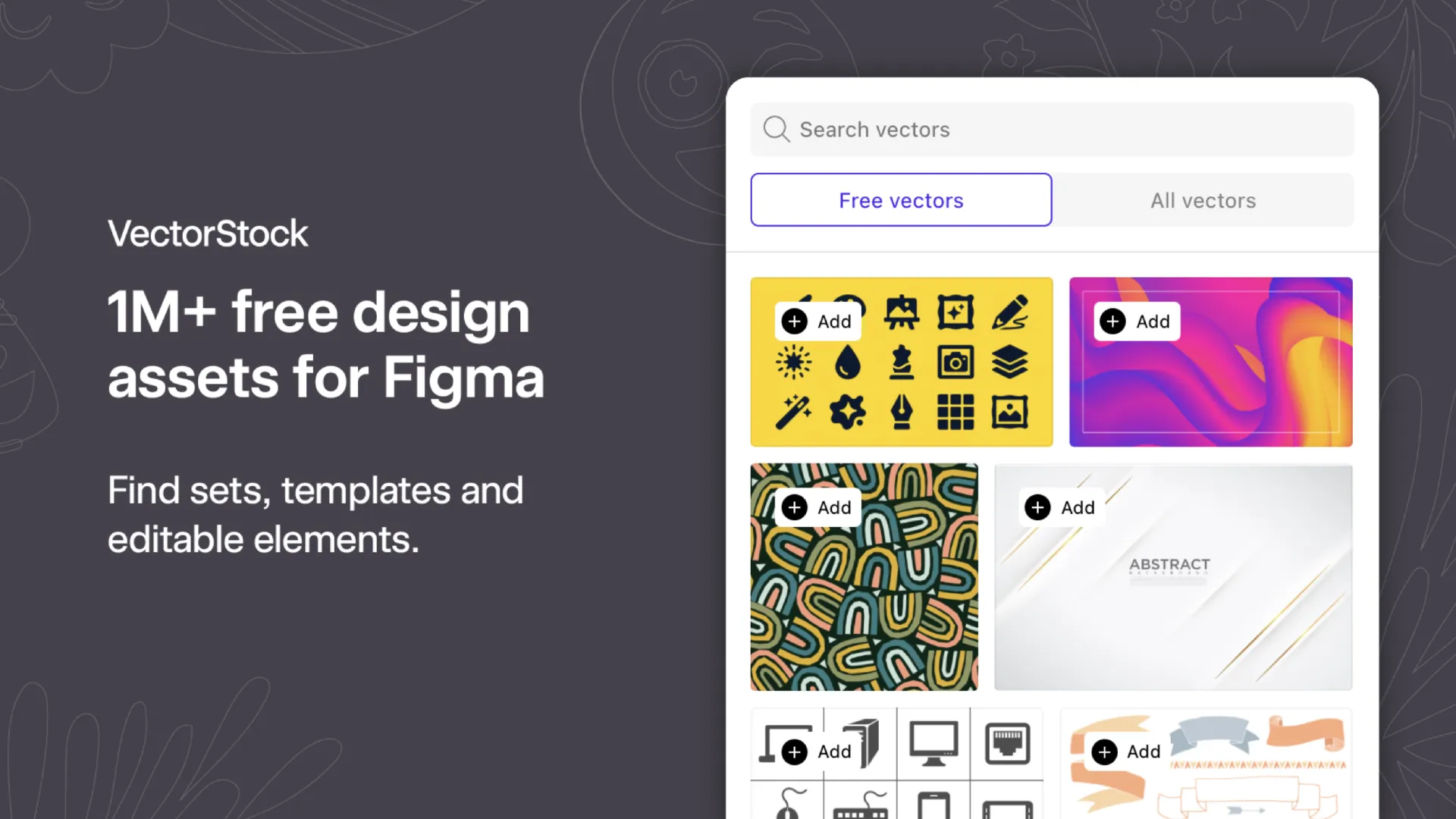
In 2026, VectorStock launched its dedicated VectorStock Figma Plugin, connecting its extensive graphics library directly with the Figma workspace.
The plugin enables designers to search VectorStock's collection and insert editable SVG artwork into their projects without the traditional process of visiting an external website, downloading files and importing them manually.
It also incorporates VectorStock's AI-powered semantic search capabilities.
For example, a designer building a wellness application can search for "soft organic illustrations for a meditation app", explore relevant results and bring vector graphics directly into Figma.
The integration is particularly useful for website concepts, user interfaces, landing pages, illustrations and digital products.
More importantly, it reflects a strategic shift.
Rather than relying entirely on designers visiting VectorStock.com, the company is bringing its content directly into the creative applications where designers already work.
The plugin is available through the Figma Community.
Why vector graphics still matter in an AI-generated world
Generative AI has raised questions about the future of traditional stock media marketplaces.
If designers can generate images using text prompts, why search for existing artwork?
The answer partly comes down to editability, consistency and creative control.
While AI-generated imagery can be useful for inspiration and visual experimentation, professional design frequently requires precise shapes, scalable graphics, consistent colours and artwork that can be modified.
Vector formats such as SVG remain particularly valuable.
An icon used in a mobile application may need to match specific dimensions and stroke widths. An illustration may need recolouring to suit an established brand identity. Packaging artwork must often be reproduced at different sizes without losing clarity.
These requirements are not always easily achieved with generated raster imagery.
VectorStock's approach combines AI-assisted discovery with a library of reusable, editable vector artwork.
Rather than using artificial intelligence solely to generate new images, the company is applying AI to make existing creative assets more accessible.
This represents an important distinction: AI as a tool for discovery and productivity, rather than simply a replacement for human-created design.
Balancing AI-generated and human-created content
The rapid expansion of generative AI has also introduced new challenges for stock marketplaces.
Large volumes of automatically generated imagery can create concerns about originality, quality, discoverability and user trust.
VectorStock has responded by introducing separate controls for AI-generated artwork, allowing users to exclude AI-created content from their search results.
The company also places limits on generative AI submissions from contributors.
This approach recognises that different designers have different requirements.
Some users actively embrace AI-generated visuals, while others prefer artwork produced by human illustrators.
For commercial applications, the origin, quality, editability and licensing of creative assets can be as important as visual appearance.
Giving users control over the types of artwork they discover is becoming an increasingly important part of operating a modern stock graphics marketplace.
The challenge is not simply whether to include AI-generated content, but how to incorporate it while preserving the value of established contributor communities.
Beyond the website, the future of creative marketplaces
VectorStock's evolution also reflects a broader change in how creative assets are distributed.
Historically, stock marketplaces were destinations. Users visited a website, searched for content, purchased a licence and downloaded a file.
Today, creative assets can be discovered through search engines, software integrations, plugins and third-party applications.
VectorStock has been expanding into these environments through its Image API, which enables external platforms to integrate its graphics collection into their own products.
These integrations are especially relevant to design software, personalisation applications and print-on-demand platforms, where users need access to editable, production-ready artwork.
The Figma plugin demonstrates the same underlying direction: bringing content closer to the point where creative work happens.
For established marketplaces, this changes how their collections can be used.
Instead of functioning solely as websites that sell individual downloads, they can increasingly operate as content infrastructure supporting a wider ecosystem of creative applications.
What VectorStock's evolution tells us about the future of design
VectorStock's transition provides an example of how an established internet business can adapt to a rapidly changing technology landscape.
Founded in 2007 as a specialist vector graphics marketplace, the company has retained its focus on scalable artwork while investing in new approaches to discovery and distribution.
AI-powered semantic search is changing how designers find images. Collaborative design platforms such as Figma are changing where creative work takes place. Software integrations are reducing the distance between content libraries and the tools designers use.
Together, these developments suggest that the future of stock graphics may depend less on the size of a collection and more on how intelligently and seamlessly it can be accessed.
For designers, the benefits are practical: more intuitive discovery, fewer workflow interruptions and easier access to editable creative resources.
For content marketplaces, the implications are more fundamental.
The next generation of stock graphics platforms may no longer function primarily as websites where users search and download files. Instead, they may become integrated creative resources, delivering content directly inside the applications where design work happens.
VectorStock's combination of a specialist graphics library, AI-powered search and Figma integration provides a clear example of that transition.
About VectorStock
VectorStock is a specialist stock vector graphics marketplace operated by VectorStock Media Limited, founded in Auckland, New Zealand, in 2007.
The platform offers more than 51 million vector graphics from a global community of over 55,000 contributors, including illustrations, icons, backgrounds, patterns, templates and commercial design assets.
In 2026, VectorStock introduced AI-powered semantic search and expanded its creative software integrations, including the VectorStock Figma Plugin.
Website: https://www.vectorstock.com/
Figma Plugin: https://www.figma.com/community/plugin/1661252995866842613/vectorstock-50m-editable-vectors-svgs
Frequently asked questions
What does the VectorStock Figma plugin do?
It connects the VectorStock library directly to the Figma workspace. A designer can search the collection and insert editable SVG artwork into a project without visiting an external website, downloading a file and importing it manually. The plugin also uses the same AI-powered semantic search as the marketplace itself.
How is semantic search different from keyword search?
Keyword search matches terms in a query against the metadata attached to an image. Semantic search interprets the meaning behind a descriptive phrase and connects it with relevant visual content. A query such as "soft organic illustrations for a meditation app" can therefore return suitable artwork even when those exact words are missing from the tags.
Can designers exclude AI-generated artwork from search results?
Yes. VectorStock introduced separate controls for AI-generated artwork, so users can exclude AI-created content from their results. The company also places limits on generative AI submissions from contributors. This recognises that some designers embrace AI-generated visuals while others prefer artwork produced by human illustrators.
Why keep using vector files when AI can generate images?
Editability. Interface work needs precise shapes, scalable graphics and consistent colours that can be modified afterwards. An icon has to match specific dimensions and stroke widths, and packaging artwork has to be reproduced at different sizes without losing clarity. If you are building an interface system, our React UI kit keeps assets in editable vector form for the same reason.