
Roman Kamushken

This article scores every major startup launch platform on five criteria, from Product Hunt to the smaller directories nobody agrees on. It shows which platform fits which kind of product, and it ends with a 4-week sequence you can copy for your own launch.
The method is simple and worth stating up front. We pulled from public launch post-mortems that founders wrote themselves, from official platform documentation, and from nine years of launching our own Figma products. Where a number is not public, we say so instead of guessing.
This is written for the founder who has already shipped something and needs to pick three platforms from twelve. If you are still validating the idea, come back once you have a working product and a landing page.
The five criteria we scored
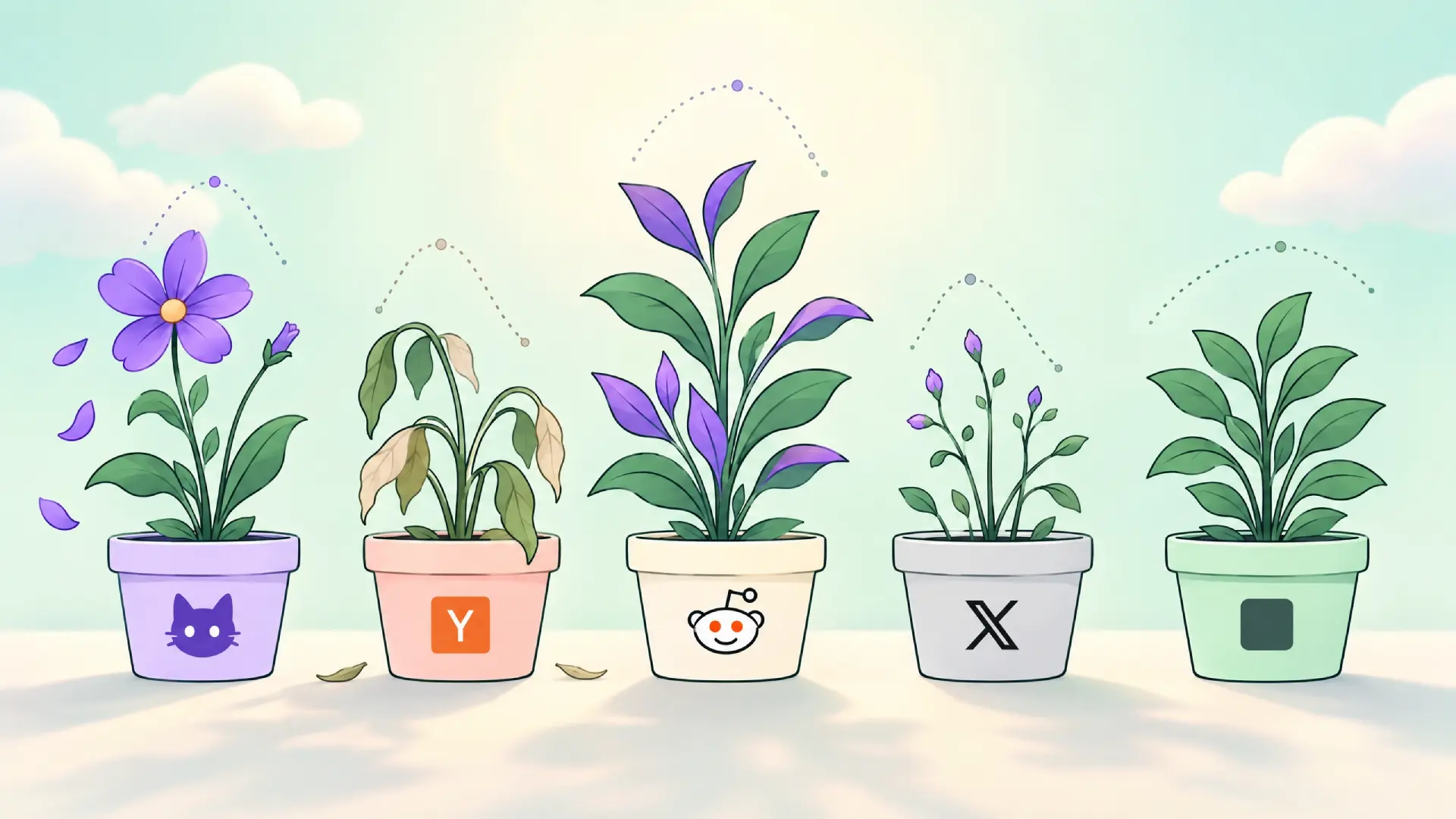
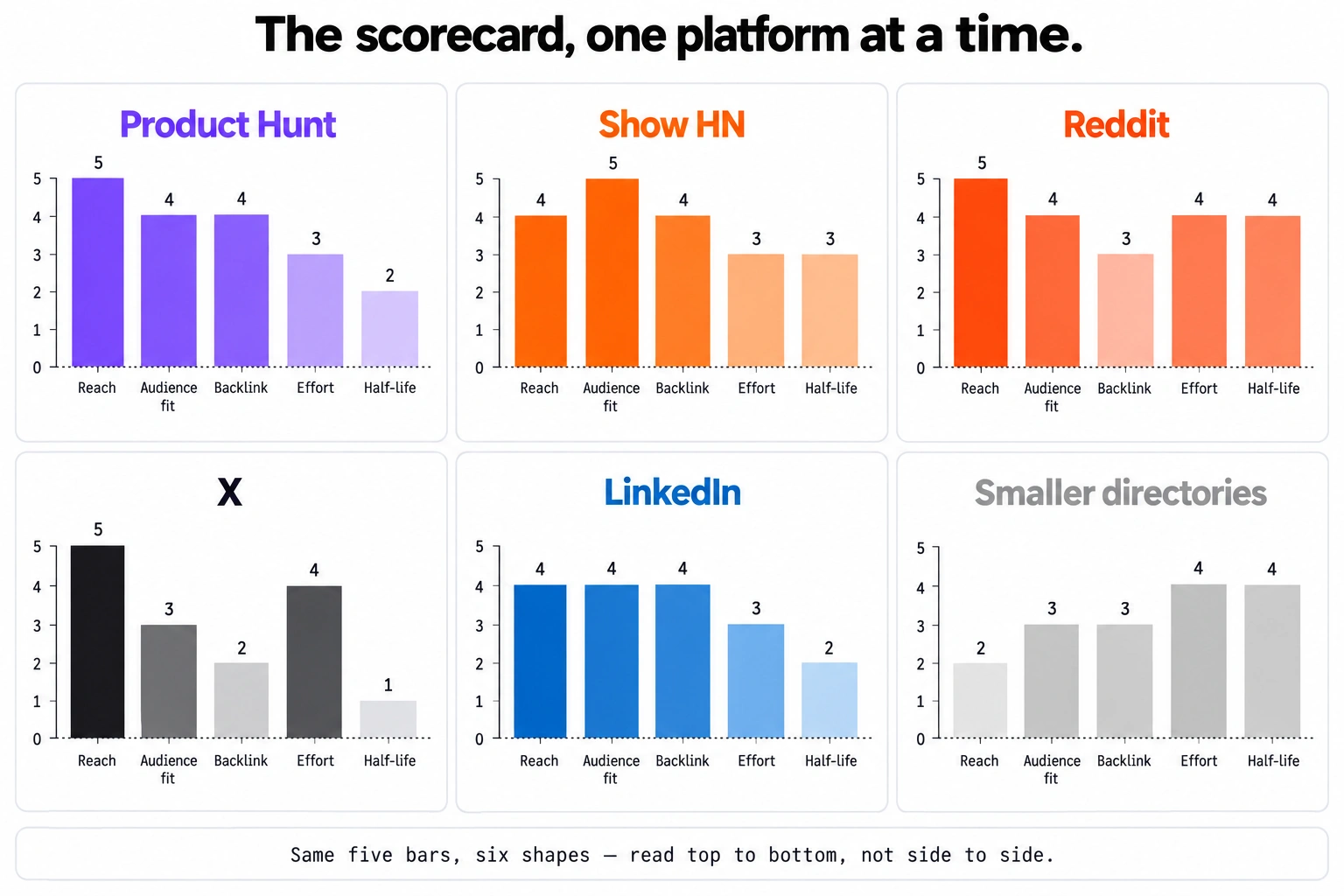
Every platform below gets scored 1 to 5 on the same five axes. This is the scorecard we use before every launch of our own.
| Criteria | What it measures |
|---|---|
| Reach on launch day | Realistic audience size that sees your listing in the first 24 hours |
| Audience fit | How well the crowd matches B2B, dev, design or consumer buyers |
| Backlink and SEO value | Do-follow status, indexing, and the domain's own authority |
| Effort and prep time | Hours needed to prepare assets, copy and community trust |
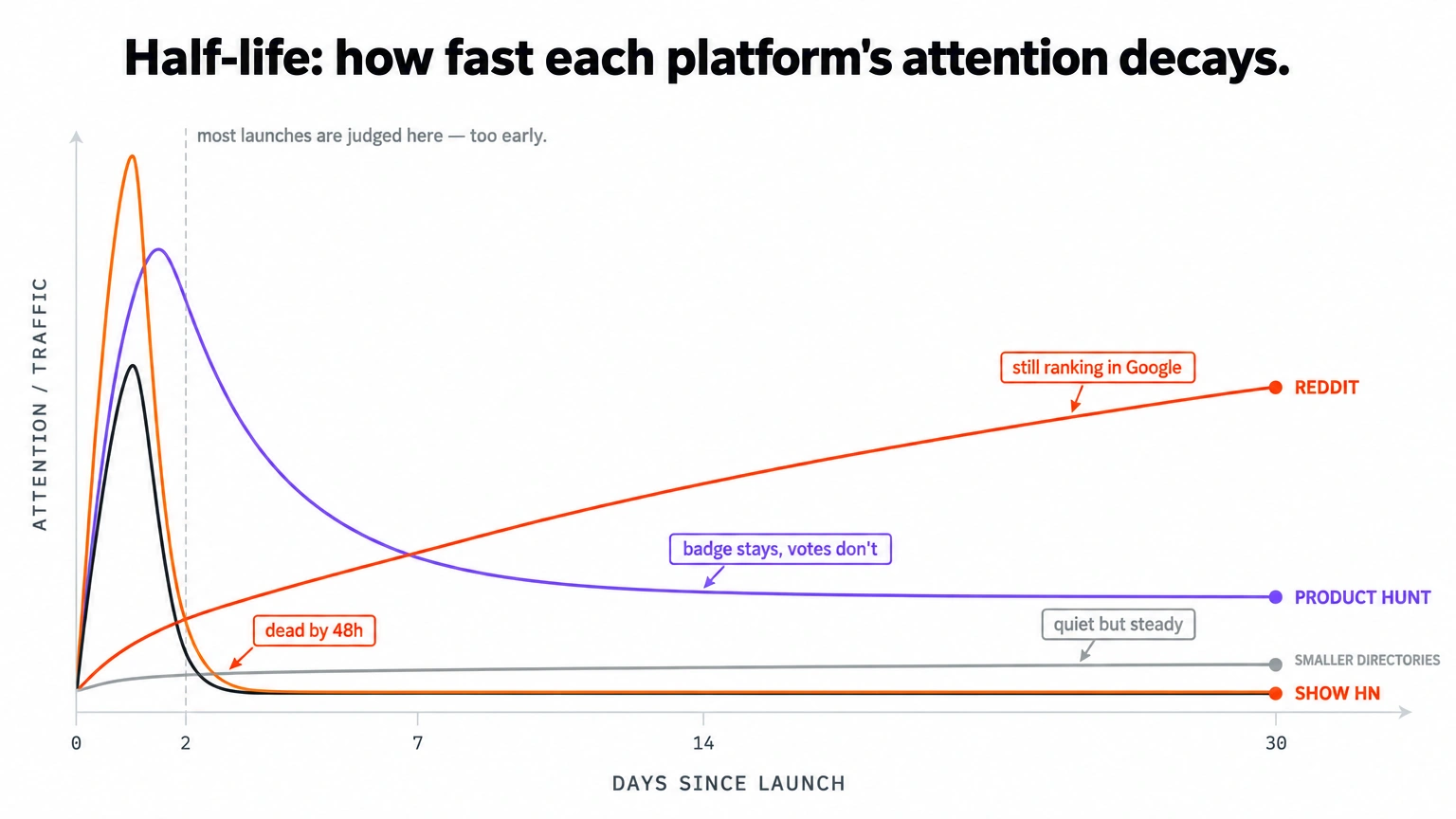
| Half-life | Whether traffic survives past day two, or dies with the feed |
| Platform | Reach on launch day | Audience fit | Backlink / SEO | Effort (5 = low) | Half-life |
|---|---|---|---|---|---|
| Product Hunt | 4 | 3 (makers, early adopters) | 2 (redirect links, verify) | 2 | 3 (listing stays indexed) |
| Show HN | 3 (4+ if front page) | 5 for dev, 2 otherwise | 3 (verify at launch) | 4 | 2 |
| Reddit (niche sub) | 3 | 5 | 2 (nofollow) | 1 (30-day warm-up) | 4 (threads rank in Google for years) |
| X / build-in-public | 2 (scales with followers) | 4 for design and indie | 1 | 3 | 1 |
| 2 | 5 for B2B, 1 otherwise | 1 | 3 | 2 | |
| Smaller directories | 1 | 3 | 4 (often do-follow, verify) | 5 | 3 |
Scores are our editorial judgment from post-mortems and our own launches rather than measured data. Read rows instead of totals: a directory scoring high on effort and backlinks does not outrank Product Hunt on the day.
Keep these two tables open while you read. Every section below explains a row.
Is Product Hunt still worth it in 2026?
Product Hunt in 2021 meant a curated front page and a community that actually clicked through to try things. That version is largely gone. AI wrappers flood the daily feed, and the ranking algorithm rewards early upvote velocity over product quality. Most of the people voting are other makers trading upvotes instead of buyers browsing for tools.
What still works has not changed much. The "Featured on Product Hunt" badge on your landing page still signals something to a first-time visitor. Investors and journalists still scan the daily list out of habit, even if they rarely convert from it directly. The listing itself gets indexed and shows up in searches for your product name for years.
What does not work is expecting the upvote count to translate into signups. Founders who go in hoping for a traffic spike are usually disappointed. The audience that upvotes is heavily weighted toward other founders launching their own thing that same week rather than your actual buyer persona.
The ranking algorithm itself rewards speed over merit. Founders consistently report that early velocity beats total volume: a fast first two hours matters more than a steady day. Understanding that mechanic matters more than polishing your tagline for the tenth time.
Product Hunt routes product links through its own redirect, so treat it as zero direct link equity until you verify at launch time. Platforms change link attributes without announcing it.
Launch on Product Hunt if: → Your buyer is a fellow builder or an early adopter who browses PH out of habit → You want the badge for social proof on your landing page → You have a network that will genuinely upvote in the first three hours
Skip Product Hunt if: → Your buyer is a non-technical enterprise stakeholder who has never opened the site → You have no existing audience to seed the first hour of votes → Your product needs a live demo to make sense, which PH's format does not reward
Hacker News and Show HN
Hacker News runs on a different currency entirely. The official Show HN guidelines are short, and most founders skip reading them, which is the first mistake. Show HN exists for things you built and can explain. It is not a venue for funded startups running a press push.
Launch HN is a separate format reserved for YC companies. Everyone else uses Show HN.
The HN audience punishes marketing language on sight. A title that reads like ad copy gets flagged or ignored. Closed-source tools pitched as "revolutionary" get torn apart in the comments, especially if an open-source alternative already exists and nobody mentioned it.
What HN rewards is the opposite. Technical depth in your own comment thread matters most, along with a founder who shows up and answers hard questions honestly. So does a live demo link that actually works without a signup wall. Admitting a limitation early earns more goodwill than pretending the product is finished.
☞ Your title is the whole launch. "Show HN: I built a tool that syncs Figma tokens to code" will get more genuine engagement than any adjective-heavy pitch. It tells a HN reader exactly what to expect before they click.
The half-life here is short. A front-page thread dies within 24 to 48 hours and rarely resurfaces. What survives is the backlink from a front-page or even a mid-page Show HN post. HN threads get indexed and occasionally get cited from other technical blogs for years afterward.
Reddit deserves its own deep dive more than a section here, and we wrote one: how to get your first users from Reddit without getting banned. It covers the mechanics of posting, the account age problem, and the 30-day routine that actually works. Read that before you touch Reddit for a launch.
For launch day specifically, the subreddit choice matters more than anything else. Places like r/SideProject and r/indiehackers tolerate and even expect launch posts. General subreddits ban self-promotion outright. Many mods still lean on the old self-promotion wiki as a reference, even though Reddit retired the formal rule. A niche subreddit built around your exact problem space, if one exists, usually converts better than either of those.
Account age and karma are not a formality. A brand-new account posting a launch on day one reads as spam to both the ranking system and the mods. It gets buried before a human ever sees it. This is why a Reddit launch is a 30-day process that starts weeks before your actual launch date instead of a single post you write the morning of.
X (Twitter) and build-in-public
X is not a launch platform in the way Product Hunt or HN are. It is a pre-launch audience engine, and by launch day the work should already be done. Founders who post their launch thread to an audience they built over months see a completely different outcome than founders posting cold.
The thread format is simple. Hook in the first post, a short demo video in the second. Put the link in the third or fourth post, since X tends to suppress early external links. Keep the whole thing under eight posts.
What a launch looks like with 300 followers versus 30,000 is mostly a difference of reach rather than format. Both can work if the 300 are the right 300, meaning people who actually buy what you sell rather than people who follow for memes. The design and indie hacker community still lives on X more than anywhere else, which is why build-in-public threads consistently outperform polished announcement posts here.
LinkedIn deserves one paragraph as the B2B alternative. If your buyer is a director of operations or a VP of engineering, they are far more likely to be on LinkedIn than X. The content style has to shift accordingly, with less meme, more case study, and concrete before-and-after numbers instead of build-log screenshots.
Product Hunt alternatives in 2026 that are actually real
A wave of smaller directories has shown up to fill the gap PH left behind. Some are a low-cost listing. Some are already fading. Here is an honest read on each, and verify do-follow status yourself before counting on any of them for SEO.
Peerlist Launchpad targets a professional, dev-and-design-adjacent crowd similar to early Product Hunt. Worth the submission if your product fits that audience, and the listing itself is a real backlink. Link status: verify at launch.
Uneed positions itself as a Product Hunt alternative for indie tools specifically, with a smaller but more founder-dense audience. Worth the 20 minutes for most SaaS and tool launches. Link status: verify at launch.
Fazier is another PH-style directory aimed at indie makers, with lower competition per listing than PH itself. Reach is modest, but so is the effort required. Link status: verify at launch.
MicroLaunch focuses specifically on solo and small-team products, which filters out the funded-startup noise that crowds PH's daily list. Good audience fit for exactly the reader of this article. Link status: verify at launch.
Tiny Launch is a lighter-weight, lower-traffic directory in the same category. Treat it as a quick add-on to a bigger sequence rather than a centerpiece. Link status: verify at launch.
Dev Hunt narrows to developer tools and APIs specifically, which makes it a strong audience-fit pick for that product type and a poor fit for consumer apps. Link status: verify at launch.
BetaList predates most of this list and targets pre-launch products looking for early beta testers rather than paying customers. Use it before you have pricing locked instead of after. Link status: verify at launch.
There's An AI For That is the right pick specifically for AI products, since its entire audience arrives looking for AI tools by category. Skip it if your product is not AI-first, since the audience mismatch shows in the clickthrough. Link status: verify at launch.
Indie Hackers product pages round out the list. The community itself is a slower-burn asset than a launch spike, worth maintaining for feedback and long-term visibility rather than a single-day push. Link status: verify at launch.
Launch as an SEO event
Reframe the whole launch day. It is the single biggest backlink moment most startups ever get, concentrated into 48 hours across a dozen directories and threads at once.
Directory backlinks add up even when individually small. A dozen listings across PH, Uneed, Dev Hunt and the smaller directories create a footprint. Search engines read that footprint as a real, active product rather than a domain that appeared last week with no history.
Launch post-mortems earn links on their own, separate from the launch itself. A founder writing "what happened when I launched on Product Hunt" months later often gets picked up by other founders' roundups and newsletter mentions. That extends the backlink window well past launch week.
The landing page has to be built to catch this traffic before it arrives. Do not scramble it together the morning of. We wrote about exactly this problem in our case study on building an AI-editable landing page. It covers the structure that holds up under a traffic spike instead of collapsing into a slow, generic homepage.
One more move outlasts the launch-day spike: pairing your launch week with one or two editorial guest posts on relevant tech publications. We compared the tradeoffs of that approach directly in guest posts vs niche edits. The short version is that a guest post gives you a durable, editorial backlink long after your PH badge stops mattering to anyone.
Which platform for which product
Every product does not fit every platform, and forcing a launch onto the wrong one wastes both the effort and the goodwill of that community.
| Product type | Warm up on | Launch first on | Launch second on | Skip |
|---|---|---|---|---|
| Dev tool or API | X | Show HN | Dev Hunt | Consumer-focused directories |
| Design tool or Figma resource | X | Product Hunt | Peerlist Launchpad | Show HN, unless it has real technical depth |
| B2B SaaS | LinkedIn build-up, then Product Hunt | Niche industry subreddit | Show HN, unless the audience is developers | |
| Consumer app | Niche subreddit | Reddit niche subreddit | Product Hunt | Show HN |
| AI wrapper or agent | X | There's An AI For That | Product Hunt | Show HN, unless genuinely novel technically |
| Open-source project | X | Show HN | Dev Hunt | Product Hunt, unless polished with real assets |
The 4-week launch sequence
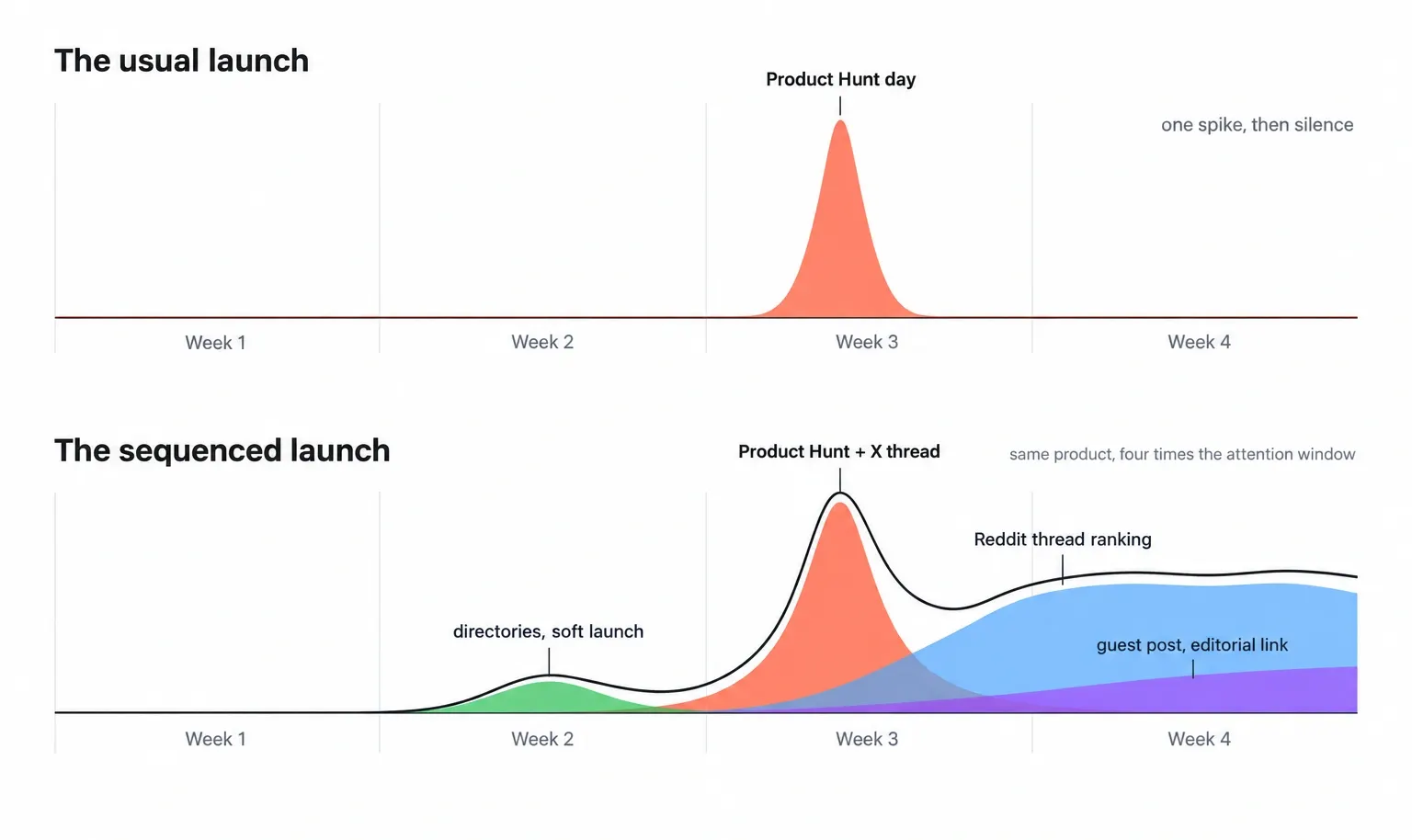
This is a template rather than a fixed law. Adjust the order based on the table above and your own product type.
Week 1: audience and assets. Write the landing page copy, record a 30-second demo, and draft your Show HN or PH tagline. Set up a Product Hunt Coming Soon page to collect followers before launch day. Start posting in your target subreddits or on X if you have not already been building there. Reach out to five people who might genuinely upvote or comment on day one.
Week 2: soft launch on a small platform. Submit to a smaller directory like Uneed, Fazier or MicroLaunch first and watch what breaks. Fix broken signup flows, confusing copy, or a demo that does not load before anyone with real reach sees it.
Week 3: main launch. Post to Product Hunt or Show HN, whichever your table row points to, and fire your X thread the same morning. Answer every comment on both within the first four hours, since early engagement compounds on both platforms.
Week 4: Reddit and the post-mortem. Share in your chosen subreddit if your account and karma are ready, and if not, wait rather than risk a ban on launch week itself. Follow the routine from our Reddit guide rather than improvising on launch day. Publish the post-mortem article a week or two later, once you have real numbers to report honestly.
Frequently asked questions
Is Product Hunt still worth it in 2026?
Yes, but not for signups. The AI product flood has diluted the front page, and most upvotes now come from other makers instead of buyers. What survives is the badge, the searchable listing, and the fact that investors and journalists still scan it. Treat it as a credibility stamp rather than a traffic engine.
What day is best to launch on Product Hunt?
Tuesday through Thursday sees the most maker traffic, because weekends and Mondays get lighter engagement from the community that actually votes. Weekends bring less traffic but far less competition, so a weekend launch is often the easier path to a top-3 badge. Avoid US holidays and major tech conference weeks, when the feed is crowded with unrelated launches. Beyond that, consistency in your own prep matters more than the exact day.
Can you launch the same product on Hacker News and Product Hunt?
Yes, and many founders do it the same week. Space them by a day or two so you are not splitting your own attention. Adapt the framing too: HN wants technical depth in the comments, PH wants a clean gallery and a tight tagline. Cross-posting the same pitch to both usually falls flat on HN.
How many followers do you need for an X launch to work?
There is no threshold that guarantees results. Founders with a few hundred engaged followers in a tight niche often outperform accounts with tens of thousands of passive ones. What matters is whether your followers are the people who buy rather than how many of them there are. Build the audience before you need it.
Do launch platforms give do-follow backlinks?
It varies and changes without notice, so verify at launch time rather than trusting old blog posts. Product Hunt and Reddit are widely reported to use nofollow on outbound links from listings and comments. Smaller directories are more likely to be do-follow, which is part of why they are worth the extra 20 minutes.
Pick the platform your buyer actually reads
The scorecard above exists to answer one question: where does your actual buyer spend their attention rather than where the loudest launch advice happens to point? Sequence the rest of the platforms around that answer instead of treating every launch as a lottery ticket on Product Hunt alone.
A launch is the start of your backlink profile rather than a one-day event you either win or lose. Treat week four's post-mortem and the guest posts that follow it as part of the same campaign as the launch itself.