



Roman Kamushken
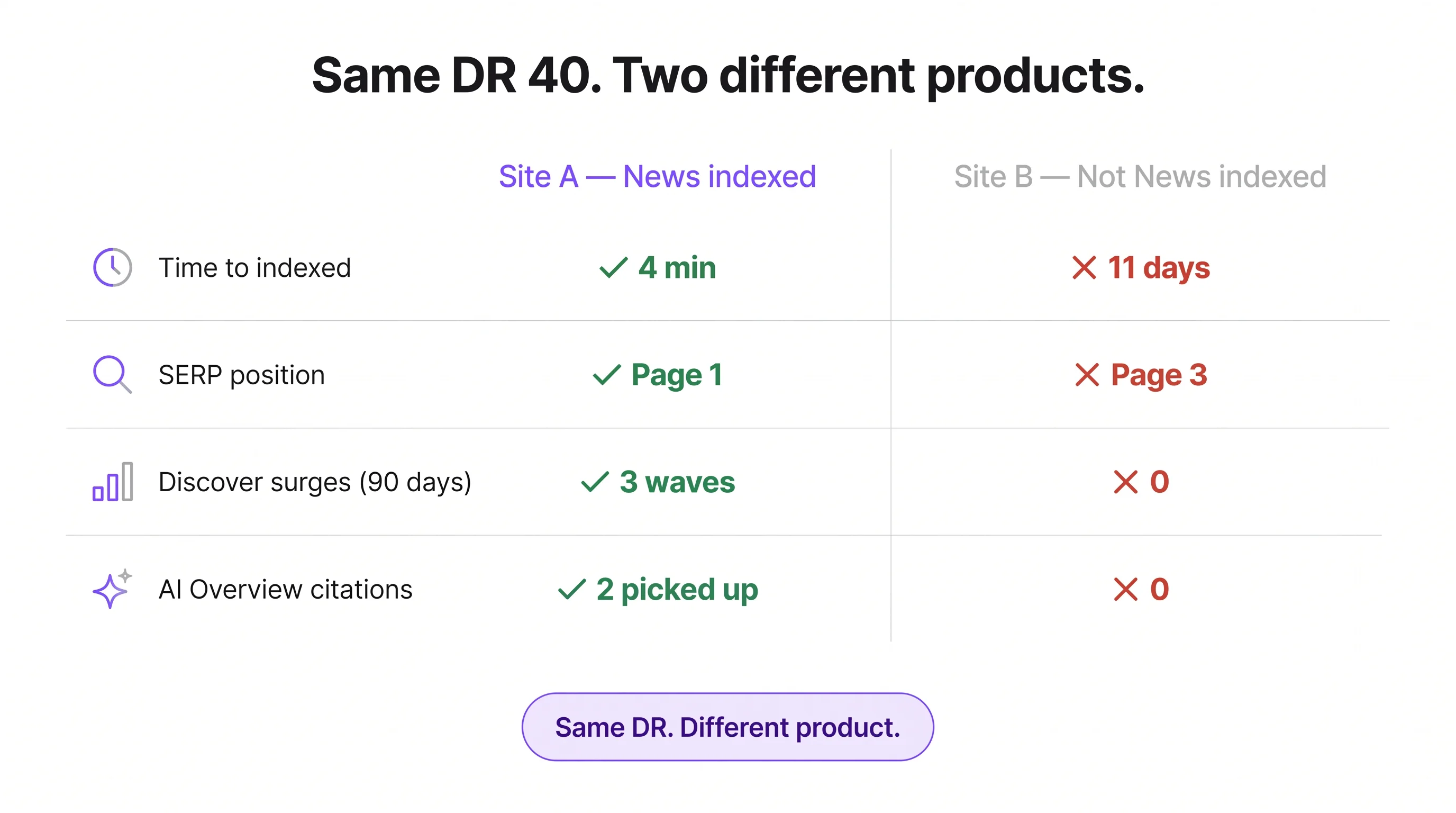
Two guest posts published the same week, on two DR 40 sites. Same anchor text, same word count, same author bio.
Site A was in Google News. Site B was not.
90 days later, Site A's post indexed in 4 minutes, ranked page 1 for its target keyword, generated 3 separate Google Discover traffic surges, and was quoted inside 2 AI Overviews. Site B's post took 11 days to index, sat on page 3, earned zero Discover impressions, and was not picked up by any AI Overview.
The only variable that mattered was News inclusion. This piece argues for treating it as the primary filter when you compare guest post sites, not a footnote you check after DR.
What Google News eligibility actually means in 2026
Google News is a curated index that sits next to the main web index. Since 2019 Google stopped requiring a manual application through the Publisher Center (the application step was removed at the publisher level). Selection now happens algorithmically.
Google looks at three things:
❶ Editorial standards. Original reporting, named authors, clear publication and update dates, correction practices.
❷ Technical structure. Article schema with NewsArticle type, datePublished and dateModified set correctly, RSS or news sitemap at /news-sitemap.xml, mobile rendering that passes Core Web Vitals on the article template.
❸ Trust history. Consistent publishing cadence, no PBN (private blog network, a group of sites built only to sell links) patterns in the link profile, and a clean record in Google's manual actions tool.
If your host site passes all three, it shows up in the News index. If it passes none, it does not. The middle ground, a clean site that just lacks one or two signals, is where most sellers falsely claim "News indexed" status.
The reward for being in the News index is concrete:
→ Faster crawl priority via the News crawler.
→ Eligibility for Top Stories carousels on news-intent queries.
→ Eligibility for Google Discover on Chrome mobile.
→ Higher E-E-A-T (Google's framework for measuring a page's Experience, Expertise, Authoritativeness, and Trustworthiness) domain weighting on news-adjacent queries.
Why News-indexed guest posts index in minutes, not days
The standard Googlebot works on a crawl cycle. A new URL on a DR 40 blog gets picked up within several days, sometimes a week, depending on the site's existing crawl demand and history.
The News crawler works on sitemaps and pings. A publisher that maintains a news sitemap and pings Google on new articles triggers crawl within minutes. This is the same infrastructure Top Stories pulls from.
For a guest post buyer, the practical difference is reporting period alignment. A link from a News-indexed placement earns equity inside the same news cycle it was published in. A link from a slow-indexing blog earns equity weeks later, often after the campaign that produced the content has already been reported on.
If you are tracking link performance inside a quarterly review, the News placement shows up in the same Q it was published. The non-News placement shows up in the Q after. That alone changes which campaigns get credit for what.
The Discover traffic multiplier nobody talks about
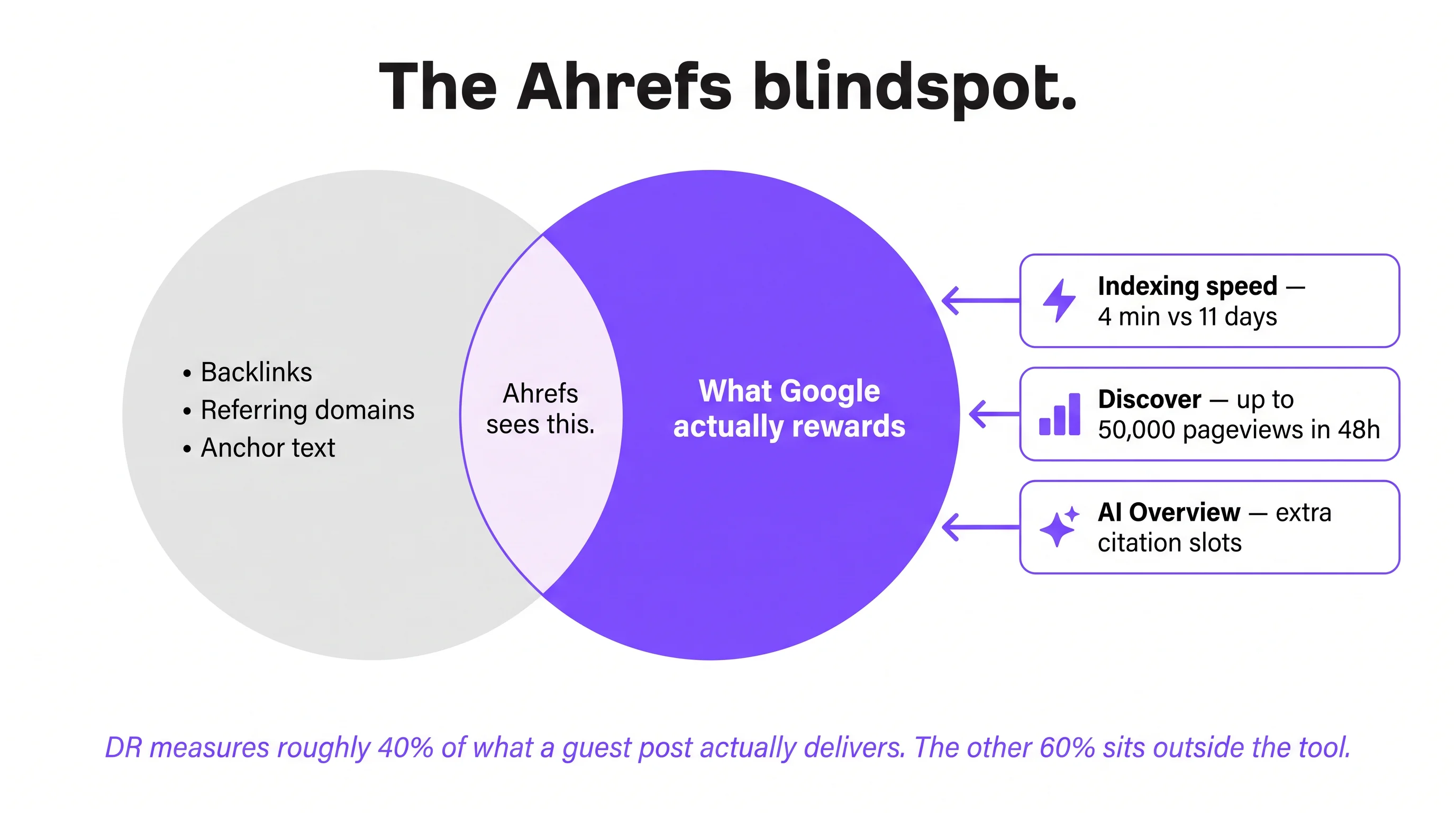
Google Discover feeds articles into Chrome mobile feeds based on user interest signals. The traffic from a Discover wave is invisible in Ahrefs, because Ahrefs models search demand, not feed distribution.
A single guest post on a News-indexed site can ride a Discover surge and drive 5,000 to 50,000 pageviews in a 48-hour window. You will not see these sessions in your standard backlink report, because they go to the host site's URL, not yours. To see them, ask the publisher for their Search Console screenshot of the Discover tab on the week of publication.
This is where the "3x" claim we see across the industry comes from. The multiplier is not raw link equity. It is the combination of:
→ Faster indexing (link equity lands in the same reporting period).
→ Discover distribution (extra sessions visible only in host Search Console).
→ AI Overview eligibility (extra citation slots inside answers, not blue links).
When buyers compare two DR 40 sites on Ahrefs and find identical DR, they miss 60% of the value proposition. The three multipliers above all sit outside Ahrefs.
AI Overview eligibility loves News sites
AI Overviews are the answer boxes Google now generates for informational queries. Search Engine Land's AI Overviews library tracks how often specific domains are cited inside these answers.
The pattern inside our own data is stark. Setproduct has 29 AI Overview appearances tracked at the time of writing, on a DR 42 domain with 2,700+ referring domains. Most DR 42 sites we have audited show fewer than 5 AIO citations. The disproportionate citation rate, relative to DR, is one of the reasons we treat News inclusion as a first-class filter.
The mechanism is straightforward. Google's training data and citation heuristics give weight to sources it already treats as authoritative on news-intent queries. Sites in the News index get pulled into that pool. Sites outside it do not, even at higher DR.
For a guest post buyer, the practical impact is that a News-indexed DR 40 placement often quotes inside an AI Overview for its target query, while a non-News DR 60 placement does not. The buyer can pay less and get a more citation-friendly link.
How to verify a site is actually in Google News (60 seconds)
Marketplaces love to claim "News indexed." Most of them are wrong. Here is the manual check that takes about a minute.
❶ Open news.google.com.
❷ In the News search bar, type site:example.com (replace with the host domain).
❸ Look for results with recent dates and thumbnail images. If pages from the domain appear with dates inside the last few weeks, the site is in the News index.
❹ Bonus check: open Publisher Center and search the domain there as well.
❺ Bonus check 2: inspect the article source in your browser. Look for <script type="application/ld+json"> containing "@type": "NewsArticle" along with datePublished and dateModified.
If two of these three signals hold, the site is genuinely News indexed. If only the seller says so and none of the signals appear, walk away.
☞ Try it now with setproduct.com. Search site:setproduct.com in the News search bar. Recent articles appear, including this one, as you read it.
The 7 signals Google actually rewards in News eligibility
Use this checklist before paying for any guest post placement. These are the signals the algorithm looks for, not the signals sellers market.
❶ Original reporting or unique data. Articles that cite primary sources, interviews, fresh stats, or original research get pulled faster than rewrites.
❷ Named authors with author schema. Look for a byline that links to an author bio page. The bio page should have Person schema with name, jobTitle, and links to social profiles.
❸ Regular publishing cadence. Sites that publish 3 or more times per week are treated as live news sources. Sites that publish once a month look like archives, regardless of freshness on individual posts.
❹ datePublished and dateModified in schema. Both fields must be present in the article schema. dateModified matters because Google uses it to decide whether an article is worth re-crawling.
❺ Editorial policy page. Usually at /editorial-policy or /about. Describes who runs the site, how corrections are handled, and what the publication standards are.
❻ Correction policy. A documented process for fixing factual errors. Sites without one signal low editorial rigor.
❼ No PBN patterns. Run the host's backlink profile through Ahrefs or Semrush. If the referring domains are a closed set of cross-linked sites, you are buying into a PBN, not a News-indexed placement.
☛ Most sellers will not produce verification on signals 5, 6, and 7. That itself is a signal. The sites that ship clean editorial and correction pages are also the sites with the cleanest News signals.
What News guest posts should cost in 2026
Price ranges below reflect what guest post placements currently run on the open market, based on direct outreach to publishers and a sampling of current broker listings. They are split by what the placement actually delivers, not by where you found it.
| Placement type | Typical 2026 price | What you actually get |
|---|---|---|
| Non-News DR 40 blog | $100 to $300 | Backlink and modest authority transfer |
| News-indexed DR 40 blog | $350 to $1,200 | Backlink, faster indexing, Discover eligibility, AIO eligibility |
| News-indexed DR 60+ (Forbes contributor, Entrepreneur, niche leaders) | $2,000 to $15,000 | Same as above plus domain-level authority transfer |
At the same DR, a guest post on a News-indexed site runs 2x to 4x more than the same placement on a non-News site. Combine News inclusion with DR 60+, and the ratio jumps to 10x to 20x over a non-News DR 40 placement.
That spread survives in the market because Discover, AIO citations, and faster indexing compound. Paying $100 for a non-News DR 40 placement is often worse ROI per dollar than paying $400 for a News-indexed DR 40 placement. You spend less, but you also gain less, and the differential compounds every quarter the link is on the page.
For a deeper breakdown of pricing by niche and DR tier, see our guest post cost guide for 2026. The full picture of which link-building tactic fits your goal is in our guest posts vs niche edits comparison.
Common myths, debunked
"Any tech blog with steady traffic is basically in Google News." False. Steady traffic alone does not get a site into Google News. The structural signals the algorithm actually rewards, NewsArticle schema with datePublished and dateModified, an active news sitemap, named authors with bio pages, three or more posts per week, are a higher bar than most mid-DR tech blogs clear, even when traffic looks healthy. Steady traffic is necessary, but it is not sufficient.
"News guest posts are just sponsored content with extra steps." False. Editorial guest posts count. The host's editorial team accepts or rejects based on quality. Sponsored tags do not exclude a page from the News index.
"You can pay Google to be indexed in News." False. There is no paid path. News inclusion is algorithmic. Sellers who imply otherwise are either confused or lying.
"News inclusion only helps if you are a journalist." False. Any authoritative topical publisher qualifies. A SaaS comparison site that publishes original product testing, names its reviewers, and ships a clear correction policy qualifies just as much as a politics site.
When News placements DON'T help
Three scenarios where paying the News premium is wasted spend.
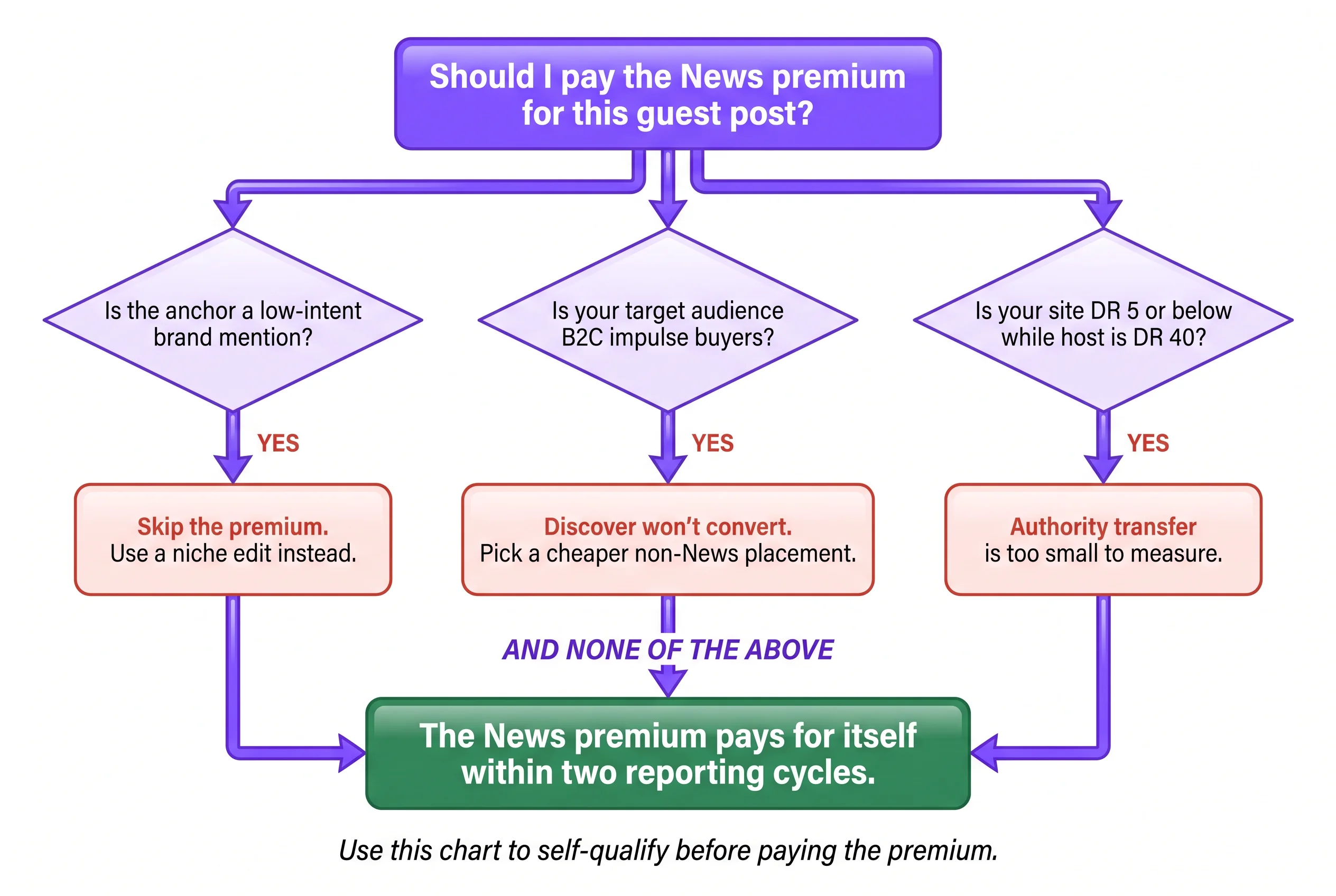
❶ Your anchor is a low-intent brand mention. If the link is just your company name with no target keyword attached to it, Discover and AIO exposure do not compound, because you have nothing to rank for. Use a niche edit (a link inserted into an existing published article, rather than a new guest post) at lower cost instead.
❷ Your target audience is B2C impulse buyers. Discover's audience is not looking to buy in the next 10 minutes. They are reading because the topic interests them. If your conversion path is "click and buy," the extra Discover sessions look good in screenshots but lose money after the first quarter.
❸ Your site has DR 5 or below. Authority transfer from a DR 40 host to a DR 5 target is too small to measure with standard tools. You will get indexed faster, and you might get one AIO citation, but the link equity component is what matters at this stage, so a cheaper non-News placement does the same job.
Outside those three scenarios, the News premium pays for itself inside two reporting cycles. For a fuller list of when guest posting is and is not worth it, see the benefits of guest blogging.
Frequently asked questions
What makes a site eligible for Google News in 2026?
Three things: editorial standards with original reporting and named authors, technical structure including NewsArticle schema plus a news sitemap, and a trust history of consistent publishing without PBN patterns. The Google Publisher Center sets the policy, and Google's crawler enforces it.
How can I check if a website is in Google News?
Go to news.google.com and run site:example.com in the search bar. If the host's recent articles show up with dates and thumbnails, it is genuinely indexed. Cross-check by inspecting the article source for NewsArticle schema with datePublished and dateModified fields.
Are Google News backlinks better for SEO?
Yes, on three measurable dimensions. They index faster (minutes vs days), they qualify for Discover distribution that non-News placements cannot reach, and they get pulled into AI Overview citations more often because Google treats News-indexed sources as authoritative.
How much does a Google News guest post cost?
In 2026, a News-indexed DR 40 placement runs $350 to $1,200. A News-indexed DR 60+ placement runs $2,000 to $15,000. The premium over a non-News DR 40 placement at $100 to $300 is 2x to 4x for the same DR, driven by Discover, AIO, and indexing speed compounding.
Do Google News guest posts help with AI Overviews?
Yes, disproportionately. Sites in the News index are over-represented in AI Overview citations because Google uses similar authority signals for both. A News-indexed DR 40 placement often quotes inside an AI Overview when a non-News DR 60 placement does not.
Is Google News the same as Google Discover?
No. Google News is an index that powers the News search box and Top Stories. Google Discover is a feed inside Chrome mobile that surfaces articles based on user interest signals. News-indexed sites become eligible for both, but the two features are separate products with separate policies.
Conclusion + product recommendation
News inclusion is the line item that separates a guest post that compounds from one that dies in 30 days. A DR 40 News-indexed site outperforms a DR 60 non-News site on indexing speed, Discover distribution, and AIO citations, the three signals that actually move rankings in 2026.
If you want the upside without four weeks of outreach, you can publish on a News-indexed domain today.
Setproduct ships on a News-indexed domain. DR 42, 2,700+ referring domains, and cited in 29 AI Overviews that we track. Both the Accelerate plan ($288, one do-follow link, 3-day turnaround, up to 3,000 words) and the Maximize plan ($348, two do-follow links, 24-hour turnaround, up to 5,000 words, homepage feature) place your post on this domain. See both guest post plans →
For a walkthrough of how to pitch a topic that gets accepted, see our guest post submission guidelines.