
Connor Patterson
Choosing the right UI/UX design agency changes how quickly a startup attracts users and validates its product. A well-designed interface is more than a visual asset. It helps users understand a product's value, complete the actions that matter and build habits that keep them coming back. For startups operating with limited budgets and tight launch schedules, getting these experiences right from the beginning is especially important.
Few agencies understand the challenges of building a product from the ground up. Early-stage companies need partners who can turn unvalidated ideas into functional prototypes, simplify onboarding, establish a consistent design language and adapt the interface as the business grows. To help founders make an informed decision, we've selected seven UI/UX design agencies for startups, comparing their capabilities, experience, engagement models and pricing.
How we selected the best UI/UX design agencies for startups
Selecting a UI/UX design partner for a startup requires looking beyond visual portfolios and impressive website presentations. Startups need agencies that understand product validation and the constraints of limited resources. They also need a partner who can deliver an intuitive experience from the first user interaction.
We evaluated potential candidates using five criteria, focusing on their ability to support startup product development and improve user adoption.
| Selection criteria | What we evaluated |
|---|---|
| Startup and product experience | Experience designing MVPs, SaaS platforms, mobile applications and digital products for early-stage and growing businesses. |
| UX research and strategy | Capabilities in user research, competitor analysis, user journey mapping, information architecture, usability testing and product validation. |
| UI/UX design capability | Expertise in interface design, interactive prototyping, onboarding experiences, responsive layouts and scalable design systems. |
| Development and scalability | Quality of developer handoff, design documentation, component libraries, and the ability to support products as their functionality expands. |
| Pricing and engagement flexibility | Transparency of pricing, availability of subscription or project-based models, and suitability for different startup budgets and timelines. |
We also considered publicly available portfolios, case studies, client experience and the range of services offered by each company. Particular attention went to evidence of work on real digital products rather than marketing websites alone.
The final selection includes agencies with different strengths and engagement models. Some sell a flexible design subscription. Others run research-led product development or a full design-and-development partnership. This variety helps startups identify a partner that matches their current product stage, internal capabilities and available resources.
Top 7 UI/UX design agencies for startups
The comparison below covers seven agencies that offer relevant UI/UX design capabilities for startups. Each has a different approach to product development, design execution and client collaboration. For a look at how agencies fold AI into the same work, see our roundup of AI web design agencies.
| Agency | Best for | Key services | Pricing |
|---|---|---|---|
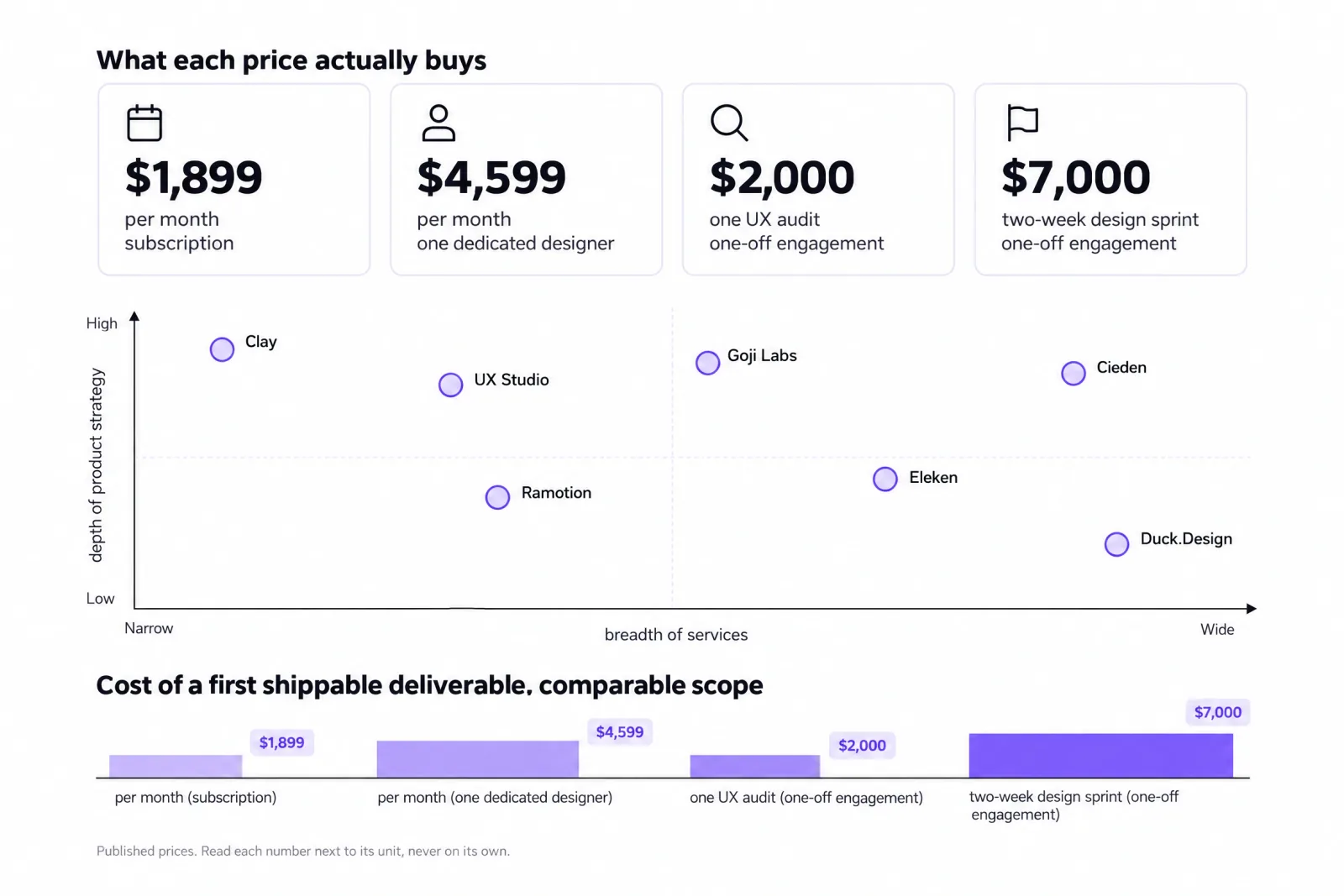
| Duck.Design | Startups needing flexible, ongoing design support | UI/UX, web and mobile app design, branding, motion graphics | From $1,899/month |
| Eleken | SaaS startups requiring dedicated product designers | SaaS UI/UX, MVP design, UX audits, design systems | From $4,599/month |
| Cieden | B2B and SaaS startups validating complex products | UX research, product strategy, MVP design, prototyping | From $2,000 for UX audits; $7,000 for design sprints |
| Goji Labs | Startups needing product strategy, design and development | Product discovery, UX/UI, prototyping, software development | Custom pricing |
| UX Studio | SaaS startups requiring research-driven product design | UX research, product design, usability testing, development | Custom pricing |
| Ramotion | Technology startups combining brand and product design | Product UX/UI, branding, design systems, web design | Custom pricing |
| Clay | Funded startups seeking premium brand and product experiences | Product strategy, UX/UI, branding, digital experiences | Custom pricing |
1. Duck.Design
Duck.Design is a UI/UX design agency for startups that need professional design support without the commitment of building a large in-house creative team. Its subscription model gives businesses access to a broad range of design services for a predictable monthly fee, making it easier to manage changing priorities and ongoing product requirements. The company works across web and mobile interfaces, brand identity, websites and other digital assets, helping startups maintain a consistent visual experience. Its approach is particularly useful for growing businesses that need to move quickly while keeping design costs under control.
Key services:
- UI/UX design for web applications and digital products
- Mobile app design for iOS and Android
- Website and landing page design
- User interface redesign and optimization
- Branding and visual identity development
- Design systems and reusable UI components
- Motion graphics, illustrations and marketing design
Pricing: Duck.Design offers subscription-based packages. Its Creative Suite plan, which includes UX/UI design, branding and motion graphics, starts at $1,899 per month. No-code development is available through a separate plan.
Best for: Early-stage and growing startups that need ongoing UI/UX design, branding and website support without hiring multiple specialists or committing to traditional project-based agency contracts.
Startup experience: Duck.Design supports startups that need to develop digital products, establish visual identities and improve existing interfaces. Its flexible subscription model is particularly relevant to teams whose design requirements change frequently during product development. Instead of estimating every new request as a separate project, founders can manage design priorities through a recurring engagement.
Why they stand out:
- Flexible subscription model: Startups can access multiple design disciplines under a predictable monthly payment, which helps them manage limited resources.
- Broad creative capabilities: The service covers UI/UX, branding, web design and motion graphics, reducing the need to coordinate several different providers.
- Unlimited design requests and revisions: Clients can submit ongoing requests and give feedback without purchasing a new project for every adjustment, subject to the plan's workflow and active-task limits.
- Fast delivery: Standard design requests can receive initial versions within 24 to 48 hours on business days, helping teams maintain momentum.
2. Eleken
Eleken is a UI/UX design agency specializing in SaaS products and software interfaces. Its approach centers on providing dedicated product designers who become familiar with a client's platform, business model and development workflow. Instead of focusing exclusively on attractive screens, Eleken works on complex interfaces, user flows and functionality that help customers interact with software more effectively. Its SaaS specialization makes it particularly relevant to startups building subscription products and B2B platforms.
Key services:
- SaaS UI/UX design
- MVP and product interface design
- Dashboard and data visualization design
- UX audits and usability improvements
- User onboarding optimization
- Design systems and component libraries
- Product redesign and interface modernization
Pricing: Subscription-based pricing starts at $4,599 per month for a part-time dedicated designer. A full-time designer costs $6,599 per month, while two full-time designers cost $11,999 per month. The minimum contract is two months.
Best for: SaaS startups that need continuous product design support, particularly companies with an existing development team but no dedicated in-house UX designer.
Startup experience: Eleken works with SaaS businesses at different stages, including companies developing products from scratch and teams improving established platforms. Its startup portfolio includes companies such as Aampe, Floret and Datawisp. The dedicated-designer model lets product teams keep design continuity instead of repeatedly onboarding new freelancers or agencies.
Why they stand out:
- SaaS specialization: Its exclusive focus on SaaS products brings experience with dashboards, complex workflows, data-heavy interfaces and software-specific UX challenges.
- Dedicated designers: Startups work with a designer who becomes familiar with their product rather than receiving disconnected design deliverables.
- Predictable monthly costs: Subscription pricing makes it easier to plan ongoing product design expenditure.
- Developer-friendly deliverables: The agency emphasizes practical handoffs, reusable components and collaboration with engineering teams.
3. Cieden
Cieden is a product design agency helping startups and established technology companies turn complex ideas into usable digital products. Its services combine UX research, product strategy, interface design and prototyping, which allows founders to validate product concepts before committing significant development resources. The agency has experience with B2B SaaS, fintech, AI and other technology-driven businesses where intuitive workflows and clear information architecture are essential. Its structured design approach is particularly relevant to startups that need to establish product direction and validate user needs.
Key services:
- UX research and product discovery
- UI/UX design for SaaS and digital platforms
- MVP design and interactive prototyping
- Product strategy and user journey mapping
- UX audits and usability testing
- Design systems and interface development
- AI product interface design
Pricing: UX audits start at $2,000, while two-week design sprints start at $7,000. More extensive product design engagements are priced according to project scope and requirements.
Best for: B2B, SaaS, fintech and AI startups that need research-backed product design and want to validate their concepts before full-scale development.
Startup experience: Cieden offers services specifically structured around startup product development. Its engagements can include defining project scope, creating user flows, developing wireframes, building interactive prototypes and validating proposed solutions. This is particularly valuable for founders who have an initial product concept but need a structured process to translate it into a development-ready solution.
Why they stand out:
- Research-driven approach: The agency builds user research and validation into product design instead of relying entirely on stakeholder assumptions.
- MVP-focused engagements: Dedicated design sprints help founders explore product concepts and test important assumptions before committing to extensive development.
- Complex product expertise: Experience with B2B software, fintech and AI applications is valuable for startups with sophisticated functionality.
- Flexible engagement models: Startups can choose a focused service such as a UX audit or a design sprint, or a broader product design partnership.
4. Goji Labs
Goji Labs is a digital product design and development agency that helps startups transform business ideas into functional digital products. Its services cover the whole product lifecycle: discovery and strategy first, then UX/UI design, software development and launch. That combination allows startups to work with a single partner instead of coordinating separate design and engineering providers. The agency is particularly relevant to founders who need strategic guidance alongside the practical execution of an MVP or a more complex digital platform.
Key services:
- Product strategy and discovery
- UX research and product planning
- UI/UX design for web and mobile applications
- MVP design and development
- Web and mobile app development
- Prototyping and usability testing
- Product improvement and ongoing development
Pricing: Custom project-based pricing. Costs depend on product complexity, discovery requirements, design scope and whether software development is included.
Best for: Startups that need an end-to-end product partner to take an idea through discovery, design, development and launch.
Startup experience: Goji Labs has experience working with technology startups and businesses building digital products across different industries. Its integrated approach is valuable for early-stage founders who need help defining product requirements and aligning design decisions with technical considerations. Instead of treating the interface as an isolated deliverable, the agency connects product strategy, user experience and engineering.
Why they stand out:
- Design and development under one roof: Startups can coordinate product design and engineering through one team, which reduces communication gaps between designers and developers.
- Strategic product discovery: Early-stage companies can get support with defining user needs, product requirements and development priorities.
- End-to-end execution: The agency can take an idea and an early prototype and carry both through to a functioning digital product.
- Experience with complex platforms: Its capabilities are relevant to startups developing SaaS applications, marketplaces, mobile products and other technology solutions.
5. UX Studio
UX Studio is a research-driven product design agency specializing in digital products, particularly B2B SaaS platforms. Its approach places user research at the center of the design process, helping product teams understand how customers interact with software and where usability problems occur. The company combines UX research, product design and development capabilities, which suits startups that need to improve existing products or build new ones around validated user needs. Its emphasis on research and continuous collaboration is particularly valuable for businesses dealing with complex workflows.
Key services:
- UX research and user interviews
- Product strategy and UX consulting
- UI/UX design for SaaS platforms
- User journey mapping and information architecture
- Usability testing and product validation
- Design systems and interface development
- Product development and team extension
Pricing: Custom pricing based on project scope and team composition. The agency also offers dedicated and scalable team engagement models.
Best for: B2B SaaS startups and technology companies that need research-driven design for complex applications and workflows.
Startup experience: UX Studio has experience working with SaaS companies and developing its own digital products, including UXfolio and Copyfolio. Its team can work as an extension of an internal product organization, combining research and design expertise throughout the development process. This model is useful for startups that want a deeper understanding of their users instead of relying on assumptions about product usability.
Why they stand out:
- Strong UX research capability: The agency emphasizes understanding real user behavior through research, interviews and usability evaluation.
- B2B SaaS expertise: Its experience with complex software interfaces is relevant to startups building products with multiple user roles and workflows.
- Embedded collaboration: Dedicated teams can work alongside internal product and development specialists.
- Research-to-design continuity: Findings from user research inform interface decisions, which helps businesses prioritize improvements that address actual user needs.
6. Ramotion
Ramotion is a digital design agency that combines brand development with product UX/UI design for startups and technology companies. Its work focuses on creating consistent brand and product experiences, helping companies establish a recognizable identity while building functional digital interfaces. The agency has a dedicated startup design offering and works with technology businesses at different stages of growth. Its experience across brand identity, product interfaces and web experiences makes it particularly relevant to startups preparing for market entry, fundraising or expansion.
Key services:
- Product UI/UX design
- Web application and mobile app design
- UX audits and usability testing
- Brand identity and visual language development
- Design systems and UI kits
- Website design and development
- MVP design and product prototyping
Pricing: Custom project-based pricing. Estimates depend on the product's complexity, branding requirements, number of interfaces and development scope.
Best for: Technology startups that need professional product design alongside a distinctive brand identity, particularly companies preparing for growth or fundraising.
Startup experience: Ramotion has a dedicated startup UI/UX design service and reports having designed products for more than 80 startups. Its startup work includes helping technology companies build SaaS workflows, digital interfaces and cohesive brand-product systems. The agency also highlights relationships with startup investors and accelerators, which makes it relevant to companies preparing products for competitive markets.
Why they stand out:
- Dedicated startup offering: Its startup-focused design services address the needs of founders and growing technology teams.
- Brand and product alignment: Companies can develop a consistent visual identity across their websites, applications and other customer touchpoints.
- Scalable design systems: Reusable components and design standards help maintain consistency as products become more sophisticated.
- Investor-ready presentation: Strong visual execution can help startups communicate product value more effectively to investors, partners and potential customers.
7. Clay
Clay is a digital product and brand design agency known for creating sophisticated digital experiences for technology companies and established global brands. Its capabilities span product strategy, user experience, interface design and brand development, helping businesses connect functional requirements with distinctive visual identities. The agency's portfolio includes work for major technology companies, which shows experience with products that require strong usability and polished execution. Its positioning is more premium than that of budget-oriented startup design providers, so it fits well-funded startups aiming to establish a strong market presence.
Key services:
- Digital product strategy
- UX research and interaction design
- UI/UX design for web and mobile applications
- Brand identity and digital branding
- Design systems and component libraries
- Website design and development
- Digital experience design
Pricing: Custom premium project pricing. Final costs depend on the scope of product strategy, branding, UX/UI design and implementation requirements.
Best for: Venture-backed and growth-stage startups that need premium product design, strong branding and cohesive digital experiences.
Startup experience: Clay's work spans digital-first companies and technology businesses that require well-developed brand and product experiences. Its approach suits startups that have moved beyond basic MVP development and need a more sophisticated interface, a distinctive visual identity and a consistent user experience across multiple digital touchpoints. Founders should weigh its premium positioning when evaluating budget and project scope.
Why they stand out:
- Product and brand integration: The agency can connect product interfaces, brand identity and digital experiences under a unified design direction.
- High-end visual execution: Its design approach suits startups competing in markets where presentation and brand perception influence customer acquisition.
- Strategic design capabilities: Product strategy and UX expertise help connect interface decisions with broader business objectives.
- Experience with major technology brands: Its portfolio shows the ability to deliver sophisticated digital experiences for demanding clients.
How to choose a UI/UX design agency for your startup
The best UI/UX design agency for a startup is the one that understands your current product challenges and can deliver the specific expertise your business needs. A large team and a famous portfolio do not guarantee that fit.
Before making a decision, consider the following factors.
1. Define your startup's current product stage
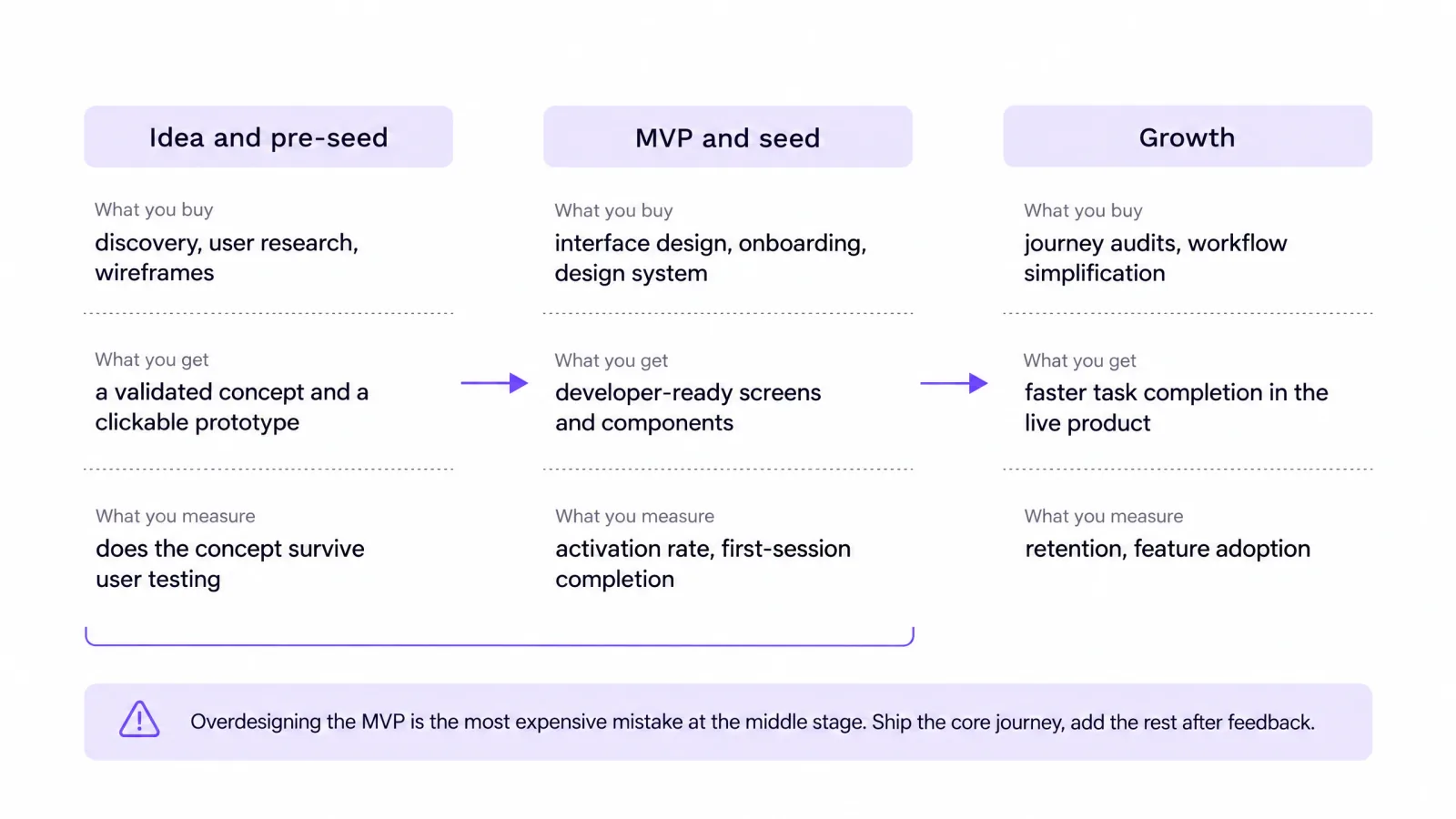
Your requirements change with the product stage. A team shaping an initial concept needs different work from one preparing an MVP or improving an established product.
- Idea and pre-seed stage: Prioritize agencies that offer product discovery, user research, wireframing and rapid prototyping. You need to validate the concept before investing in full development.
- MVP and seed stage: Look for teams experienced in interface design, onboarding flows, design systems and developer-ready deliverables.
- Growth stage: Consider agencies that can improve existing user journeys, simplify complex functionality and support continuous product development.
2. Evaluate UX research capabilities
A visually attractive interface does not automatically create a usable product. Ask how the agency identifies user needs, evaluates existing experiences and validates design decisions.
Look for experience with user interviews, competitor analysis, usability testing and behavioral research. These activities help identify friction points that could prevent users from completing important actions.
3. Check experience in your product category
Designing a consumer mobile application is different from creating a B2B SaaS platform with multiple user roles, dashboards, integrations and complex workflows.
Prioritize agencies that have worked with products similar to yours. They are more likely to understand your audience, industry requirements and common usability challenges.
4. Understand the engagement model
Different startups need different levels of design support.
A fixed-price project suits the case where deliverables and requirements are clearly defined. A subscription is more practical when design requests are continuous and priorities change often. Dedicated designers or embedded product teams are valuable when close collaboration with internal developers is essential.
5. Review deliverables and developer handoff
Before signing a contract, establish exactly what your startup will receive. A full UI/UX engagement may include:
- User flows and information architecture.
- Wireframes and interactive prototypes.
- High-fidelity interface designs.
- Responsive layouts.
- Design systems and reusable components.
- Design specifications and developer handoff documentation.
6. Connect design work to product metrics
The purpose of UI/UX improvements should extend beyond visual consistency. Discuss how the agency can help improve measurable indicators such as onboarding completion, activation rate, feature adoption, task completion and retention.
A good design partner should understand these metrics and explain how design decisions contribute to them. Two guides go deeper on the parts founders ask about most: choosing a design team and design systems for business.
Questions to ask before hiring a UI/UX design agency
Before committing to a design partner, founders should clarify how the agency works, what its team will deliver and how success will be evaluated.
The questions below help you assess whether a potential partner suits your startup.
| Question | Why it matters |
|---|---|
| Have you designed products for startups at a similar stage? | Shows whether the agency understands early-stage constraints, MVP development and changing requirements. |
| How do you conduct UX research and validate design decisions? | Reveals whether the process rests on user needs or mostly on visual preference. |
| Can you show examples of similar digital products? | Helps you judge relevant industry and product experience instead of unrelated portfolio work. |
| Who will actually work on our project? | Clarifies the experience of the designers, researchers and project managers involved. |
| What deliverables are included in the engagement? | Prevents misunderstandings about prototypes, design systems, documentation and developer handoff. |
| How do you handle changes in product requirements? | Shows whether the agency can absorb the uncertainty common in startup environments. |
| How do you measure the impact of design improvements? | Establishes whether the agency tracks usability, activation and adoption alongside visual quality. |
| What happens after the initial design phase? | Clarifies whether ongoing improvements, developer support and post-launch iterations are available. |
Common mistakes when choosing a UI/UX design agency
Even a promising design partnership can become expensive and ineffective when the selection process focuses on the wrong priorities. Startups should avoid the following mistakes.
1. Choosing based only on visual portfolios
A portfolio filled with attractive interfaces does not necessarily prove strong UX expertise. Evaluate how agencies approach user flows, information architecture, usability and functional requirements.
2. Ignoring UX research
Skipping research produces interfaces based on assumptions rather than actual user behavior. That is particularly risky for startups that have not yet found product-market fit.
3. Overdesigning the MVP
Early-stage startups do not need to design every potential feature before launch. Prioritize essential functionality and the core user journey. Additional features can arrive as the product evolves and customer feedback comes in.
4. Selecting an agency without relevant product experience
An agency specializing in marketing websites may lack the expertise needed to design a complex SaaS dashboard or a mobile application. Check whether its previous projects demonstrate the specific capabilities your product requires.
5. Focusing only on the lowest price
Low initial costs can become expensive when deliverables need extensive revisions or developers struggle to implement them. Weigh total project value, communication quality and completeness of deliverables.
6. Neglecting developer collaboration
Design and development should work together throughout the project. Without proper documentation, component specifications and implementation discussions, even excellent designs become difficult to translate into a functional product.
7. Failing to define success metrics
A project should have clear objectives. Without measurable targets, it is hard to tell whether the new interface actually improves the product experience or user adoption.
Final thoughts
Choosing the right UI/UX design agency is an important decision for startups because early product experiences shape how users understand a product and how long they stay. The ideal partner combines design execution with an understanding of customer behavior, product development and the practical constraints of growing businesses.
The right choice depends on your product's maturity, internal capabilities, budget and long-term objectives. Prioritize a partner that understands your users, can translate business requirements into intuitive interfaces and treats design as an ongoing contributor to product adoption rather than a one-time visual exercise.
Frequently asked questions
Why do startups need a UI/UX design agency?
Startups use agencies to turn a product idea into an interface people can actually use. Designers validate concepts, simplify the first session, improve onboarding and keep the interface consistent as features ship. That leaves founders free to run the business while specialists handle the product experience.
How much does UI/UX design cost for a startup?
Cost depends on project complexity, required expertise and the engagement model. Subscription services start at roughly $1,500 to $2,000 per month, while a dedicated SaaS designer runs from $4,000 to $7,000 monthly. Work that includes research, prototyping and development sits well above that.
What should a startup look for in a UI/UX design agency?
Look for relevant product experience, real UX research capability, MVP design work, transparent pricing and a working method for developer handoff. The agency also needs to understand startup constraints and adapt its process when product requirements change mid-project.
Should a startup hire a UI/UX designer or an agency?
A freelance or in-house designer fits when the workload is clearly defined and steady. An agency makes more sense when a company needs several skills at once, such as research, interface design, prototyping and branding. Budget, workload and the depth of expertise required decide the rest.
How long does it take to design an MVP?
MVP design usually takes two to eight weeks. The range depends on functionality, research requirements and the number of screens. A simple application can move in a few weeks, while a complex SaaS platform takes considerably longer to research, prototype and document.
How can UI/UX design improve user adoption?
Good design removes friction from the customer journey. Clear navigation, intuitive onboarding and well-organized screens help people understand the product and reach its core value faster, which shows up in activation, feature adoption and retention.
What is the difference between UX design and UI design?
UX design covers the overall experience: research, navigation, information architecture and interaction flows. UI design covers the visual and interactive layer: typography, color, buttons, layout and components. Both disciplines have to work together for a product to feel usable.
Should startups invest in UX research before building an MVP?
Yes. Research helps founders understand their audience and test product assumptions before development costs pile up. Even lightweight work, such as a few user interviews, a competitor review and prototype testing, can surface usability problems early and save features nobody needs.