
Connor Patterson
User retention is one of the biggest challenges for SaaS businesses. Even a product with valuable features and a competitive pricing model can struggle to retain customers if its interface is confusing, onboarding is complicated, or users cannot easily find the functionality they need. Effective UI/UX design addresses these problems by making software easier to understand, reducing friction across key workflows, and helping customers recognize product value faster.
Choosing the right SaaS UI/UX design agency can help companies turn these principles into a consistent product experience. The best partners combine user research, product strategy, interface design, and usability testing to create software that customers want to keep using. Some of them focus on launching an MVP, others rebuild an established platform, and others work on activation and feature adoption. The following eight agencies cover all three cases with different engagement models.
How we ranked the best UI/UX design agencies for SaaS
To identify the best SaaS UI/UX design agencies, we evaluated companies based on their ability to design and scale software products. Our ranking focuses on capabilities that directly influence the everyday user experience, from initial onboarding to complex workflows and long-term product engagement.
We used five evaluation criteria to assess each agency:
| Evaluation criteria | What we examined |
|---|---|
| SaaS product design experience | Demonstrated experience designing SaaS platforms, dashboards, web applications, and mobile products with complex functionality. |
| UX research and usability | Capabilities in user interviews, behavioral research, journey mapping, usability testing, and identifying friction points in existing products. |
| Retention-focused design | Experience improving onboarding, activation, navigation, feature discoverability, and other product interactions that influence continued usage. |
| Design systems and scalability | Ability to build reusable components, maintain interface consistency, and support products as features, user roles, and functionality expand. |
| Delivery and collaboration | Design handoff quality, communication processes, developer collaboration, engagement flexibility, and transparency of pricing. |
We also reviewed publicly available agency portfolios, SaaS-specific case studies, service descriptions, and client feedback to understand the type of products each team works on and how its capabilities align with SaaS requirements.
Particular attention was given to agencies that understand the entire product experience rather than focus exclusively on visual interface design. That includes simplifying complex workflows, shortening the time it takes users to reach their first meaningful result, and keeping the experience consistent across different product areas.
The ranking highlights different strengths rather than assigning arbitrary numerical scores. Each agency was selected for its relevant capabilities, and the final list includes options for startups, growing SaaS businesses, and established software companies with more complex product requirements.
Top SaaS UI/UX design agencies
The following agencies offer different approaches to SaaS product design, from flexible monthly subscriptions to specialized UX research and full product design engagements. For a startup-specific shortlist, see our roundup of UI/UX design agencies for startups.
| Agency | Best for | Key services | Pricing |
|---|---|---|---|
| Duck.Design | SaaS teams needing flexible, ongoing design support | UI/UX, web and mobile app design, design systems, branding | From $1,899/month |
| Eleken | Dedicated SaaS product design support | SaaS UI/UX, UX research, dashboards, design systems | From $4,599/month |
| Cieden | Complex B2B SaaS and AI-powered platforms | Product strategy, UX research, prototyping, UI/UX | $50–$99/hour |
| UX Studio | Research-driven SaaS redesigns | UX research, product design, usability testing, development | Approximately €42–€85/hour |
| Arounda | SaaS products focused on engagement and retention | Product strategy, UX/UI, onboarding, dashboards, development | Custom pricing |
| Halo Lab | End-to-end SaaS design and development | SaaS UX, onboarding, dashboards, design systems, software development | Projects from approximately $5,000 |
| Ramotion | Established SaaS platforms needing sophisticated product interfaces | Product UX/UI, design systems, branding, prototyping | Projects from approximately $50,000 |
| Clay | Premium SaaS product experiences and brand integration | Product strategy, UX/UI, UX research, branding, design systems | Custom premium pricing |
Pricing figures are indicative starting points based on publicly available plans and market listings. Project scope, team size, and engagement terms can significantly affect the final cost.
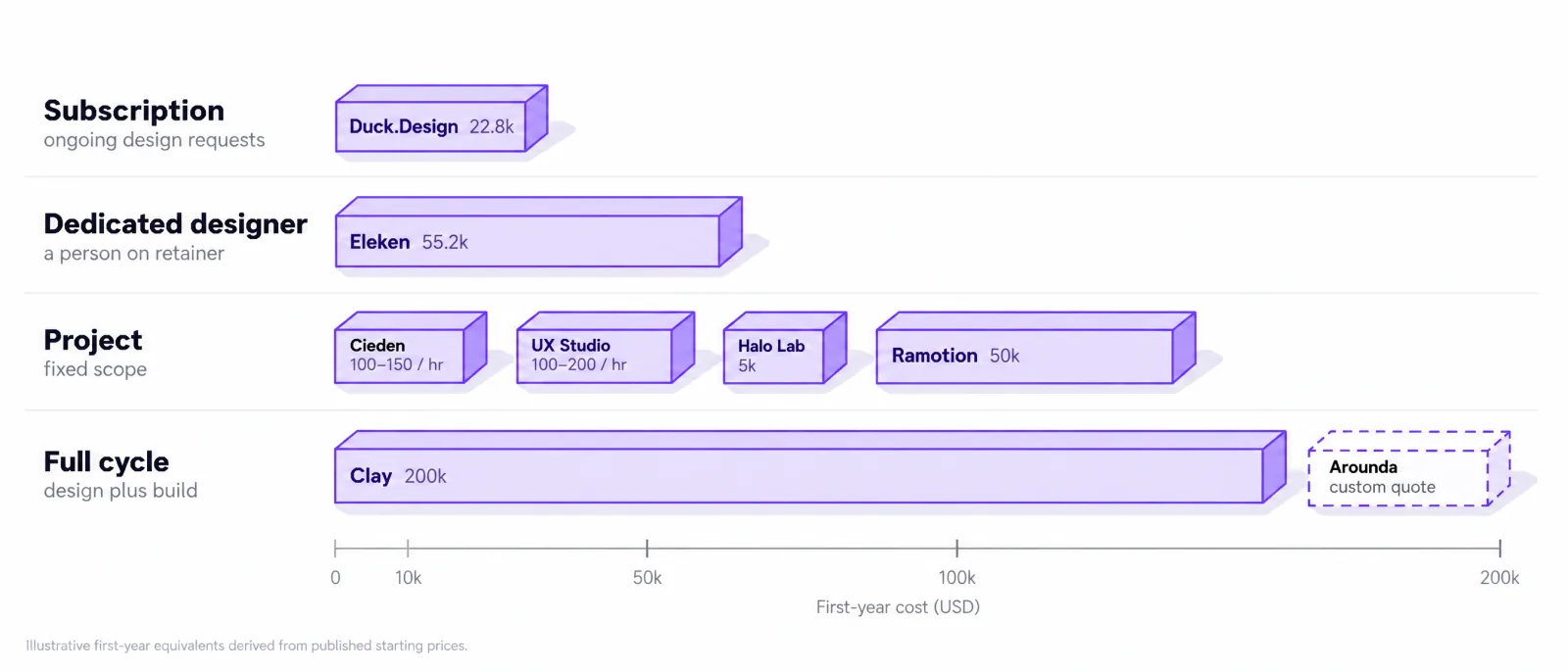
The table mixes four different billing units, which makes the prices impossible to compare at a glance. Monthly subscriptions, hourly rates and fixed project budgets all describe the same thing from different angles. Put on one first-year axis, the gap opens up: Ramotion and Clay cost roughly as much as ten months of a Duck.Design subscription, and Arounda's custom quote sits outside the scale entirely.
1. Duck.Design
Duck.Design is a leading provider of SaaS UI/UX design services, helping software companies create intuitive digital products and maintain consistent user experiences through a flexible subscription model. The company provides access to a multidisciplinary design team covering product interfaces, mobile applications, websites, branding, and other creative requirements. Its subscription approach allows SaaS businesses to manage ongoing design requests without repeatedly negotiating separate project contracts. This makes it particularly useful for product teams that need continuous design improvements as their software evolves.
Key services:
- UI/UX design for SaaS platforms and web applications
- Dashboard and user interface design
- Mobile app design
- Website and landing page design
- UX and UI redesign
- Design systems and reusable components
- Branding and visual identity
- Interactive prototypes and motion graphics
Pricing: Duck.Design offers subscription-based services starting at $1,899 per month for its Creative Suite plan, which includes UX/UI design alongside branding and motion graphics. Higher-tier arrangements provide additional design capacity and support for broader creative requirements.
Best for: SaaS startups and growing software companies that need continuous UI/UX improvements, product interface design, and additional creative services under one predictable subscription.
Why they stand out:
- Flexible subscription model: Product teams can submit ongoing design requests without having to negotiate a new project budget for every interface update or creative deliverable.
- Multiple design disciplines: The service combines UI/UX, branding, website design, and motion graphics, allowing SaaS companies to coordinate several creative requirements with one provider.
- Fast design delivery: Initial versions of standard requests can be delivered within 24–48 hours on business days, helping teams maintain momentum during product sprints.
- Developer-ready deliverables: Clickable prototypes, design components, specifications, and native design files help internal developers translate approved interfaces into functional product features.
2. Eleken
Eleken is a UI/UX design agency specializing exclusively in SaaS products, helping software companies improve usability and build interfaces that support complex workflows. Its primary engagement model provides clients with dedicated product designers who become familiar with their platform and work alongside internal teams. The agency has experience with dashboards, data-heavy applications, onboarding flows, and multi-role software interfaces. This specialization makes Eleken particularly relevant to SaaS companies that need consistent product design rather than occasional visual updates.
Key services:
- SaaS product UI/UX design
- User research and UX audits
- Dashboard and data visualization design
- MVP and application interface design
- User onboarding optimization
- Design systems and component libraries
- Product redesign and usability improvements
Pricing: Eleken offers monthly subscription plans starting at $4,599 for a part-time designer working 20 hours per week. A full-time designer costs $6,599 per month, while a two-designer engagement starts at $11,999 per month.
Best for: B2B SaaS companies that already have product managers and developers but need a dedicated UI/UX designer to continuously improve their software.
Why they stand out:
- SaaS-only specialization: Eleken focuses on software products, giving its designers experience with complex dashboards, application navigation, user permissions, and multi-step workflows.
- Dedicated designer model: Clients work with a designer who becomes familiar with their product, reducing the need to repeatedly explain requirements and business logic.
- Ongoing UX improvements: The subscription structure supports continuous work on onboarding, new features, interface redesigns, and usability issues.
- Direct collaboration: Designers can work within the client's existing communication and project management tools, making coordination with product and engineering teams easier.
3. Cieden
Cieden is a digital product design agency specializing in B2B SaaS, fintech, and AI-powered applications. The company combines UX research, product strategy, prototyping, and interface design to help businesses turn complex software functionality into understandable user experiences. Its work is particularly relevant to platforms with sophisticated business logic, multiple user roles, and data-intensive interfaces. Cieden also offers focused design engagements, allowing product teams to address specific UX challenges before committing to a broader redesign.
Key services:
- SaaS product design and UX strategy
- User research and competitive analysis
- UI/UX design for web applications
- MVP design and interactive prototyping
- UX audits and usability testing
- AI product interface design
- Design systems and component libraries
- Product discovery and information architecture
Pricing: Publicly listed hourly rates are approximately $50–$99, depending on the engagement. Fixed-price projects and dedicated design support are quoted according to complexity and scope.
Best for: B2B SaaS and AI companies that need research-backed product design, particularly those dealing with complex workflows, enterprise dashboards, and sophisticated application functionality.
Why they stand out:
- Complex workflow expertise: The agency focuses on making sophisticated software easier to understand and use, an important capability for enterprise SaaS products.
- Research-led approach: User research, information architecture, and product discovery help establish a foundation for design decisions before interface development begins.
- Rapid prototyping: Interactive prototypes allow teams to explore functionality and validate product concepts before investing in full implementation.
- AI product experience: Its experience with AI-powered applications is relevant to SaaS companies introducing intelligent features, automated workflows, and new interaction patterns.
4. UX Studio
UX Studio is a research-driven UX design agency that helps SaaS companies improve digital products through user-centered design and continuous product development. The Budapest-based team works with B2B software businesses, combining UX research, interface design, and development expertise. It also has experience building its own digital products, including UXfolio and Copyfolio, giving the team a practical perspective on the challenges of maintaining software used by real customers. Its approach is particularly suitable for companies that want to understand why users struggle with their product before investing in a redesign.
Key services:
- UX research and user interviews
- SaaS product design
- UI/UX audits and usability evaluations
- User journey mapping and information architecture
- Dashboard and web application design
- Interactive prototyping and usability testing
- Design systems and frontend development
Pricing: UX Studio offers project-based and embedded design engagements. Publicly available hourly estimates are approximately €42–€85, depending on the team and project requirements.
Best for: B2B SaaS companies that need research-driven redesigns, improved usability, or ongoing product design support.
Why they stand out:
- Research-first methodology: UX research helps identify user frustrations, navigation problems, and functionality that customers struggle to understand.
- Experience building digital products: Its own products provide practical insight into user engagement, product usability, and the challenges of maintaining software over time.
- Embedded collaboration: Dedicated designers can integrate with internal product teams, creating continuity throughout the design and development process.
- Design and development capabilities: The agency can support both the design process and implementation, helping reduce the gap between prototypes and functional interfaces.
5. Arounda
Arounda is a digital product design and development company helping SaaS businesses create user experiences that support engagement, adoption, and retention. Its services cover the entire product design process, from discovery and UX strategy to interface design, prototyping, and development. The agency works with businesses across SaaS, fintech, AI, and other digital industries, focusing on solving practical product problems rather than simply modernizing visual elements. Its combination of design and development capabilities makes it relevant to companies that want to improve their software without coordinating several independent providers.
Key services:
- SaaS product strategy and discovery
- UX research and user journey mapping
- UI/UX design for web and mobile applications
- User onboarding and activation flows
- Dashboard and data visualization design
- Design systems and reusable components
- Usability testing and UX optimization
- Web and software development
Pricing: Custom project-based and monthly engagement pricing. Final costs depend on product complexity, design requirements, team composition, and whether development is included.
Best for: SaaS companies that want to improve product engagement and retention through better onboarding, dashboards, navigation, and integrated design and development.
Why they stand out:
- Retention-oriented product design: The agency considers onboarding completion, feature adoption, engagement, and churn when planning UX improvements.
- Full product lifecycle support: Its services cover discovery, design, prototyping, and development, making it possible to work with one team throughout the project.
- Experience with complex digital products: Its portfolio includes SaaS, fintech, and AI applications that require structured interfaces and clear information architecture.
- Design aligned with business goals: The team connects usability improvements with measurable product objectives instead of treating visual redesign as the only measure of success.
6. Halo Lab
Halo Lab is a design and technology company providing UI/UX design, branding, and software development services for SaaS businesses and other digital companies. Its SaaS-specific capabilities include designing onboarding experiences, dashboards, web applications, and scalable design systems. The agency combines user research with product design and engineering, allowing software companies to move from early product discovery to implementation with one partner. Its broad in-house team also makes it suitable for projects requiring several design and development disciplines.
Key services:
- SaaS UI/UX and product design
- UX research and product discovery
- User onboarding and activation design
- Dashboard and web application design
- Design systems and component libraries
- Website and landing page design
- MVP and custom software development
- Frontend and mobile application development
Pricing: Project-based pricing, with publicly advertised market estimates starting at approximately $5,000. Larger SaaS design and development engagements require individual quotes based on scope and technical complexity.
Best for: SaaS startups and established software businesses looking for an integrated partner covering product design, interface development, and website creation.
Why they stand out:
- End-to-end SaaS capabilities: Halo Lab combines product design and software development, helping teams coordinate design decisions with technical implementation.
- Dedicated SaaS services: Its service offering specifically addresses onboarding, dashboards, design systems, and other important elements of software experiences.
- User-centered methodology: Product discovery, research, prototyping, and validation help establish a clearer understanding of customer needs.
- Scalable delivery: Its multidisciplinary in-house team can support projects that require several specialists working across product design, branding, and development.
7. Ramotion
Ramotion is a digital product and brand design studio specializing in sophisticated interfaces for SaaS companies and technology businesses. Since its establishment, the company has worked with software platforms and technology organizations to simplify complex product experiences and create consistent visual systems. Its SaaS design capabilities combine user experience, interaction design, and visual design, helping businesses make feature-rich applications easier to navigate. Ramotion is particularly relevant to established products that need a full redesign or more mature design systems.
Key services:
- SaaS product UI/UX design
- Product strategy and UX research
- Dashboard and application interface design
- Interaction design and prototyping
- UX redesign and usability optimization
- Design systems and component libraries
- Branding and visual identity
- Frontend development
Pricing: Premium project-based engagements. Publicly listed starting budgets are approximately $50,000 per project, with complex full-product design engagements potentially costing $80,000–$200,000 or more.
Best for: Funded SaaS companies and established technology businesses that need sophisticated product interfaces, scalable design systems, and coordinated product branding.
Why they stand out:
- Complex SaaS interface expertise: The agency works on software products where usability depends on simplifying large amounts of information and functionality.
- Scalable design systems: Reusable components and consistent interface guidelines help product teams maintain design quality as their platforms expand.
- Strong product and brand integration: Ramotion can align application interfaces with broader brand identity and digital experiences.
- Enterprise-level execution: Its experience with large technology organizations makes it a relevant option for software businesses with demanding design requirements and substantial budgets.
8. Clay
Clay is a premium digital product design and branding agency known for creating polished user experiences for technology companies and global brands. Its work combines product strategy, UX research, interface design, and visual identity to create cohesive experiences across digital platforms. The agency has experience with complex products and enterprise interfaces where usability, consistency, and brand perception are all important. Its approach is especially relevant to established SaaS businesses looking to modernize their product experience or strengthen their market positioning.
Key services:
- SaaS product strategy and UX design
- UI/UX design for web and mobile applications
- UX research and usability testing
- Enterprise dashboard and interface design
- Interaction design and prototyping
- Brand strategy and visual identity
- Design systems and component libraries
- Website and digital experience design
Pricing: Custom premium project pricing. Independent market listings commonly indicate project minimums around $50,000 and hourly rates of approximately $150–$199, although the actual cost depends on scope and team requirements.
Best for: Well-funded SaaS companies and established technology businesses seeking premium product design, sophisticated interfaces, and consistent brand experiences.
Why they stand out:
- Premium product execution: Clay focuses on refined digital experiences that combine usability, visual consistency, and attention to interaction details.
- Strategic design expertise: Product strategy and UX research help align the interface with customer expectations and business objectives.
- Enterprise interface capabilities: The agency has experience designing sophisticated digital products and interfaces with demanding functional requirements.
- Brand consistency: Combining product design and branding helps companies create a recognizable experience across their website, software, and other digital touchpoints.
How to choose a SaaS UI/UX design agency for your needs
Choosing a SaaS UI/UX design agency requires understanding what is preventing users from getting value from your product. A company struggling with onboarding needs a different design partner from one dealing with inconsistent interfaces, complicated dashboards, or poor feature adoption.
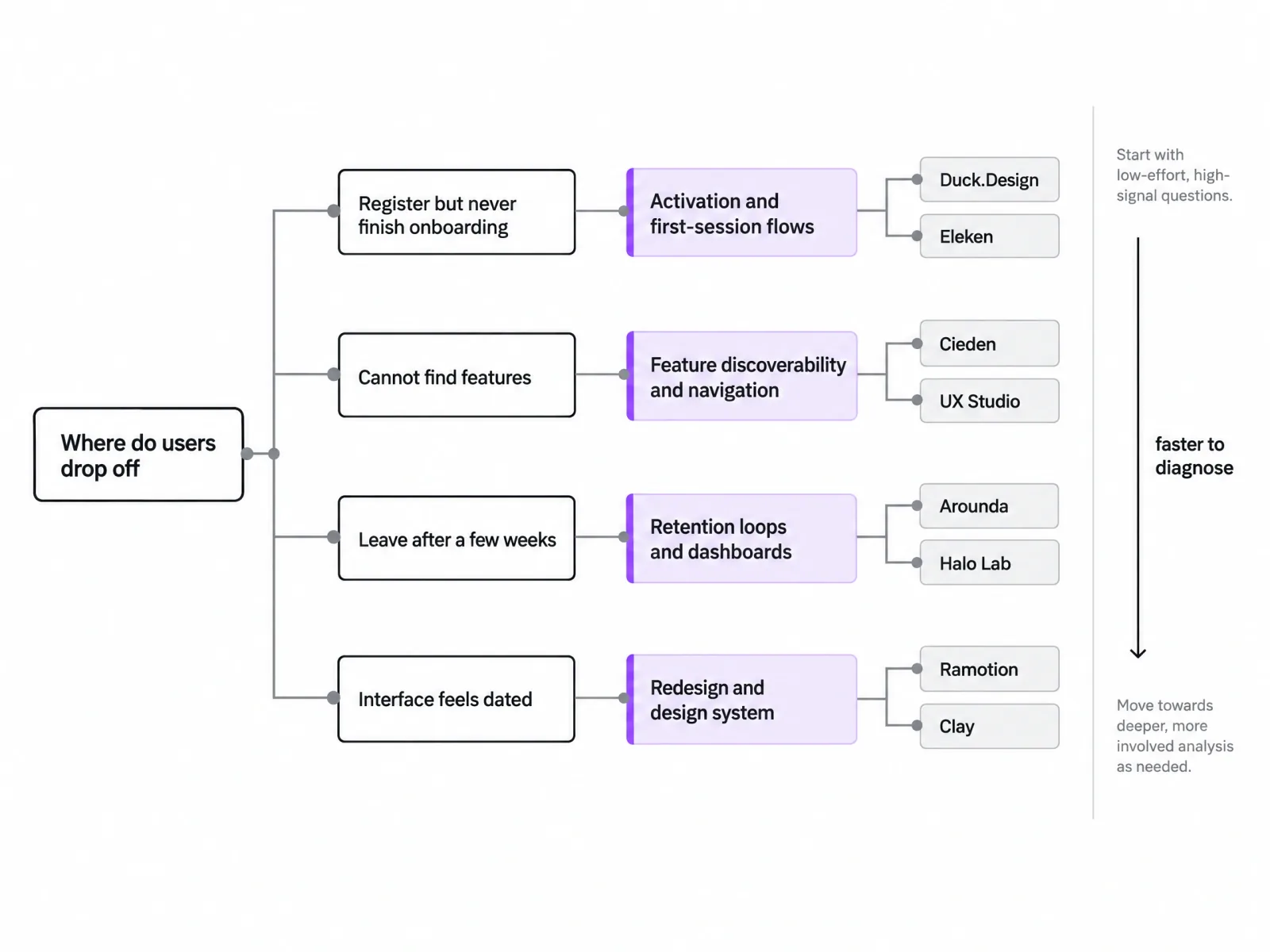
The tree below shortens the shortlist. Start from where users actually drop off, follow the branch to the design response it calls for, and the agencies that fit sit at the end of it. Duck.Design and Eleken handle activation gaps, Cieden and UX Studio cover discoverability, Arounda and Halo Lab work on the long tail of engagement, and Ramotion with Clay take the redesign route.
Consider the following factors before making your decision.
1. Identify your main product UX challenge
Start by examining where users experience the most friction.
- If users register but never complete onboarding, look for agencies with experience designing activation flows and first-time user experiences.
- If customers struggle to navigate your platform, prioritize information architecture, UX research, and usability testing.
- If users ignore important features, consider agencies experienced in feature discoverability, contextual guidance, and product navigation.
- If customers leave because the interface feels outdated or inconsistent, look for expertise in product redesign and design systems.
2. Prioritize SaaS-specific experience
SaaS products have different design requirements from conventional business websites. They often include dashboards, account settings, subscription management, integrations, user permissions, and complex workflows.
Review case studies involving software products similar to yours. Pay particular attention to how agencies approach functional requirements, different user roles, and the relationship between interface design and actual product functionality.
3. Evaluate their UX research process
A design partner should understand why users behave in certain ways before proposing interface changes.
Ask whether the agency can work with customer interviews, product analytics, session recordings, usability testing, and competitor research. These methods help identify problems that may not be obvious from the interface itself.
4. Check design system capabilities
As SaaS products grow, their interfaces often become inconsistent because different teams develop new features independently. A well-structured design system helps prevent this problem.
Look for agencies that can create reusable components, typography standards, color tokens, interaction patterns, and documentation that developers can use throughout the product lifecycle. Our write-up on design systems for business covers the same ground from the product side.
5. Match the engagement model to your roadmap
Different engagement structures work better for different requirements.
- Subscription-based design: Suitable for continuous design requests, regular interface updates, and evolving product roadmaps.
- Dedicated designers: Useful when you need a specialist who works closely with your internal product and engineering teams.
- Project-based engagements: Better for clearly defined initiatives such as an MVP, UX audit, or complete product redesign.
- Full-cycle partnerships: Appropriate when you need product discovery, design, and software development from one provider.
6. Connect design deliverables to retention metrics
Ask how the agency will evaluate the effectiveness of its work. Relevant metrics can include onboarding completion, activation rate, time-to-value, feature adoption, task completion, and product retention.
Remember that design is only one contributor to retention. Pricing, product-market fit, customer support, performance, and feature quality also influence whether users remain customers. A good agency should be able to explain how its design work addresses specific usability problems rather than promise a particular retention increase without evidence.
Questions to ask before hiring a SaaS UI/UX design agency
Before signing a contract, make sure the agency understands your product, users, and business objectives. The following questions help evaluate whether a potential partner can address real usability challenges and collaborate effectively with your internal team.
| Question | Why it matters |
|---|---|
| Have you worked on SaaS products similar to ours? | Establishes whether the agency understands your product category, user roles, and technical requirements. |
| How do you identify UX problems that affect user retention? | Reveals whether the team uses research, product analytics, and usability testing to identify friction. |
| Can you improve our existing onboarding experience? | Helps determine whether the agency can simplify registration, initial setup, and the path to the product's core value. |
| How do you approach complex dashboards and workflows? | Shows how the team handles information architecture, data visualization, and sophisticated functionality. |
| Do you conduct usability testing before finalizing designs? | Helps establish whether proposed interfaces are validated with users rather than approved solely on visual preferences. |
| Can you create a scalable design system? | Determines whether the agency can establish reusable components and consistent design standards for future development. |
| How do you collaborate with in-house developers? | Clarifies the handoff process, documentation, communication channels, and implementation support. |
| How do you measure the success of a redesign? | Establishes whether the agency connects its work to measurable indicators such as activation, engagement, and feature adoption. |
Red flags when choosing a SaaS UI/UX design agency
Plenty of agencies offer UI/UX services without the product experience that improving a SaaS platform requires. Watch for these warning signs during the selection process.
1. A portfolio focused only on visual design
If an agency showcases attractive screens but cannot explain the UX decisions behind them, it may lack experience with complex software products. Look for examples demonstrating improved navigation, simplified workflows, and practical usability solutions.
2. No user research or testing
An agency that immediately starts designing without understanding your customers may produce interfaces based on assumptions. UX research and usability validation should be part of the process, especially when redesigning an existing product.
3. Promises of guaranteed retention improvements
No design agency can guarantee a specific retention increase through interface changes alone. Retention depends on several factors, including product value, pricing, customer support, and market fit. Be cautious of providers promising dramatic results without explaining the methodology behind their projections.
4. Limited understanding of SaaS functionality
Designing a dashboard is not simply arranging charts and buttons. SaaS products often involve permissions, account management, subscriptions, integrations, and complex user journeys. An agency unable to discuss these elements may struggle with your product requirements.
5. No clear developer handoff process
Incomplete Figma files, missing component documentation, and unclear interaction specifications create additional work for engineering teams. Before hiring an agency, confirm how designs will be documented and prepared for implementation.
6. Unclear pricing and project scope
Vague estimates, undefined revision limits, and unclear deliverables can lead to unexpected costs. Make sure the contract explains what is included, who is responsible for each deliverable, and how additional requests will be handled.
7. Poor communication and no design ownership
A reliable design partner should communicate decisions, explain recommendations, and respond to feedback. Be cautious when an agency cannot identify the people responsible for your project or explain how progress will be tracked.
Final thoughts
The right SaaS UI/UX design agency can help transform a functional software product into an intuitive experience that customers understand and want to continue using. From simplifying onboarding to improving navigation and feature discoverability, effective design addresses the friction points that often stand between users and long-term product adoption.
The best choice depends on your product's current challenges, budget, development resources, and long-term roadmap. Prioritize an agency that understands how customers interact with your software and can translate that understanding into practical improvements. A successful UI/UX partnership should not end with a redesigned interface; it should establish a foundation for continuous product improvement and stronger user retention.
Frequently asked questions
What is SaaS UI/UX design?
SaaS UI/UX design is the process of creating and improving the interfaces and user experiences of software-as-a-service products. It involves user research, information architecture, navigation, onboarding, dashboards, interaction design, and usability testing. The goal is software that stays intuitive and easy to use through the customer journey.
How can UI/UX design improve SaaS user retention?
UI/UX design can improve retention by reducing friction and helping customers receive value from a product more easily. Clear onboarding, intuitive navigation, accessible features, and consistent workflows encourage users to engage with the software. These improvements can reduce frustration and make customers more likely to continue using the product.
How much do SaaS UI/UX design agencies charge?
Pricing depends on the agency's specialization, team structure, and project complexity. Subscription-based services can start at approximately $1,900 per month, while dedicated SaaS designers often cost $4,500–$7,000 monthly. More extensive product redesigns and enterprise engagements can require budgets of $50,000 or more.
What should a SaaS UI/UX design agency deliver?
A SaaS UI/UX design agency should provide deliverables that support both product usability and implementation. These may include UX research findings, user journey maps, wireframes, interactive prototypes, high-fidelity interface designs, design systems, responsive layouts, and developer documentation.
What is the difference between SaaS UX design and UI design?
UX design focuses on how users interact with software, including navigation, workflows, information architecture, and usability. UI design focuses on the interface's visual and interactive elements, such as buttons, typography, colors, layouts, and components. Both disciplines are necessary to create SaaS products that are functional and visually consistent.
How often should SaaS companies redesign their user interfaces?
There is no universal redesign schedule for SaaS products. Instead of waiting several years for a complete overhaul, companies should regularly evaluate usability, monitor customer feedback, and improve interfaces as product requirements evolve. Major redesigns are most useful when existing UX problems cannot be addressed through smaller iterative changes.
Should SaaS startups hire a freelance designer or a UI/UX agency?
A freelance designer can be a cost-effective choice for clearly defined tasks, particularly when a startup already has product strategy and UX research capabilities internally. An agency is generally more suitable when a company needs multiple specialists, including UX researchers, product designers, and design system experts. The right option depends on the complexity of the product and the amount of ongoing support required.
Which SaaS UX metrics should businesses track?
SaaS companies should monitor metrics that reveal how users find and keep using product features. Important indicators include activation rate, onboarding completion, time-to-value, feature adoption, task completion rate, user engagement, customer retention, and churn rate. Combining these metrics with qualitative user feedback provides a more complete understanding of product usability.