



Roman Kamushken
In April a founder I know paid $450 for a guest post on a DR 55 marketing blog. The pitch was polite. The Ahrefs screenshot showed 38,000 monthly organic visits. The post went live in 48 hours with a do-follow link to his pricing page.
Three months later he searched site: plus the domain. Zero results. Google had deindexed the entire site, so the link now points from a page that no longer exists in the index. The $450 is gone, and so is the writer's time.
Every signal that predicted this was visible before he replied to the email. He just did not know what to look for.
Guest post outreach in 2026 is a wasteland. Copy-paste pitches from resellers who own nothing. PBN networks (private blog networks, groups of sites built only to sell links) dressed up as niche blogs. Traffic numbers inflated by bot farms. Your job as a buyer is to filter out 90% of what lands in your inbox before spending a cent.
Below are 13 red flags, most of them checkable without a paid tool, followed by a 5-minute workflow to run on every pitch that survives the first glance.
The meta red flag, how the pitch reveals the site
Outreach quality and site quality move together. The person who sends 5,000 templated emails a week runs the site the same way.
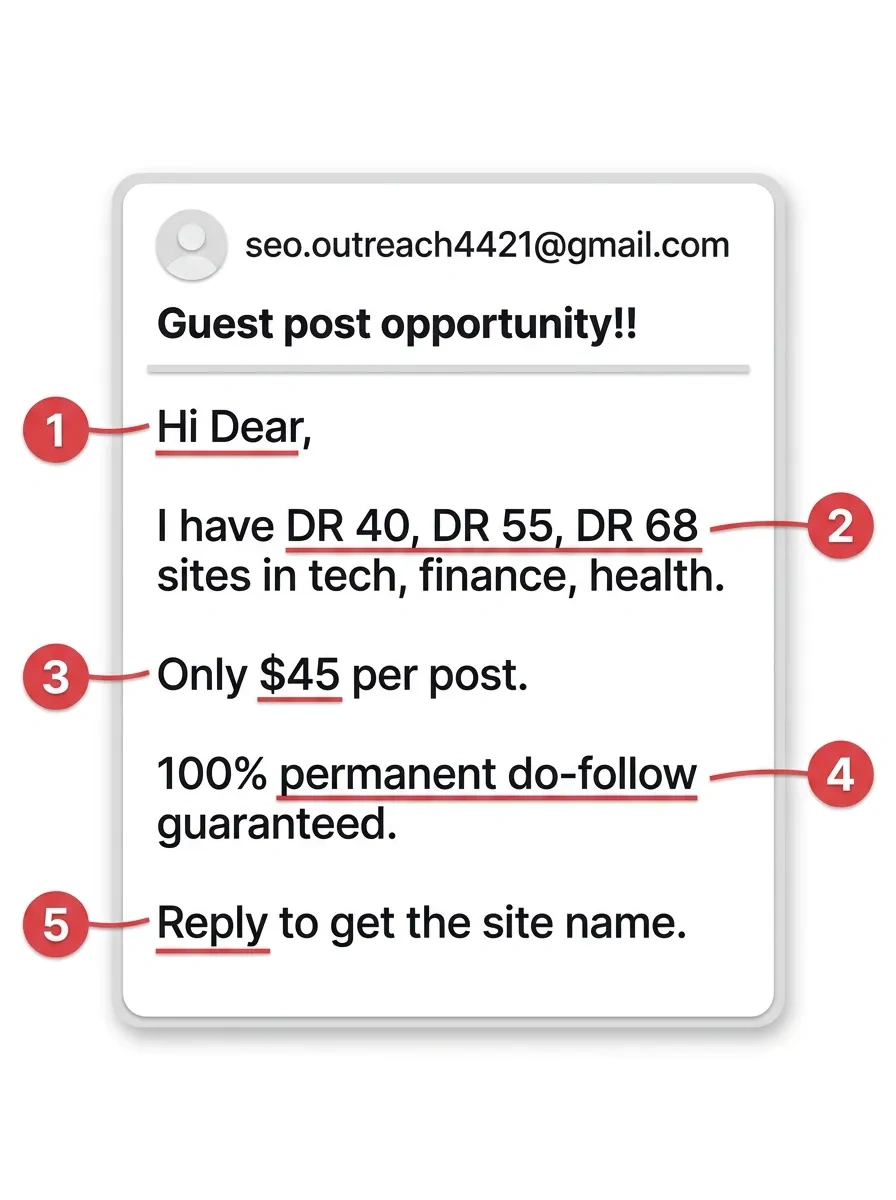
1. The email opens with "Hi Dear" or gets your name wrong
"Hi Dear," "Dear Webmaster," "Hi [First Name]," or a greeting addressed to your co-founder who left two years ago. Any of these means the sender scraped your domain from a list and never opened your site.
That same person publishes your post. The editorial standard you are buying is the standard you see in the greeting. A publisher who cannot get your name right will not fix broken formatting in your article, and will not notice when a casino affiliate slides in next to it either.
Delete without replying.
2. The pitch offers 5+ sites in a single email
"I have DR 40, DR 55, and DR 68 sites in tech, finance, and health. Take your pick." This is a reseller, and a reseller owns none of the inventory.
Legitimate publishers sell their own site. They know the editor's name because they are the editor. A reseller sits between you and an unknown site owner, takes 30-50% as margin, and cannot promise your post stays live or keeps its do-follow attribute. When the site drops out of the index, the reseller has already moved on to the next list.
3. The pitch quotes a price under $100
Run the math on a real editorial post. A writer at freelance rates costs $50-100 for 1,200 words. An editor spends an hour reviewing at $30-50. Publishing and formatting take another 30 minutes. Real cost per post lands at $80-150 before the publisher makes a cent.
A $50 offer means one of two things. Either the content is AI-spun with no human review, or the site is a PBN where nothing is reviewed because there are no readers to review it for. Both put your link in a neighborhood Google's spam systems already know about.
Our own guest post cost breakdown for 2026 puts the floor for a real editorial placement at $200. Anything under $100 is priced for volume, and volume is the PBN business model.
4. The site name is hidden until after you reply
"I run a great DR 45 tech blog with real US traffic. Interested?" No URL. No name.
The seller knows you would reject the site on sight. That is the only reason to hide it. A publisher proud of their site puts the URL in the first line, because the URL is the product.
Reply-gating also feeds the reseller funnel. Once you answer, you are a warm lead who gets pitched a different site every week for a year. Never engage.
Red flags in the site itself
Open the site. Spend 30 seconds. This visit tells you more than any metric screenshot the seller will ever send.
5. The homepage looks like a WordPress default from 2016
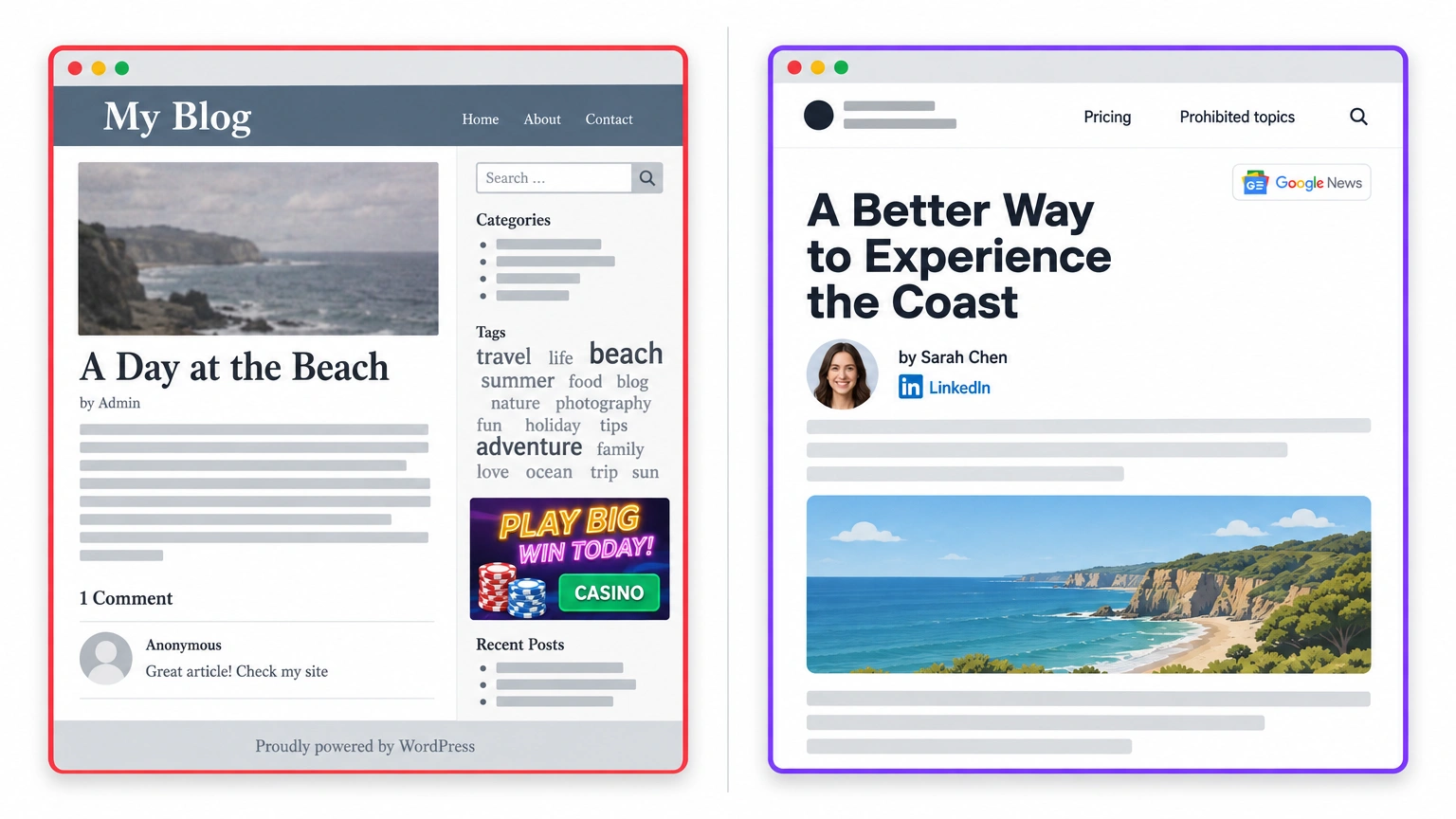
Default theme, stock hero image, sidebar with a tag cloud, footer that says "Proudly powered by WordPress." No logo beyond a text string. No about page with a face on it.
Real content sites invest in design because design is how they keep readers. A PBN uses the cheapest template because it was never built for readers. It exists to hold links, and the operator runs 40 more sites that look identical with a different color scheme.
Visual triage catches more PBNs than Ahrefs does. Eyes first, data second.
6. Every post is by "Admin" or a stock-photo author
Click any byline. If it says "Admin," "Editorial Team," or a name with an AI-generated headshot and a two-sentence bio, you are looking at fake authorship.
Search that name on LinkedIn. A real editor has a profile, a job history, and usually a post or two about the publication. A fake byline has nothing, or a profile created last month with 12 connections.
Fake bylines are editorial fraud. Google's quality raters look for author identity as part of E-E-A-T (Experience, Expertise, Authoritativeness, Trustworthiness). A site that fakes its authors will fake the traffic numbers it sent you too.
7. Comment sections are either empty or filled with obvious spam
Scroll to the bottom of three recent posts. Real audiences leave the occasional comment, even in 2026 when most discussion has moved to social. Zero comments across 3 years of publishing means zero readers. Comments that say "Great article! Check out my site" with a link to a pharmacy mean zero moderation.
Either way, referral traffic from your placement will be zero, whatever the Ahrefs estimate says. Disabled comments are neutral; many real publishers turned them off. Enabled and empty is the signal.
8. The publishing schedule is 5-15 posts per day
Check the blog archive or the sitemap. A real editorial team with 2-4 people publishes 3-10 posts per week. That is what human review allows.
A site pushing 5-15 posts per day with no visible newsroom is running a content mill. Every one of those posts is a paid placement, and yours will be buried under 60 more by the end of the week. Internal link equity gets split across hundreds of new URLs a month.
Volume is the clearest signature of a site that sells everything to everyone. The publishers worth pitching all share a slower cadence.
Red flags in the metrics
Screenshots are cheap. Every number a seller sends you can be edited in a browser inspector in 20 seconds. Here is how to catch the edits.
9. Ahrefs traffic doesn't match anything else
Pull the domain in Ahrefs, then SimilarWeb, then Semrush. The three tools use different models and will never agree exactly. A 2x spread is normal. A 5x spread is manipulation.
If the seller sends a Google Analytics screenshot, look for the browser URL bar and the property name in the top-left of the GA interface. Cropped screenshots that hide both are worthless. Ask for GA4 read-only access for 24 hours. A real publisher grants it. A seller who refuses has something to hide, and that refusal ends the conversation.
Bot traffic also shows up as a flat line. Real traffic has a weekday rhythm and dips around holidays. A graph that looks like a ruler was drawn by a script.
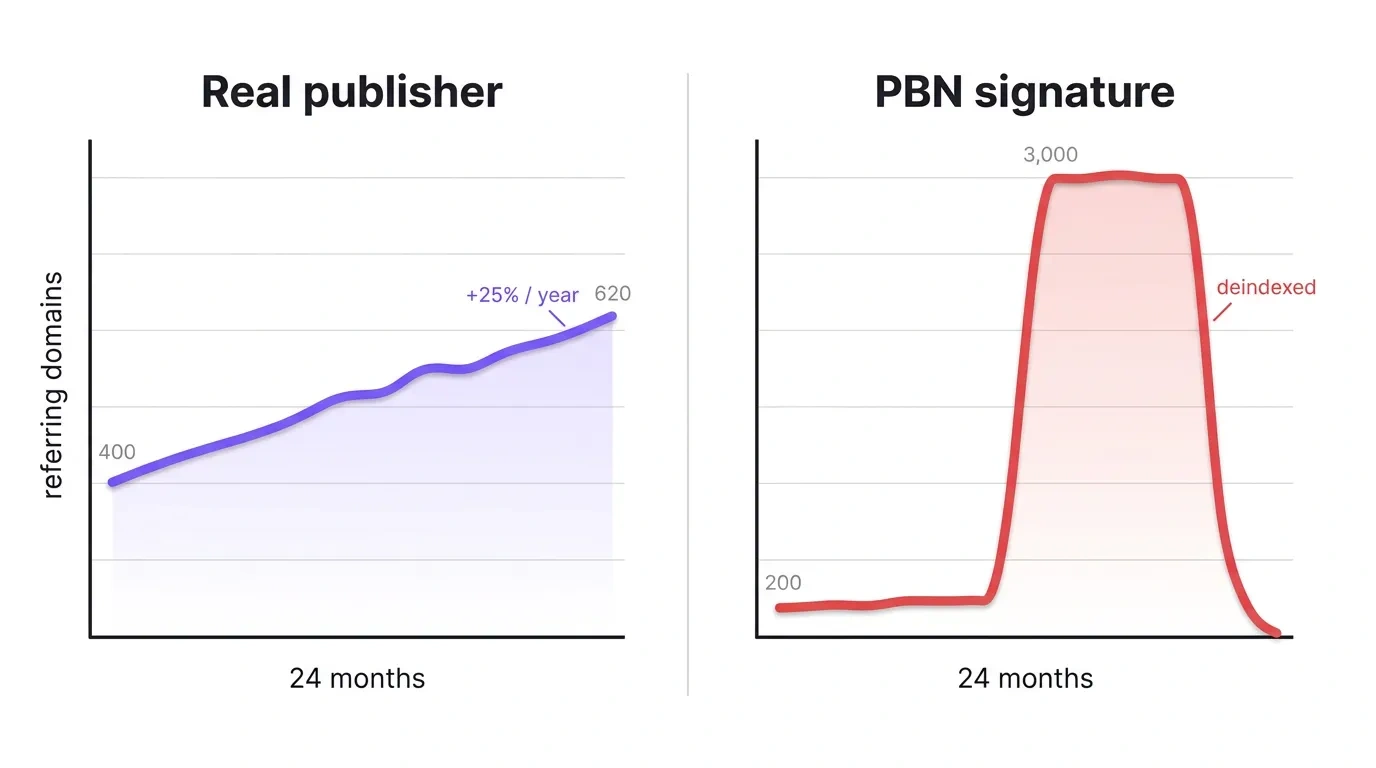
10. Referring domains growth chart is a hockey stick
Open the referring domains graph in Ahrefs Site Explorer. A real site grows 20-30% a year, with bumps around a viral post or a PR mention. A PBN or link-farm site jumps from 200 referring domains to 3,000 in six months, then flattens or crashes.
That shape is a paid-network signature. The operator built the links in a burst to inflate DR before selling placements. When Google's penalty lands, your link goes down with the site. The founder in the opening story would have seen exactly this graph.
Ahrefs published a detailed piece on how to identify a PBN from its backlink footprint. The referring domain chart is step one in their process too.
11. The site ranks for hundreds of unrelated keywords
In Ahrefs, open Organic Keywords and sort by traffic. A "tech blog" that pulls its top traffic from "online casino bonus," "cbd gummies," "payday loan," and "buy essay online" is a link farm with cross-vertical spam.
Your post will sit next to gambling promo content, and site-wide reputation drags every page on the domain. A clean placement on a smaller site that ranks only for its stated niche beats a DR 60 domain that ranks for everything.
Quick version without Ahrefs: search site:domain.com casino and site:domain.com cbd. If either returns results on a site that claims to be about SaaS, close the tab.
12. Anchor text distribution is 60%+ exact-match commercial
Open the site's outbound links report (in Ahrefs, Outgoing Links, then Anchors). Read the anchors. A real publication links out with anchors like "this study," "Stripe's pricing page," or the name of a source.
A paid-link factory links out with "best crypto wallet," "buy insurance online," "top VPN 2026." When 60% or more of external anchors are money keywords, the site exists to sell those anchors. Google's link spam policy names this pattern explicitly: optimized anchor text in articles, distributed as part of a paid scheme.
A site that already looks like this to Google cannot pass equity to you. It only passes association.
Red flags in the deal terms
13. No editorial rejection, no revision loop, no prohibited topics list
Ask three questions before paying. Do you reject submissions? Do you request revisions? Which topics do you refuse?
A real publisher has answers, and usually a public page with them. They reject posts that miss their bar. They send drafts back with edits. They refuse casino, adult, CBD, and payday loan content because those topics poison the domain for everyone else on it.
A site that accepts everything for a fee has no quality gate. Your article sits alongside whatever the last buyer paid to place, and your link's value averages down to its neighbors. Our own submission guidelines publish the rejection criteria for exactly this reason: buyers should know what they are paying to sit next to.
The 5-minute evaluation workflow
Run this before replying to any pitch. Most sites fail by step 3.
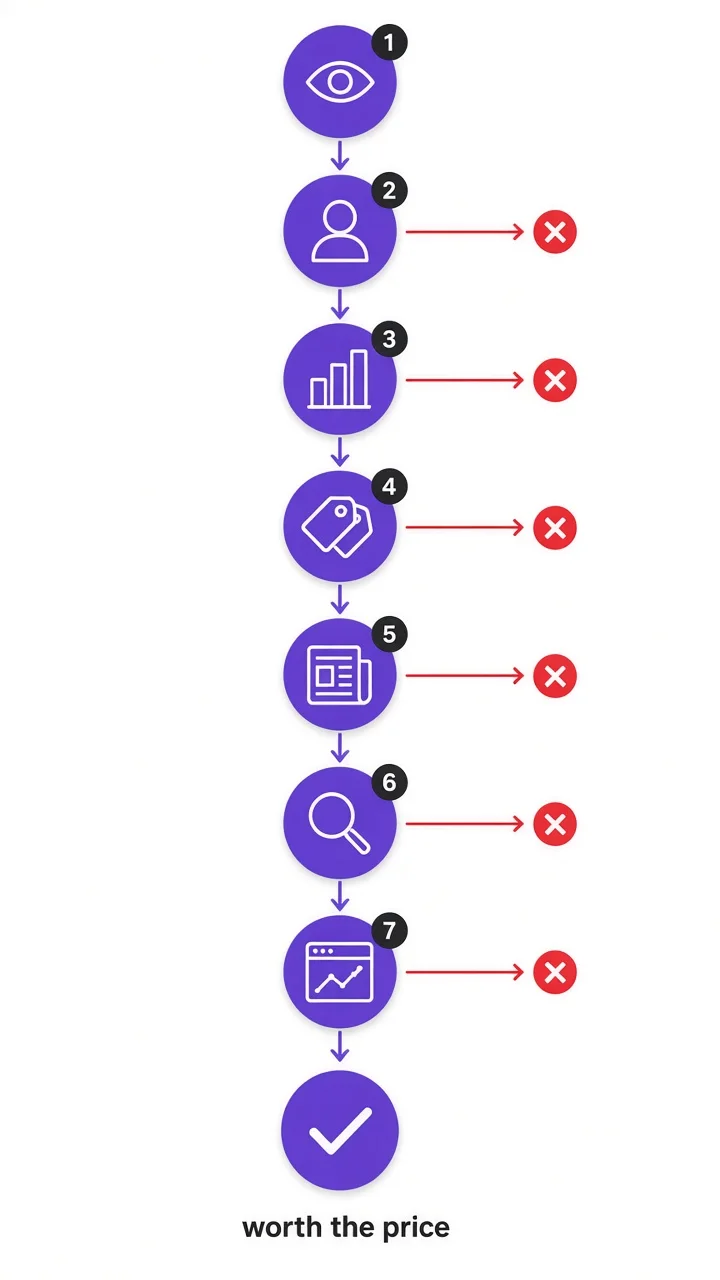
❶ Open the site and read two recent posts. If either reads like AI slop or has broken English, stop. Nothing downstream will fix this.
❷ Click a byline and check the /author URL. Search that name on LinkedIn. One verified human editor is the minimum.
❸ Paste the domain into Ahrefs. Note DR, referring domain count, and the shape of the referring domains graph. Hockey stick means stop.
❹ Scan Organic Keywords for off-topic verticals. Casino, CBD, loans, essays. One stray keyword is noise. A cluster is a link farm.
❺ Check Google News inclusion. Search site:domain.com at news.google.com. Inclusion is a trust signal most PBNs cannot fake. We covered why News inclusion matters for guest posts in detail.
❻ Search site:domain.com "guest post" and site:domain.com sponsored. You want to see whether the site discloses paid placements or hides them. Disclosure is fine. Hundreds of undisclosed placements is the pattern Google's spam updates have targeted in every release since 2024.
❼ Ask the seller for a GA4 screenshot with the URL bar visible. Or read-only access for 24 hours. Refusal ends the conversation.
☞ If the site passes all seven, the price is worth paying. If it fails three or more, walk away regardless of DR. DR measures link volume, and link volume is what PBNs are built to fake.
What green flags look like
The contrast is useful. Here is what a publisher that respects its own domain does differently.
→ A public pricing page. "Message for rates" means the price depends on how much they think you will pay.
→ An explicit prohibited topics list. Casino, CBD, adult, payday loans, essay mills. Published, and enforced.
→ Public evaluation criteria for accepted content. Word count floor and originality requirements, stated up front.
→ A named editor with a LinkedIn profile that predates the site.
→ A cadence of 3-10 posts per week, every week, for at least a year.
→ Real GA or Search Console numbers on request, with the URL bar in the screenshot.
→ Google News inclusion where the niche supports it.
→ A reply within 48 hours, from a person, addressing your actual pitch.
A publisher that checks every item on this list rejects a large share of what gets submitted. That rejection rate is the product. It keeps the domain clean enough for your link to mean something.
Frequently asked questions
What is a fair price for a guest post in 2026?
For a real editorial site with a human editor and a rejection policy: $200-800 at DR 30-50, $800-2,500 at DR 50-70, and above $2,500 for enterprise media with a newsroom. Anything under $100 is priced for volume, which means no review and a high chance of PBN placement.
Can Google penalize you for buying guest post links?
Yes. Google's spam policies name paid links that pass PageRank as link spam. In practice the penalty hits the selling site first, and your link loses value when that site drops. A manual action against the buyer is rarer but documented. Placing on sites with real editorial standards is the only durable protection.
How do you tell if a guest post site is a PBN?
Look for a referring domains chart that spikes in a short window, organic rankings across unrelated verticals, fake or "Admin" bylines, a default WordPress template, and outbound anchors dominated by commercial keywords. Two of these together is a strong signal. Four is a certainty.
Should you accept a no-follow guest post placement?
Only if the site sends real referral traffic or the byline itself has PR value. No-follow links pass no PageRank in Google's stated model, though Google has treated the attribute as a hint since 2020. For a pure link-building budget, a no-follow placement at do-follow prices is a bad trade.
Is Ahrefs DR a reliable metric on its own?
No. DR measures the volume and strength of referring domains, and referring domains are exactly what PBN operators manufacture. A DR 55 site can be deindexed next month. Use DR as a first filter, then verify with traffic cross-checks and the referring domain growth shape.
Conclusion
The goal of filtering outreach is ROI, and the numbers are lopsided. One placement on a real publisher with a rejection policy and a named editor outperforms ten placements on link farms. The ten cost more in total, and most get deindexed within two years.
The founder from the opening lost $450 and three months. The checklist above takes 5 minutes. Run it on every pitch, and the 10% of sites that pass will be the only ones worth your budget. The case for guest blogging holds only when the host site is real. If you are weighing a new post against a link in an existing article, our guest posts vs niche edits comparison covers which tactic fits which goal.